




What Are the Purported Benefits of B7-33?
B7-33 is a single-chain relaxin mimetic peptide primarily studied for its potential anti-fibrotic and cardioprotective effects in preclinical research. It is an investigational compound and has not been approved for medical use.
Early laboratory and animal studies suggest that B7-33 may act as a functionally selective agonist at the RXFP1 relaxin receptor, with signaling that favors ERK1/2 over cAMP. Research findings include:
- Anti-Fibrotic Activity: Reduced fibrosis in preclinical models of the heart, lungs, liver, and kidneys, with lower fibroblast activation and collagen buildup.
- Cardioprotection After Ischemia: In mouse myocardial infarction/reperfusion models, B7-33 has been associated with smaller infarct sizes, less adverse remodeling, and better preservation of cardiac function.
- Vasodilation and Blood Pressure Support: Animal studies suggest B7-33 may enhance nitric oxide signaling, promote vasodilation, and reduce blood pressure in hypertensive models.
- Renal and Vascular Support: Some models show improved renal blood flow, reduced inflammatory markers, and vascular-protective effects.
- Tissue Repair and Remodeling Research: B7-33 is being explored for its potential in tissue repair and organ remodeling, due to its effects on extracellular matrix regulation and inflammation-related pathways.
The benefits listed above are based on preclinical research only. B7-33 is not an approved drug for any medical indication.
What Is the Chemical Makeup of B7-33?
B7-33 is a synthetic single-chain analog derived from the B-chain region of human H2 relaxin, designed to maintain RXFP1 activity while offering a distinct signaling profile.
- Category: Healing and regenerative peptides
- Class: Relaxin-family research peptide (single-chain relaxin mimetic)
- Target: Selective agonist of relaxin family peptide receptor 1 (RXFP1)
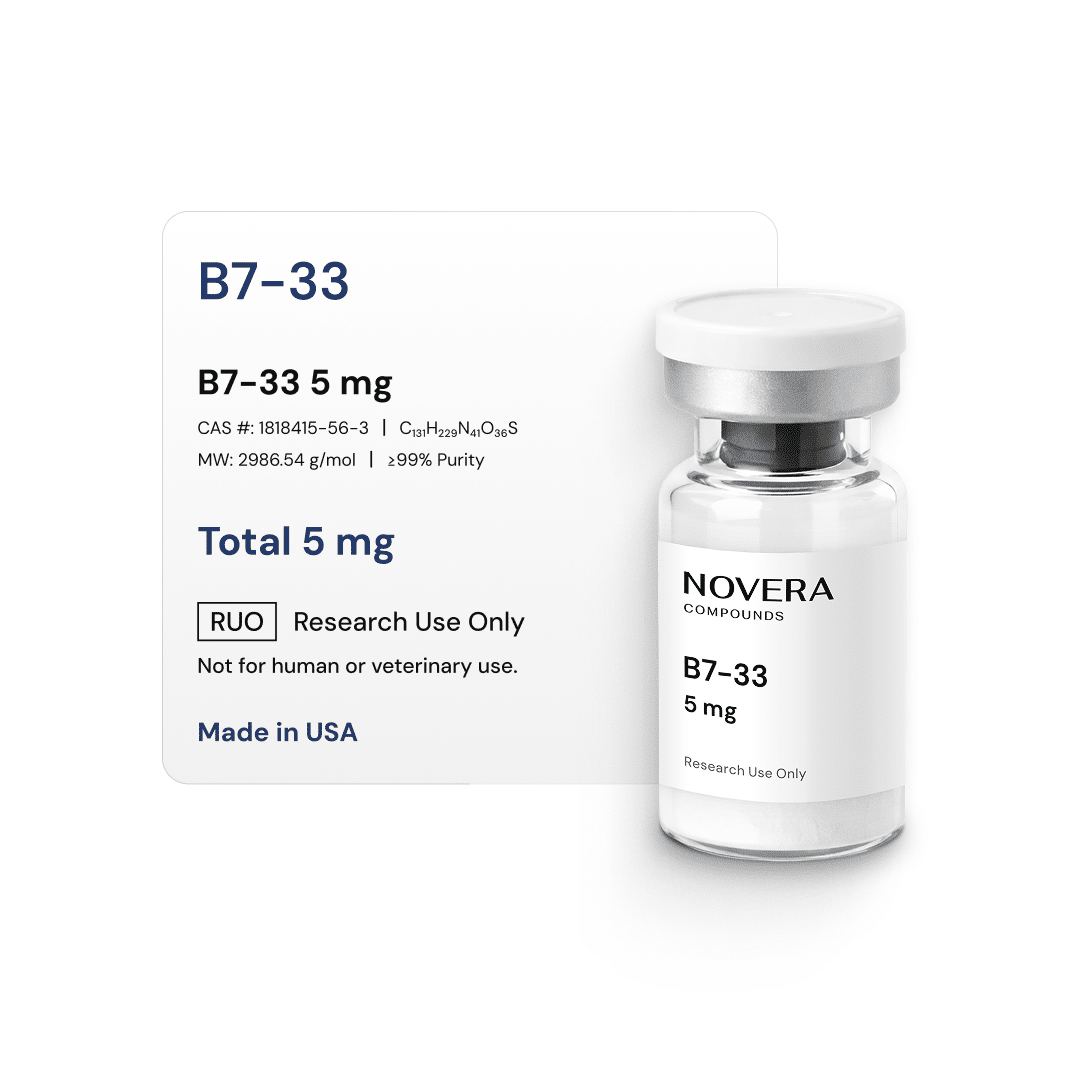
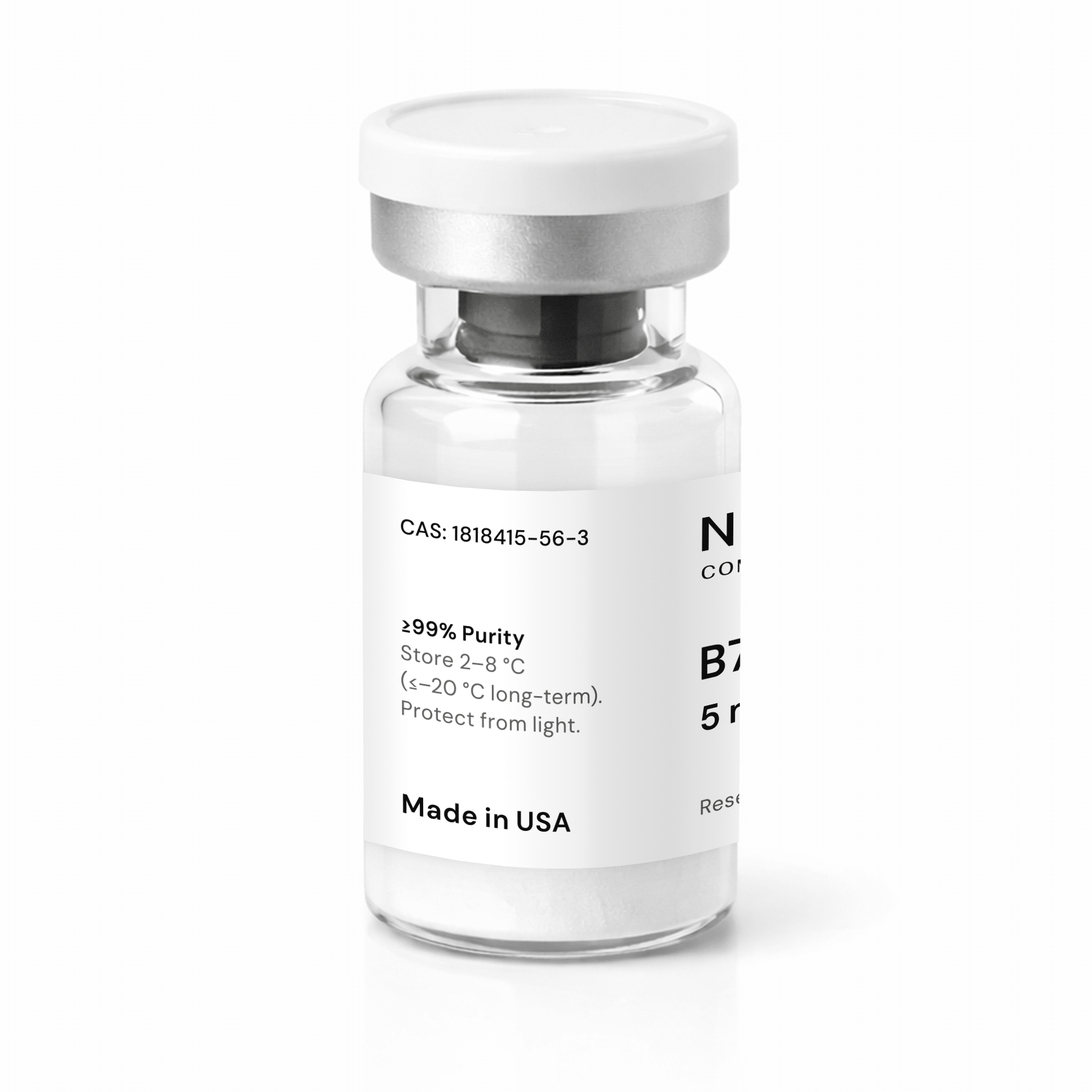
- CAS Number: 1818415-56-3
- Chemical Formula: C₁₃₁H₂₂₉N₄₁O₃₆S
- Molecular Weight: 2986.54 g/mol
- Peptide Sequence: Val-Ile-Lys-Leu-Ser-Gly-Arg-Glu-Leu-Val-Arg-Ala-Gln-Ile-Ala-Ile-Ser-Gly-Met-Ser-Thr-Trp-Ser-Lys-Arg-Ser-Leu-NH₂
B7-33 is a 27-mer peptide, representing a minimal B-chain motif that retains RXFP1 activity with a signaling bias that differs from native relaxin-2.
What Does Scientific Research Say About B7-33?
Current research describes B7-33 as a promising experimental RXFP1 agonist with a signaling profile that may allow researchers to study fibrosis, vascular function, and organ protection in a more targeted manner.
Mechanism and Signaling
Studies suggest that B7-33 binds to RXFP1 and preferentially activates ERK1/2 (pERK) signaling while producing lower cAMP responses compared to relaxin-2. This signaling bias is of interest because it may preserve certain anti-fibrotic and vasodilatory effects in experimental models.
Anti-Fibrotic and Organ-Protective Findings (Preclinical)
- Cardiac Models: In mouse myocardial infarction/reperfusion studies, B7-33 has been reported to reduce infarct size, limit remodeling, lower ER-stress markers (such as GRP78), and improve function-related readouts.
- Multi-Organ Fibrosis Research: Studies suggest B7-33 is comparable to H2 relaxin in reducing fibrosis in preclinical models of cardiovascular and other organ fibrosis.
- Vascular and Renal Models: Animal data suggest improvements in vascular tone, arterial stiffness, blood pressure, and selected renal function markers.
Development Status and Limitations
B7-33 remains a research-grade compound. Available data are based on in vitro and animal studies, and no human clinical trials have been completed (as of early 2026). Therefore:
- Human safety is unknown
- Human dosing is unknown
- Pharmacokinetics in humans are unknown
- Clinical efficacy is unknown
Any therapeutic claims at this stage would be speculative.
What Are the Storage Conditions for B7-33?
- Shelf life: Up to 24 months when stored properly as a dry lyophilized peptide.
- Temperature: Store at 2–8 °C for routine storage; store at ≤ –20 °C for long-term storage. Protect from light and moisture to prevent degradation.
- Transport: Room temperature exposure during transport is acceptable.
- Storage Recommendations: For optimal stability, keep the vial tightly sealed and avoid unnecessary temperature cycling.
Are you looking to buy B7-33 online?
If you’re looking to order B7-33 online at wholesale prices, contact Medical Spa RX for guidance on how to do so.
This product is supplied strictly for laboratory research use only and is not approved for human or veterinary administration. It is not intended for diagnostic, therapeutic, or clinical applications. Any reference to biological activity or potential effects is based solely on preclinical or in-vitro findings and should not be interpreted as validated clinical outcomes. Researchers are responsible for ensuring proper handling, storage, and disposal in accordance with institutional, federal, and international guidelines. By purchasing or using this material, the buyer confirms that they are a qualified researcher and that the product will be used exclusively in controlled research settings compliant with all applicable regulations.
References
- Handley TNG, Praveen P, Tailhades J, Wu H, Bathgate RAD, Hossain MA. Further Developments towards a Minimal Potent Derivative of Human Relaxin-2. Int J Mol Sci. 2023;24(16):12670. Published 2023 Aug 11. doi:10.3390/ijms241612670
- Devarakonda T, Mauro AG, Guzman G, et al. B7-33, a Functionally Selective Relaxin Receptor 1 Agonist, Attenuates Myocardial Infarction-Related Adverse Cardiac Remodeling in Mice. J Am Heart Assoc. 2020;9(8):e015748. doi:10.1161/JAHA.119.015748
- Hossain MA, Kocan M, Yao ST, et al. A single-chain derivative of the relaxin hormone is a functionally selective agonist of the G protein-coupled receptor, RXFP1. Chem Sci. 2016;7(6):3805-3819. doi:10.1039/c5sc04754d
- Samuel CS, Royce SG, Hewitson TD, Denton KM, Cooney TE, Bennett RG. Anti-fibrotic actions of relaxin. Br J Pharmacol. 2017;174(10):962-976. doi:10.1111/bph.13529