




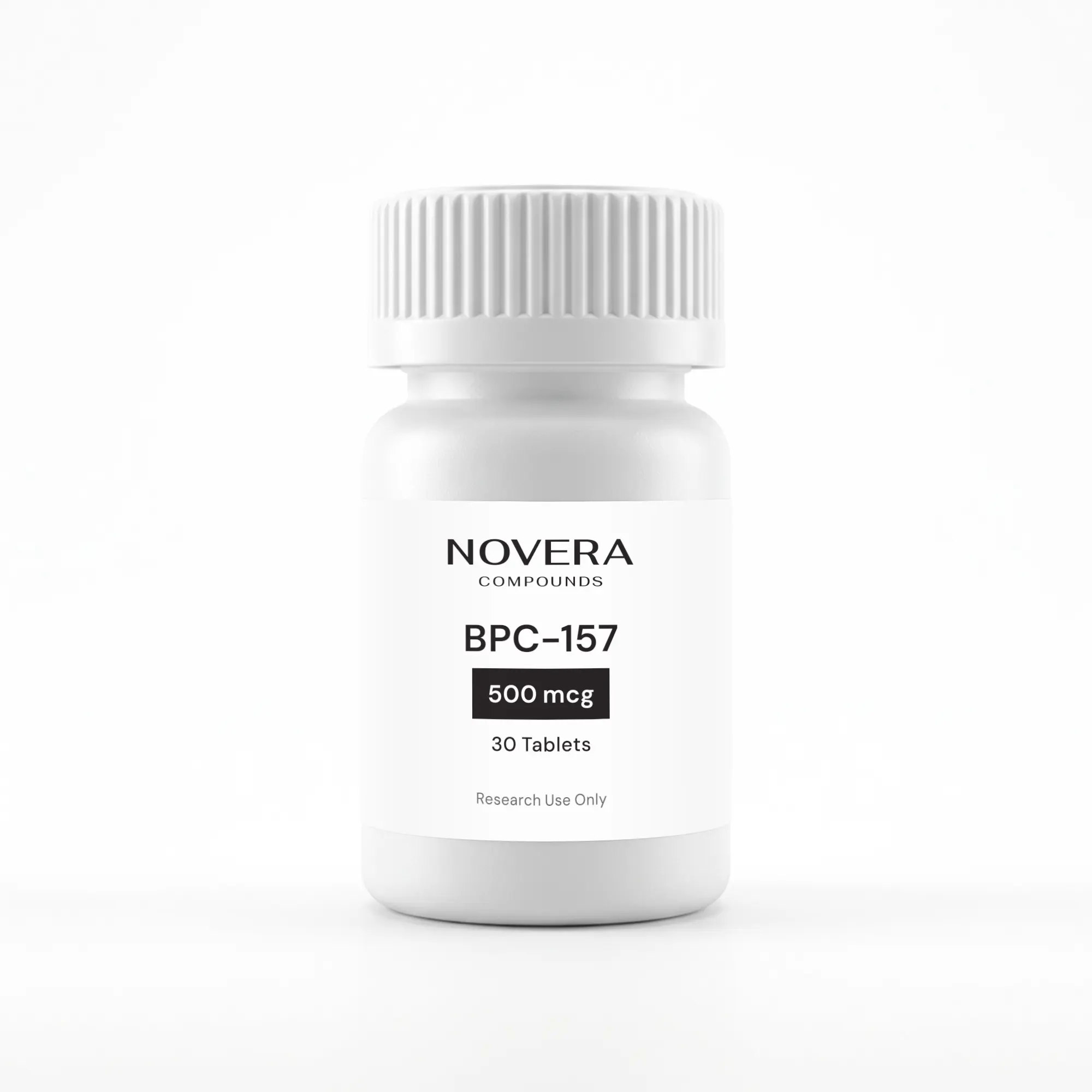
What Are The Purported Benefits Of BPC-157 (500 mcg) x 30 tablets?
BPC-157 (500 mcg) x 30 tablets is an oral research format of the gastric pentadecapeptide BPC-157, investigated in preclinical studies focused on tissue repair and gastrointestinal protection. Preclinical research—and very limited human data—suggests that BPC-157 may support broad healing and cytoprotective pathways across multiple tissues:
- Musculoskeletal Repair Support: Animal studies report faster healing in models of muscle injury, transected tendons, tendon-to-bone healing, and bone/ligament injury, with improved structural strength.
- Gastrointestinal and Organ Protection: BPC-157 has been studied for GI mucosal protection and repair, with reported benefits in models of gastric ulcers, colitis, certain liver/pancreatic injuries, and endothelial damage.
- Anti-Inflammatory and Angiogenic Activity: Research suggests BPC-157 may reduce inflammatory-cell infiltration, edema, and oxidative stress, while supporting angiogenesis and microvascular repair (including VEGFR2 and FAK-paxillin–related pathways).
- Neural and Systemic Research Interest: Animal models suggest potential protective effects in CNS injury, stroke, and some neurotoxic states, as well as modulation of NO signaling and vascular tone.
The oral tablet format is used in research settings investigating systemic peptide delivery. However, robust clinical validation of oral dosing, bioavailability, and efficacy remains lacking.
What Is The Chemical Makeup Of BPC-157 (500 mcg) x 30 tablets?
BPC-157 is a synthetic fragment of a larger “body protection compound” found in gastric juice. It is categorized among healing and regenerative peptides due to its broad tissue-repair research profile.
- Category: Healing and regenerative peptides
- CAS Number: 137525-51-0
- Chemical Formula: C₆₂H₉₈N₁₆O₂₂
- Molecular Weight: 1419.5 g/mol
- Peptide Sequence: Gly-Glu-Pro-Pro-Pro-Gly-Lys-Pro-Ala-Asp-Asp-Ala-Gly-Leu-Val
- Synonyms: BPC157, Bepecin
Tablet Format Details (500 mcg x 30)
This product format is typically made by compressing microgram amounts of BPC-157 into an oral tablet with inactive excipients:
- 0.5 mg (500 mcg) per tablet
- 30 tablets per bottle
- 15 mg total active peptide per bottle
The active peptide is the same BPC-157 used in injectable or lyophilized research formats; the main difference is the oral tablet delivery matrix.
What Does Scientific Research Say About BPC-157 (500 mcg) x 30 tablets?
Most published BPC-157 research comes from animal and in vitro studies, where it has been investigated across a wide range of injury and tissue-protection models.
- Wound and Soft-Tissue Healing: Rodent studies frequently report accelerated healing in skin, muscle, tendon, ligament, bone, and anastomosis models (including gastrocutaneous, colonic, and esophageal), with improved tensile strength and tissue repair markers.
- Proposed Mechanisms: Reported mechanisms include support for growth-factor signaling, increased growth hormone receptor expression in tendon fibroblasts, pro-angiogenic effects, NO-pathway modulation, and stabilization of microvascular and extracellular matrix interactions.
- GI and Organ Protection: Animal data suggest protection in models of NSAID-related gut injury, alcohol- and stress-induced ulcers, hepatotoxicity, pancreatitis, and vascular thrombosis, often with improved mucosal integrity and reduced bleeding-related outcomes.
Human Data and Regulatory Status
Human evidence remains limited, and the tablet form specifically has not been validated with strong clinical data.
A 2025 narrative review and trial summaries cite at least three small human studies (knee pain, interstitial cystitis, and intravenous safety) reporting symptom improvement and no serious adverse events, but these studies were small and not placebo-controlled.
A planned Phase I safety/pharmacokinetics trial (NCT02637284) was initiated but later cancelled, leaving a significant gap in high-quality human safety and pharmacokinetic data.
No major regulatory agency (FDA, EMA, etc.) has approved BPC-157 as a drug. It is commonly sold as an unapproved research chemical or supplement, and human safety, dosing, and long-term risk profiles remain uncertain.
Much of the published animal research uses parenteral or intragastric administration, so direct extrapolation to fixed-dose 500 mcg oral tablets in humans remains speculative (especially for absorption and effective dose).
What Are The Storage Conditions For BPC-157 (500 mcg) x 30 tablets?
- Shelf Life: When properly stored in sealed packaging, BPC-157 products can have a shelf life of up to 24 months, consistent with stability data for lyophilized or solid-state peptide forms.
- Temperature: Store at 15–25 °C for optimal stability. For long-term storage, protect from light and moisture. Freezing is not recommended for the oral tablet format, as freezing may cause tablet cracking, hardening, or degradation due to moisture condensation.
- Transport: Short-term room-temperature exposure during transport is generally acceptable, provided the product is returned to recommended storage temperatures upon receipt.
- Protection: BPC-157 should be protected from light and moisture; tablets should remain in tightly closed, original containers to limit humidity and photo-degradation.
Are you looking to buy BPC-157 (500 mcg) x 30 tablets online?
If you’re looking to order BPC-157 (500 mcg) x 30 tablets online at wholesale prices, contact Medical Spa RX for guidance on how to do so.
This product is supplied strictly for laboratory research use only and is not approved for human or veterinary administration. It is not intended for diagnostic, therapeutic, or clinical applications. Any reference to biological activity or potential effects is based solely on preclinical or in-vitro findings and should not be interpreted as validated clinical outcomes. Researchers are responsible for ensuring proper handling, storage, and disposal in accordance with institutional, federal, and international guidelines. By purchasing or using this material, the buyer confirms that they are a qualified researcher and that the product will be used exclusively in controlled research settings compliant with all applicable regulations.
References
- McGuire FP, Martinez R, Lenz A, Skinner L, Cushman DM. Regeneration or Risk? A Narrative Review of BPC-157 for Musculoskeletal Healing. Curr Rev Musculoskelet Med. 2025;18(12):611-619. doi:10.1007/s12178-025-09990-7
- Seiwerth S, Milavic M, Vukojevic J, et al. Stable Gastric Pentadecapeptide BPC 157 and Wound Healing. Front Pharmacol. 2021;12:627533. Published 2021 Jun 29. doi:10.3389/fphar.2021.627533
- Chang CH, Tsai WC, Hsu YH, Pang JH. Pentadecapeptide BPC 157 enhances the growth hormone receptor expression in tendon fibroblasts. Molecules. 2014;19(11):19066-19077. Published 2014 Nov 19. doi:10.3390/molecules191119066
- Vasireddi N, Hahamyan H, Salata MJ, et al. Emerging Use of BPC-157 in Orthopaedic Sports Medicine: A Systematic Review. HSS J. Published online July 31, 2025. doi:10.1177/15563316251355551
- Kim G, Fang W, Chung J, et al. Application of peptide therapy for ligaments and tendons: A narrative review. Journal of Orthopaedic Reports. Published online October 2025:100791. doi:https://doi.org/10.1016/j.jorep.2025.100791