




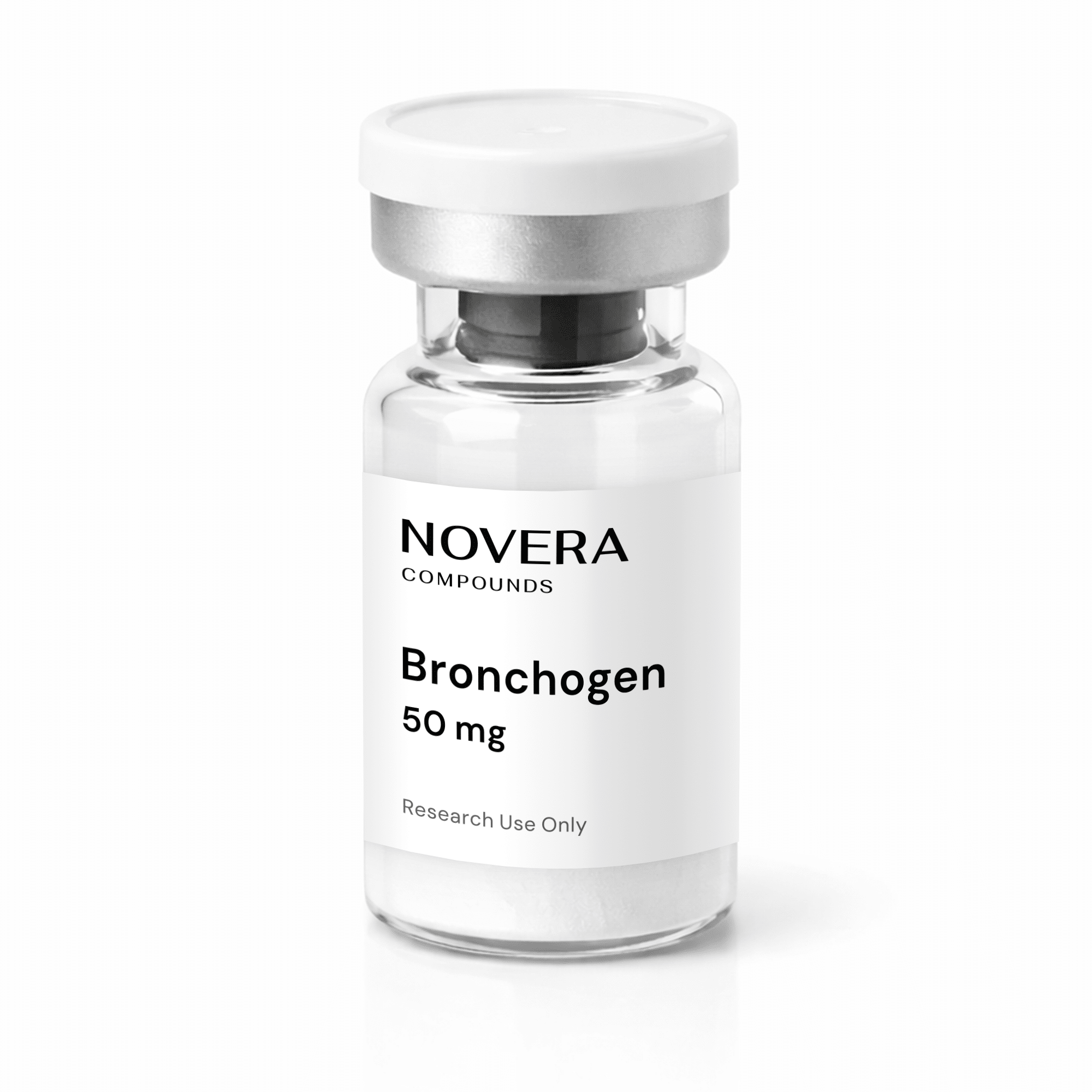


Bronchogen (50mg) About This Product
Bronchogen (50 mg) is a synthetic tetrapeptide (Ala–Glu–Asp–Leu; AEDL) composed of alanine, glutamic acid, aspartic acid, and leucine. It has a molecular weight of 446.45 g/mol and a chemical formula of C₁₈H₃₀N₄O₉. Bronchogen originates from research on bioregulatory peptides and has been examined in laboratory settings focused on respiratory tissue structure, cellular differentiation, and nucleic acid stability.
The Bronchogen peptide is supplied as a sterile, lyophilized compound intended for controlled experimental use. Research-grade material is manufactured at a reported purity of ≥98% and packaged in sealed vials to support stability, traceability, and reproducibility.
Laboratories that buy Bronchogen peptide commonly include it in peptide research programs investigating tissue-specific regulatory processes, particularly in bronchial and pulmonary model systems.
Bronchogen (50mg) Key Features and Benefits
- Defined Tetrapeptide Sequence: Ala–Glu–Asp–Leu (AEDL)
- Precisely Characterized Composition: 446.45 g/mol, C₁₈H₃₀N₄O₉
- High Purity (≥98%): Suitable for analytical and experimental laboratory studies
- Lyophilized Powder Format: Supports long-term stability and controlled reconstitution
- Respiratory Biology Research Focus: Examined in bronchial and pulmonary tissue models
- Sealed, Labeled Vials: Manufactured for quality assurance and traceability
- For Laboratory Research Use Only: Not approved for clinical, diagnostic, or therapeutic use
Bronchogen (50mg) Mechanism & Research Applications
Bronchogen is being researched as a bioregulatory peptide associated with lung and bronchial tissue function.
DNA Stabilization and Nucleic Acid Interactions
Bronchogen is reported in preclinical literature to modulate nucleic acid physicochemical stability and influence transcriptional programs in a tissue-biased manner. In vitro microcalorimetry studies describe increased DNA thermostability in the presence of Bronchogen, consistent with altered DNA duplex stability and peptide–nucleic acid interactions.
Transcriptional Network Responsiveness
Preclinical investigations in organotypic tissue culture and cellular systems associate Bronchogen with altered differentiation trajectories and transcription factor–linked signaling signatures. Identified associations include regulatory nodes involving:
- CXCL12: Chemokine-driven migration cues and immune signaling pathways
- HOX gene clusters: Developmental patterning and differentiation programs
These effects demonstrate tissue specificity and age-context dependence, evaluated through transcriptomic profiling and transcription factor activity assays.
Research Applications
Bronchogen has been investigated in the following preclinical research contexts:
- DNA Thermostability and Nucleic Acid Interaction Assays
- Differential scanning calorimetry and microcalorimetry
- Peptide–DNA binding and thermal stability characterization
- Transcriptional Regulation Screening
- Organotypic tissue culture differentiation studies
- Comparative analyses across young and older experimental contexts
- Cell-based transcription factor activity assays
- Epithelial Remodeling in Obstructive Lung Pathology Models
- Rodent models of induced obstructive lung disease
- Bronchial epithelium morphofunctional assessment
- Inflammation-linked readouts, including cytokine profiles
- Inflammatory Signaling and Regenerative Effects
- Cytokine network modulation and epithelial barrier state analysis
- Tissue-specific gene expression changes in respiratory pathology
- Age-Associated Functional Changes
- Comparative studies in young versus older experimental systems
- Evaluation of age-context dependence of differentiation responses
- Tumor Biology and Oncology Research (Preclinical)
- Investigation of peptide-associated modulation of tumor growth kinetics
- Analysis of immune and tissue transcriptional programs in animal models
- Microvascular Biology and Extracellular Matrix Signaling
- Assessment of signaling mediators involved in microvessel permeability
- Studies in cardiovascular and renal stress models examining tissue remodeling
Bronchogen (50mg) Dosing & Observed Effects in Research
Published preclinical studies employ Bronchogen at microgram-scale quantities, adjusted according to experimental design and model system. In rodent models, administration has been evaluated via intraperitoneal and inhalation routes. No standardized or approved dosing protocols exist.
The following are reported preclinical observations for Bronchogen:
- DNA and Chromatin Effects
- Increased DNA thermal stability measured by differential scanning calorimetry
- Enhanced DNA–histone interactions
- Context-dependent changes in chromatin accessibility
- Gene Expression and Differentiation
- Tissue-biased activation of differentiation-related transcription factors
- Altered expression of CXCL12 and HOX-family genes
- Differential responses in young versus older experimental systems
- Epithelial Function and Inflammatory Response
- Shifts in bronchial epithelium morphofunctional parameters
- Modulation of inflammatory cell infiltration
- Changes in cytokine expression profiles
- Enhanced epithelial barrier integrity markers
All observations derive exclusively from in vitro, organotypic culture, and in vivo animal studies. No clinical outcomes or human data exist.
Bronchogen (50mg) Storage, Safety & References
Store Bronchogen (50 mg) as a lyophilized powder at 2–8 °C, protected from light, moisture, and temperature fluctuation. For extended storage, lower temperatures may be used in accordance with laboratory protocols. Allow vials to equilibrate to room temperature before opening to prevent condensation.
Reconstitution should be performed under aseptic conditions using suitable laboratory-grade solvents. Avoid repeated freeze–thaw cycles.
Bronchogen is not FDA-approved and is supplied exclusively for laboratory research use. It is not intended for human or veterinary use, clinical application, diagnosis, or therapeutic intervention. Laboratories that order Bronchogen peptide are responsible for compliance with institutional and regulatory requirements.
References
https://pubmed.ncbi.nlm.nih.gov/21240358
https://pubmed.ncbi.nlm.nih.gov/22808515
https://pubmed.ncbi.nlm.nih.gov/17152728
https://pubmed.ncbi.nlm.nih.gov/26468022
https://pubmed.ncbi.nlm.nih.gov/30199201
Compliance Notice
This product is intended for laboratory research use only and is not approved for human or veterinary use.