



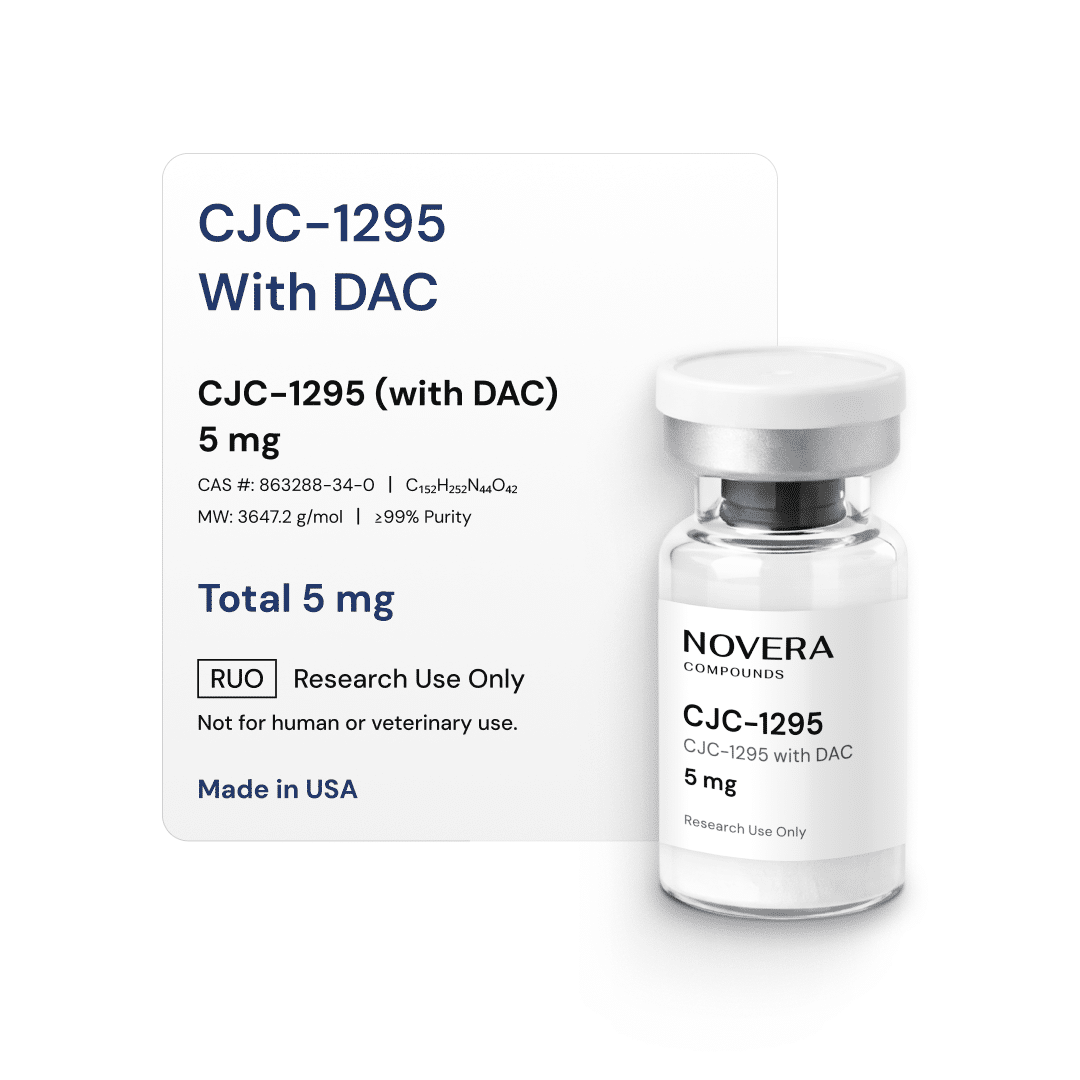


CJC-1295 – With DAC (5mg) About This Product
The CJC peptide is a synthetic 29-amino-acid analog of growth hormone–releasing hormone (GHRH) that incorporates a Drug Affinity Complex (DAC). Laboratories that buy CJC peptide or order CJC peptide materials reference this formulation for controlled laboratory research examining long-acting GHRH analog behavior and growth-hormone–axis signaling under experimental conditions.
The DAC modification enables reversible binding to serum albumin, resulting in prolonged peptide persistence in circulation compared with native GHRH and short-acting analogs. In research models, this extended exposure enables investigation of sustained growth hormone signaling dynamics over longer observation windows.
CJC-1295 with DAC has been evaluated in early-phase clinical research programs. Although clinical development was discontinued, published data remain relevant to laboratory studies of endocrine signaling behavior and long-term regulatory mechanisms.
Product Specifications
- Molecular weight: ~3,350–3,650 g/mol (including DAC and acetate)
- Molecular formula: C₁₅₉H₂₅₈N₄₆O₄₅
- CAS number: 446262-90-4
- Purity: ≥95%, verified by HPLC
- Form: Lyophilized powder
CJC-1295 – With DAC (5mg) Key Features and Benefits
- Chemical identity: 29-amino-acid GHRH analog with DAC modification
- Purity: Commonly produced at ≥95%, verified by HPLC
- Long-acting format: Evaluated in research models requiring extended peptide exposure
- Albumin-binding property: Studied for its effect on peptide persistence in circulation
- Research focus: Used in laboratory investigations of sustained growth-hormone–axis signaling
- Format: Supplied as a lyophilized powder suitable for controlled laboratory handling
For laboratory research use only.
CJC-1295 – With DAC (5mg) Mechanism & Research Applications
CJC-1295 with DAC has been examined in laboratory research as a long-acting GHRH analog used to study endogenous growth-hormone release mechanisms under sustained exposure conditions. In experimental systems, the peptide interacts with pituitary cell models, while the DAC component prolongs systemic availability through albumin binding.
This extended activity profile enables researchers to investigate regulatory responses associated with continuous growth hormone signaling rather than pulsatile secretion.
Research applications include:
- Growth-hormone–axis signaling studies under prolonged stimulation
- Endocrine regulation research models examining downstream signaling markers
- Metabolic regulation investigations focused on experimental hormone dynamics
- Long-duration exposure studies assessing cumulative signaling behavior
All applications described reflect controlled laboratory research contexts and do not imply clinical or therapeutic use.
CJC-1295 – With DAC (5mg) Dosing & Observed Effects in Research
Research protocols involving CJC-1295 with DAC vary by study design, species, and experimental objective. Published laboratory and early clinical research describes experimental dosing frameworks designed to evaluate prolonged peptide activity and sustained signaling behavior.
Reported laboratory observations include time-dependent changes in growth-hormone–related biomarkers, IGF-1-associated signaling markers, and other assay-specific molecular readouts. These findings are derived exclusively from controlled research environments and do not establish safety, efficacy, or therapeutic relevance.
Researchers who order CJC peptide materials are expected to establish dose-response parameters appropriate to their specific experimental models, as outcomes vary by protocol, species, and analytical endpoints.
CJC-1295 – With DAC (5mg) Storage, Safety & References
- Store lyophilized vials at ≤ –20 °C for long-term stability
- Short-term storage at 2–8 °C is acceptable when necessary
- Keep vials sealed, dry, and protected from light
- Allow vials to equilibrate to room temperature before opening
- Reconstitute only with bacteriostatic water using sterile technique
- Store reconstituted solutions at 2–8 °C and use within 2–3 weeks
- Avoid repeated freeze–thaw cycles
Handle materials in accordance with institutional laboratory biosafety procedures. Review the Certificate of Analysis (CoA) and Safety Data Sheet (SDS) prior to use.
References
https://pubmed.ncbi.nlm.nih.gov/16352683
https://pubmed.ncbi.nlm.nih.gov/17018654
https://pubmed.ncbi.nlm.nih.gov/19386527
Compliance Notice
This product is intended for laboratory research use only and is not approved for human or veterinary use.