




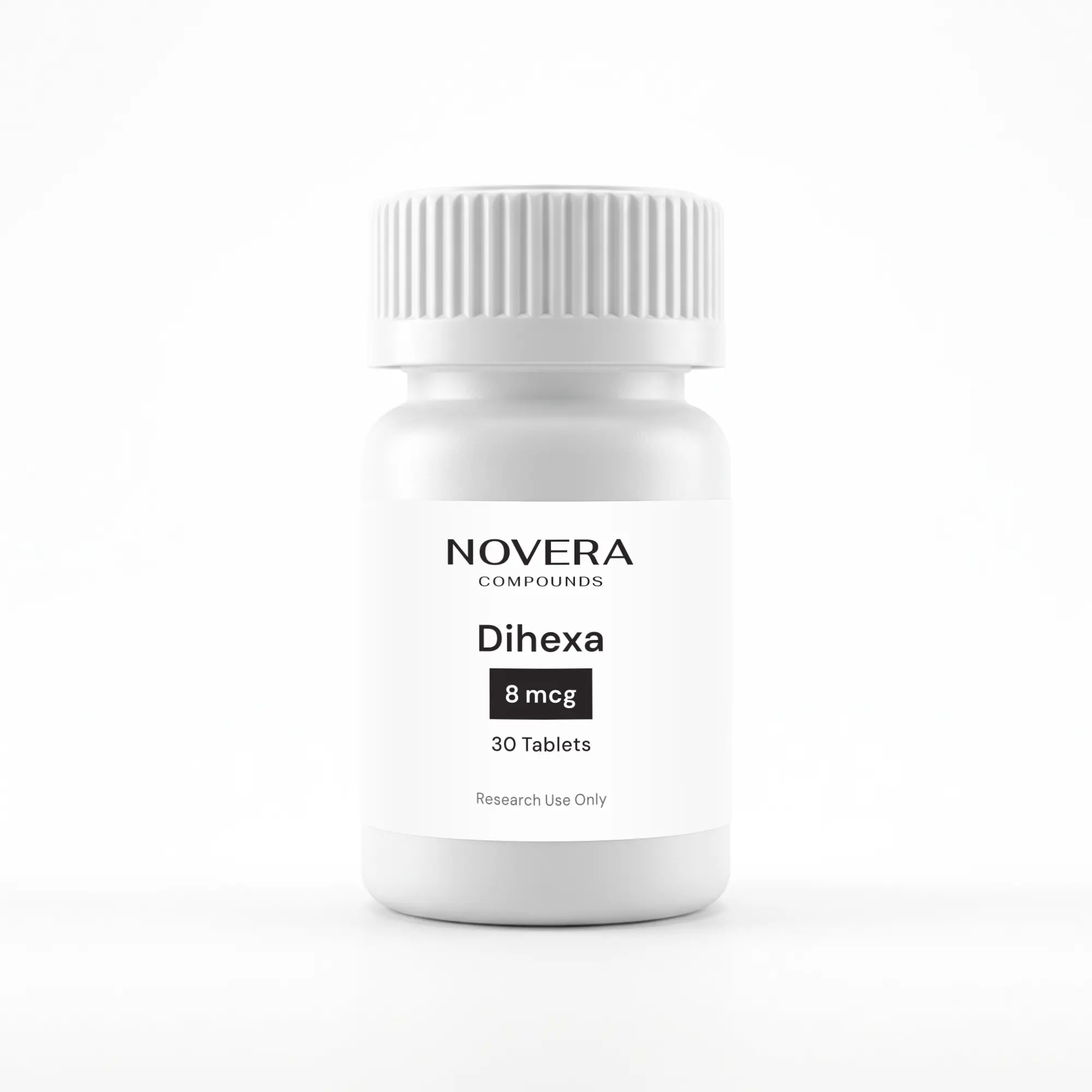
What Are The Purported Benefits Of Dihexa (8mg) x 30 Tablets?
Dihexa (8 mg) x 30 Tablets is an oral research formulation of Dihexa, a small peptide analog studied in preclinical models for neurotrophic signaling, synaptic plasticity, and cognitive function.
The 8 mg strength and 30-tablet count refer to the product format. The potential effects discussed below are based on the Dihexa molecule itself in cell and animal research:
- Cognitive and Memory Support (Preclinical): AngIV-derived analogs, such as Dihexa, have shown improvements in learning and memory in rodent models, including spatial learning and memory consolidation tasks.
- Synaptogenic and Neurotrophic Activity: Dihexa is studied as an HGF mimetic, meaning it may enhance HGF/c-Met signaling, which is linked to synapse formation, dendritic growth, and long-term potentiation (LTP) in hippocampal systems.
- Neuroprotection Research Interest: Through modulation of HGF/MET pathways, Dihexa and related compounds have shown protective effects in preclinical models involving neurotoxicity, neuroinflammation, oxidative stress, and mitochondrial stress.
Important: No human efficacy has been established. All proposed benefits remain preclinical and investigational.
What Is The Chemical Makeup Of Dihexa (8mg) x 30 Tablets?
Dihexa is a small, acylated peptide analog derived from the angiotensin IV (AngIV) research pathway and designed to penetrate the blood–brain barrier while enhancing HGF/c-Met signaling.
- Category: Brain, Cognitive and Nootropic Peptides
- CAS Number: 1401708-83-5
- Chemical Formula: C₂₇H₄₄N₄O₅
- Molecular Weight: 504.7 g/mol
- Peptide Sequence: Hexanoyl-Tyr-Ile-Unk (N-Hexanoyl-L-tyrosyl-N-(6-amino-6-oxohexyl)-L-isoleucinamide)
Tablet Format Details (8 mg x 30)
In this product format:
- 8 mg Dihexa per tablet
- 30 tablets per bottle
- 240 mg total active compound per bottle
The active ingredient is combined with inactive excipients to create an oral tablet format for research use. This is not an approved medicinal dosage form.
What Does Scientific Research Say About Dihexa (8mg) x 30 Tablets?
Most research findings relate to Dihexa itself, and not specifically to the tablet format.
- HGF/c-Met Modulation: Dihexa has been reported to bind hepatocyte growth factor (HGF) with high affinity and enhance HGF-dependent c-Met phosphorylation. In research terms, it functions as an HGF mimetic/positive modulator, helping activate c-Met signaling even when HGF levels are low.
- Synaptogenesis and Cognition (Preclinical): In hippocampal neuron cultures and rodent studies, Dihexa has been associated with:
- Increased dendritic spine density
- Increased synaptic protein expression
- Induction of long-term potentiation (LTP)
- Improved performance in memory-related tasks
These findings support continued interest in Dihexa as a procognitive and synaptogenic research compound.
- AngIV Research Context: Dihexa belongs to a broader class of AngIV-derived analogs designed to cross the blood–brain barrier and interact with brain signaling systems relevant to cognition and neurodegeneration research.
- Relationship to Fosgonimeton: Fosgonimeton (ATH-1017; also described as fosgo-AM in preclinical contexts) is a small-molecule HGF/MET modulator that builds on the same general idea of enhancing neurotrophic HGF signaling. It has advanced into Phase 2 Alzheimer’s disease trials and shown biomarker/procognitive signals, though a pivotal trial missed its primary endpoint.
This clinical experience supports the broader HGF/MET therapeutic concept, but it does not provide direct clinical evidence for Dihexa or for any specific 8 mg tablet regimen.
Dihexa is supported by preclinical evidence as a potent HGF/MET-mediated, synaptogenic, and procognitive research agent in cell and animal systems. However, it remains non-clinical, and its human safety, pharmacokinetics, and optimal dosing are unknown.
What Are The Storage Conditions For Dihexa (8mg) x 30 Tablets?
Specific storage instructions may vary by supplier, but general peptide and tablet-handling guidance is consistent.
- Shelf Life: Up to 24 months when stored properly in sealed form.
- Storage Temperature: Store at 15–25 °C in a dry location. Protect from light, moisture, and humidity. Keep tablets in the original, tightly sealed container. Freezing is not recommended for the compressed tablet format.
- Transport: Short-term room-temperature exposure during shipping is generally acceptable, provided the product is returned to recommended storage conditions upon receipt.
- Protection: Keep protected from light and moisture in a tightly sealed container.
Are you looking to buy Dihexa (8mg) x 30 Tablets online?
If you’re looking to order Dihexa (8mg) x 30 Tablets online at wholesale prices, contact Medical Spa RX for guidance on how to do so.
This product is supplied strictly for laboratory research use only and is not approved for human or veterinary administration. It is not intended for diagnostic, therapeutic, or clinical applications. Any reference to biological activity or potential effects is based solely on preclinical or in-vitro findings and should not be interpreted as validated clinical outcomes. Researchers are responsible for ensuring proper handling, storage, and disposal in accordance with institutional, federal, and international guidelines. By purchasing or using this material, the buyer confirms that they are a qualified researcher and that the product will be used exclusively in controlled research settings compliant with all applicable regulations.
References
- Johnston JL, Reda SM, Setti SE, et al. Fosgonimeton, a Novel Positive Modulator of the HGF/MET System, Promotes Neurotrophic and Procognitive Effects in Models of Dementia. Neurotherapeutics. 2023;20(2):431-451. doi:10.1007/s13311-022-01325-5
- Wright JW, Harding JW. The brain renin-angiotensin system: a diversity of functions and implications for CNS diseases. Pflugers Arch. 2013;465(1):133-151. doi:10.1007/s00424-012-1102-2
- Wright JW, Harding JW. The angiotensin AT4 receptor subtype as a target for the treatment of memory dysfunction associated with Alzheimer’s disease. J Renin Angiotensin Aldosterone Syst. 2008;9(4):226-237. doi:10.1177/1470320308099084
- Wright JW, Harding JW. The Brain Hepatocyte Growth Factor/c-Met Receptor System: A New Target for the Treatment of Alzheimer’s Disease. J Alzheimers Dis. 2015;45(4):985-1000. doi:10.3233/JAD-142814