




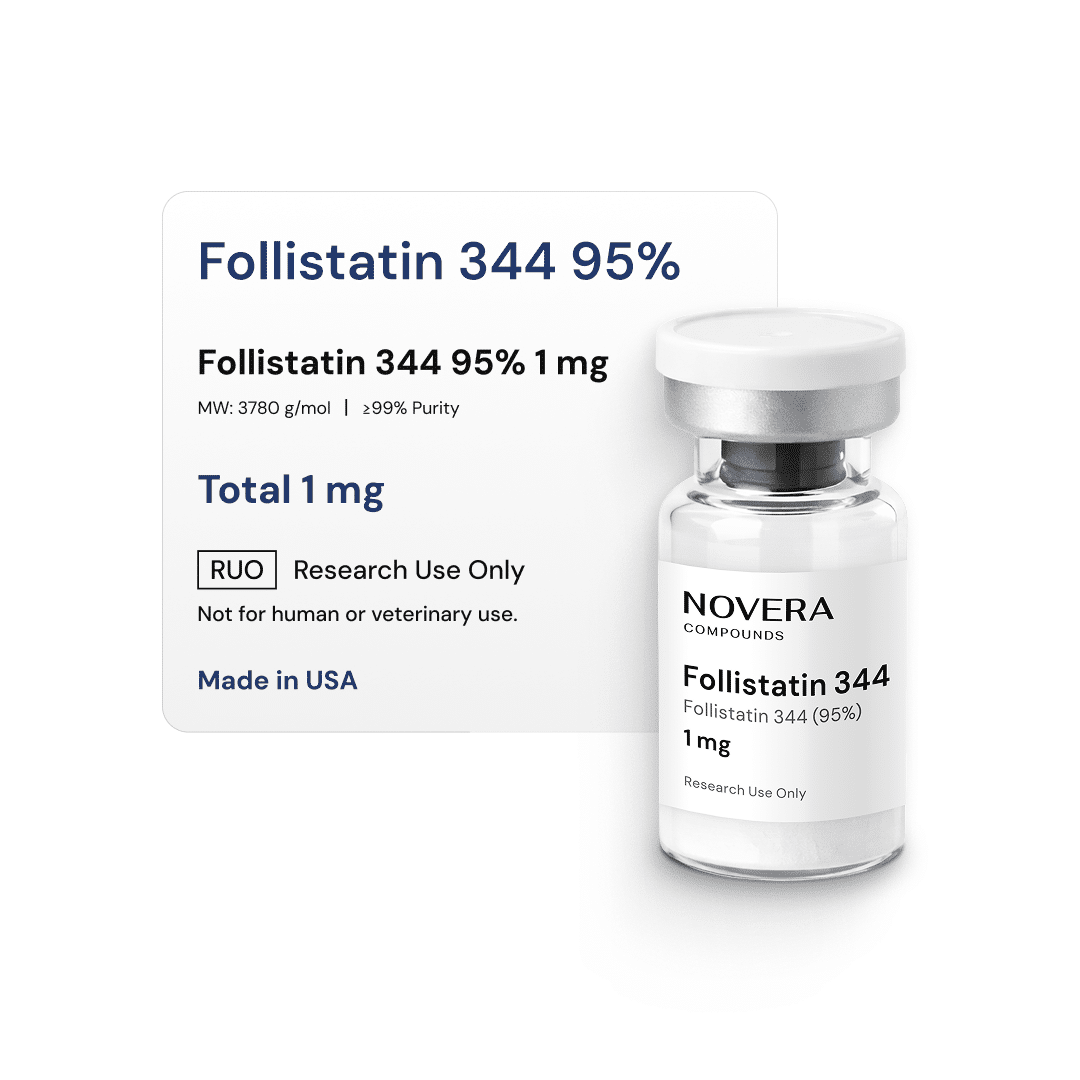


What Are The Purported Benefits Of Follistatin 344 (95%) (1mg)?
Follistatin 344 (or FST, Activin-Binding Protein) is widely studied as a myostatin antagonist and activin inhibitor, making it a compound of interest in muscle growth and tissue regeneration research. By binding to inhibitory signaling proteins within the TGF-β superfamily, the follistatin peptide has been studied for its role in reducing biological constraints on skeletal muscle development.
The most frequently cited research focus is myostatin inhibition. Myostatin functions as a regulatory brake on muscle growth by limiting fiber expansion. When Follistatin 344 neutralizes myostatin, research models suggest enhanced muscle hypertrophy and, under specific conditions, potential muscle hyperplasia (formation of new muscle fibers). This mechanism distinguishes follistatin from anabolic agents that primarily increase cell size.
In addition to myostatin suppression, activin blockade represents another key research pathway. Activin is implicated in inflammation, fibrosis, and tissue scarring, and its inhibition has been studied for effects on muscle recovery and fibrotic remodeling following injury.
These mechanisms occur through non-androgenic pathways. This muscle growth and performance peptide does not interact with androgen receptors, suppress endogenous testosterone, or convert to estrogen, which differentiates it from hormonal growth modulators.
What Is The Chemical Makeup Of Follistatin 344 (95%) (1mg)?
Follistatin 344 is a cysteine-rich glycoprotein encoded by the FST gene, which produces multiple isoforms through alternative splicing. The “344” designation refers to the 344–amino acid sequence of the precursor form.
Structurally, Follistatin 344 is proteolytically cleaved in vivo to generate Follistatin 315, the primary serum-circulating isoform. This post-translational modification includes a C-terminal acidic region that promotes stability in blood circulation. In contrast, other isoforms (FS-288, FS-317) demonstrate preferential tissue binding and cellular localization.
Structural characteristics of Follistatin 344 with the strength of 1mg include:
- Molecular Weight: 3780 g/mol
- Cysteine-rich domains: Multiple disulfide bonds critical for structural integrity
- Glycosylation: Post-translational modification affecting bioactivity and stability
- Purity: ≥95%, with trace peptide fragments and residual moisture from lyophilization
Recombinant research versions may differ in glycosylation profiles depending on the expression system (mammalian cells, insect cells, bacteria), which can influence stability and bioactivity. This purity level is standard for research-grade materials when laboratories buy follistatin peptide for non-clinical studies.
What Does Scientific Research Say About Follistatin 344 (95%) (1mg)?
Scientific literature distinguishes between gene therapy delivery and peptide-based administration of follistatin. Many of the most pronounced muscle growth outcomes, often described as “double muscling,” originate from studies using AAV-mediated gene therapy, which enables continuous endogenous production of follistatin.
In contrast, the Follistatin 344 peptide has a short to moderate biological half-life when administered directly. Without viral vectors or sustained-release systems, the protein experiences more rapid clearance from circulation. As a result, peptide-based research protocols do not reproduce the magnitude of hypertrophy observed in gene therapy models.
Research also indicates functional differences between isoforms. Follistatin 315 (the serum-circulating product of FS-344 cleavage) circulates more freely in plasma, while tissue-bound isoforms demonstrate higher affinity for extracellular matrix components via heparan sulfate proteoglycan interactions. This distinction has guided investigation into systemic versus localized muscle research applications.
Mechanisms of Action
Follistatin 344 exerts its effects through high-affinity binding of TGF-β superfamily ligands, particularly:
- Myostatin neutralization: Prevents receptor binding at ActRIIB (Activin Receptor Type IIB), blocking SMAD2/3 phosphorylation cascades that suppress muscle growth
- Activin inhibition: Blocks activin-mediated suppression of satellite cell proliferation and myogenic differentiation
- Synergistic inhibition: Codelivery of myostatin and activin antagonists produces multiplicative muscle growth (reported up to 150% increase in gene therapy models)
Research Findings
Animal studies using gene delivery have documented:
- Muscle mass increases of 37–60% in targeted muscles
- Systemic effects extending beyond injection sites (suggesting circulating follistatin activity)
- Enhanced satellite cell activation and myogenic differentiation
- Reduced fibrotic markers and inflammation in muscle tissue
- Safety profiles without significant adverse organ effects in long-term studies
Human clinical trials using gene therapy (AAV1-FS344) have demonstrated:
- Safe and well-tolerated administration
- Sustained muscle growth without disruption of endocrine function (FSH, LH, testosterone levels unchanged)
- Potential benefit in muscular dystrophy models
From a safety perspective, prolonged inhibition of myostatin and activin raises theoretical concerns, as activin is involved in reproductive signaling, pituitary hormone regulation, and tissue homeostasis. However, short-term and long-term animal studies have generally reported no consistent evidence of organ toxicity or reproductive disruption under controlled laboratory conditions.
What Are The Storage Conditions For Follistatin 344 (95%) (1mg)?
Due to its complex tertiary structure and reliance on disulfide bonds, Follistatin 344 requires careful handling.
Lyophilized Powder Storage
In its lyophilized powder form, the compound should be stored at –20 °C upon receipt:
- Optimal stability: 12–24 months when kept frozen, dry, and protected from light
- Extended storage: –80 °C preferred for maximum long-term stability
- Brief room-temperature exposure: Only acceptable during shipping if vials remain sealed and dry
- Avoid: Humidity, direct light exposure, and repeated temperature fluctuations
Reconstituted Solution Storage
Once reconstituted with bacteriostatic water or sterile saline:
- Storage temperature: 2–8 °C (refrigeration required)
- Handling technique: Gentle rolling or swirling, never vortexing, to preserve structural integrity
- Best practice: Aliquot solutions into single-use vials and freeze at –20 °C to minimize exposure and freeze–thaw cycles
Critical Handling Guidelines
- Avoid vigorous agitation or vortexing (damages disulfide bonds)
- Minimize light exposure (photodegradation risk)
- Never subject to repeated freeze–thaw cycles
- Reconstitute only what is needed for immediate use
- For extended protocols, maintain aliquots at –20 °C
Proper handling is essential for laboratories that order follistatin peptide to maintain experimental consistency and ensure reliable results across research cycles.
Are you looking to buy Follistatin 344 (95%) (1mg) online?
If you’re looking to order Follistatin 344 (95%) (1mg) online at wholesale prices, contact Medical Spa RX for guidance on how to do so.
This product is supplied strictly for laboratory research use only and is not approved for human or veterinary administration. It is not intended for diagnostic, therapeutic, or clinical applications. Any reference to biological activity or potential effects is based solely on preclinical or in-vitro findings and should not be interpreted as validated clinical outcomes. Researchers are responsible for ensuring proper handling, storage, and disposal in accordance with institutional, federal, and international guidelines. By purchasing or using this material, the buyer confirms that they are a qualified researcher and that the product will be used exclusively in controlled research settings compliant with all applicable regulations.
Sources
https://openmedscience.com/follistatin%E2%80%91344-a-multifaceted-agent-in-research-investigations
https://pmc.ncbi.nlm.nih.gov/articles/PMC6405513
https://www.nature.com/articles/srep17535
https://www.sciencedirect.com/topics/biochemistry-genetics-and-molecular-biology/follistatin
https://pmc.ncbi.nlm.nih.gov/articles/PMC2393740
https://journals.physiology.org/doi/full/10.1152/ajpendo.00193.2009