




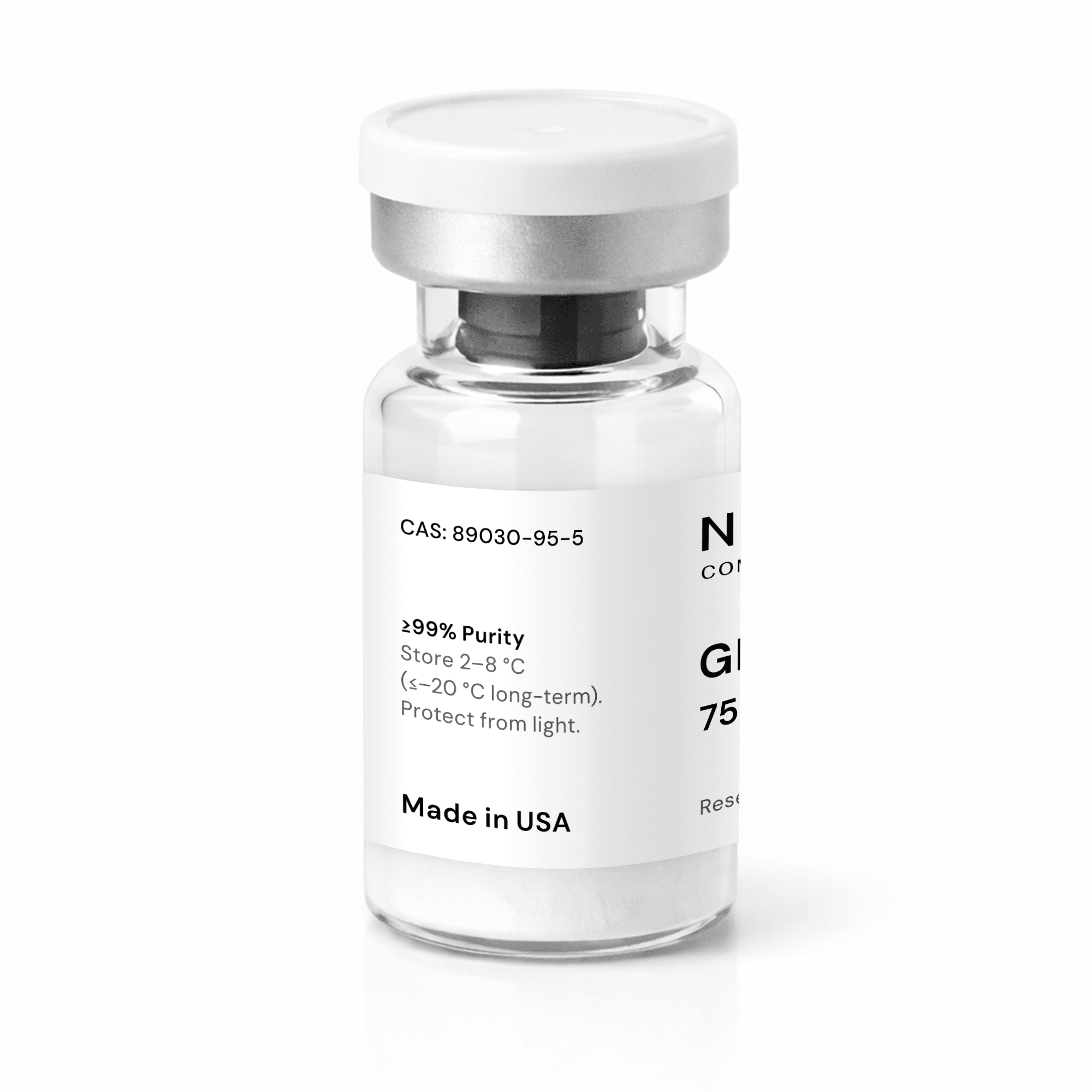
GHK-Cu About This Product
GHK-Cu, also known as copper tripeptide-1, is a small peptide-copper complex composed of three amino acids—glycine, histidine, and lysine—bonded to a divalent copper ion (Cu²⁺). The GHK tripeptide is naturally found in human plasma and extracellular matrix, though the GHK-Cu complex itself is synthesized in the laboratory by binding copper to the tripeptide.
This GHK CU peptide has a molecular weight of approximately 403.92 g/mol with the molecular formula C14H24CuN6O4. It is provided as a lyophilized powder at research-grade purity (≥99%) in 10 mg vials, designed for controlled laboratory research applications.
The GHK CU copper peptide has been studied for its proposed role in tissue repair, wound healing, collagen synthesis, and gene expression modulation. Researchers have focused on its effects on extracellular matrix regulation, fibroblast activation, and cellular signaling pathways. GHK CU skin peptide research has expanded to investigate antioxidant and anti-inflammatory properties in preclinical models.
GHK-Cu Key Features and Benefits
- GHK CU Peptide Research Formulation: Copper-bound tripeptide complex for investigating extracellular matrix modulation and cellular signaling in controlled laboratory settings
- Research-Grade Purity: Lyophilized powder verified at ≥99% purity using HPLC and mass spectrometry, ensuring reproducible experimental results
- Stable Lyophilized Format: Optimized for long-term storage and stability prior to reconstitution, supporting batch-to-batch consistency for research applications
- Buy GHK CU for Multiple Research Areas: Investigated in fibroblast proliferation studies, collagen synthesis assays, wound healing models, and antioxidant pathway research
- Flexible In Vitro and In Vivo Applications: Suitable for cell culture experiments, tissue regeneration models, dermal research, and controlled animal studies
- Redox-Controlled Copper Coordination: The histidine imidazole ring and terminal amine groups coordinate Cu²⁺ ions, stabilizing copper in a form suitable for experimental systems
- Quality-Verified Documentation: Supplied with analytical testing confirmation, including HPLC chromatography and mass spectrometry validation for each batch
- GHK CU for Research Use Only: Intended exclusively for qualified researchers conducting preclinical laboratory investigations and not approved for human or veterinary use
GHK-Cu Mechanism & Research Applications
GHK-Cu functions as a copper-peptide complex that interacts with extracellular matrix components, transcriptional regulators, and cell-surface proteins. In laboratory research, GHK-Cu has been investigated for its proposed role in modulating gene expression patterns involved in tissue regeneration and collagen remodeling. The copper coordination enables the complex to participate in redox-controlled enzymatic pathways and antioxidant response mechanisms.
Researchers have used GHK-Cu to investigate fibroblast migration and proliferation, collagen production and remodeling, and angiogenic signaling in preclinical models. The peptide has been studied in dermal fibroblast cultures, endothelial cell assays, and controlled animal injury models.
Laboratory observations have reported enhanced extracellular matrix deposition, modulation of inflammatory markers, and altered gene-expression patterns in tissue regeneration research. These findings remain limited to preclinical experimental systems without clinical outcome implications.
GHK-Cu’s copper-mediated properties make it a valuable molecular tool for studying matrix metalloproteinase regulation, antioxidant enzyme activity, and redox-dependent cellular signaling under controlled laboratory conditions.
GHK-Cu Dosing & Observed Effects in Research
All reported observations derive exclusively from preclinical laboratory and animal research systems. No clinical human trial data exist for GHK-Cu as a therapeutic agent. The observed effects were evaluated under controlled experimental conditions and do not constitute clinical efficacy claims.
- In Vitro Dosing: GHK-Cu is typically used in cell culture studies at concentrations ranging from 1–10 nanomolar (nM), with maximum biological activity observed at approximately 1 nM or lower. Research demonstrates that copper availability is efficiently obtained from biological fluids, with GHK-Cu remaining active at very low molar concentrations.
- In Vivo Animal Model Dosing: In preclinical animal studies, GHK-Cu has been administered at doses ranging from 1–5 mg/kg body weight, with specific protocols varying based on research objectives and model systems employed.
Laboratory studies report the following observations under controlled experimental conditions:
- Collagen Synthesis: Increased collagen production in dermal fibroblast and keratinocyte cultures
- Extracellular Matrix: Enhanced extracellular matrix deposition and tissue remodeling in wound healing models
- Gene Expression: Modulation of genes involved in collagen synthesis, matrix metalloproteinase regulation, and antioxidant response pathways
- Cellular Migration: Enhanced fibroblast migration and endothelial cell recruitment in tissue regeneration models
GHK-Cu Storage, Safety & References
Store GHK-Cu lyophilized powder at –20°C or below in a tightly sealed, light-protected container for long-term stability. For short-term use (days to weeks), room temperature storage (15–25°C) is acceptable.
Once reconstituted with sterile, RNase-/DNase-free water or appropriate buffer, store the solution at 2–8°C and use within 5–7 days. Avoid repeated freeze-thaw cycles after reconstitution to preserve peptide integrity.
- Laboratory Safety: Follow standard laboratory safety protocols, including appropriate personal protective equipment (PPE), sterile handling techniques, and aseptic conditions during reconstitution. GHK-Cu contains copper; follow institutional guidelines regarding copper-containing materials. Dispose of unused material in accordance with local chemical and biological waste regulations.
Preclinical studies indicate GHK-Cu has a low toxicity profile in research systems. However, long-term human safety data does not exist. Copper-related toxicity is a theoretical concern if concentrations are significantly exceeded.
Additionally, injectable formulations of GHK-Cu have been flagged by the FDA as a category of bulk drug substances, raising significant safety concerns, including potential immunogenicity risks and aggregation potential related to compounding processes.
- Regulatory Status: GHK-Cu is not FDA-approved for clinical, therapeutic, or medical use. Topical formulations are recognized by the FDA as cosmetic ingredients (which do not require premarket approval). Injectable GHK-Cu formulations are not approved for therapeutic use and have been noted by the FDA as raising significant safety concerns. This product is intended for laboratory research use only.
References
https://onlinelibrary.wiley.com/doi/10.1155/2012/324832?msockid=36cff49983836f38395fe1a382976e7b
https://www.sciencedirect.com/science/article/pii/001457938880509X
https://pubmed.ncbi.nlm.nih.gov/11045606
https://pmc.ncbi.nlm.nih.gov/articles/PMC5332963
https://pubmed.ncbi.nlm.nih.gov/39351323
https://pubchem.ncbi.nlm.nih.gov/compound/Cu-GHK
Compliance Notice
This product is intended for laboratory research use only and is not approved for human or veterinary use.