






What Are the Purported Benefits of GLOW GHK-Cu (27mg) / BPC-157 (5mg) / TB500 (10mg)?
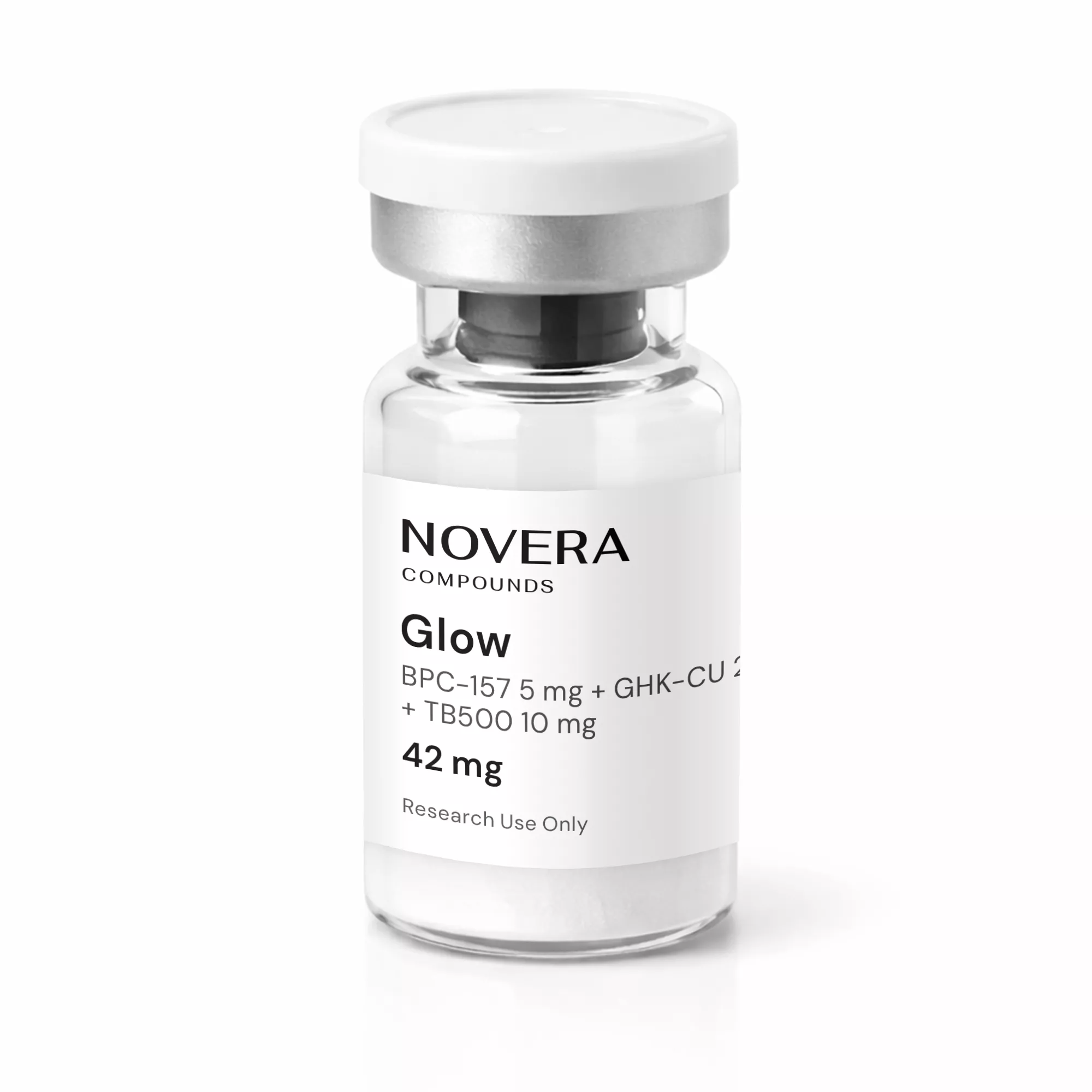
GLOW GHK-Cu (27 mg) / BPC-157 (5 mg) / TB500 (10 mg) is a multi-peptide research formulation that combines three well-studied peptides frequently examined for their roles in cellular signaling, tissue repair, and regenerative research models. This formulation, supplied at a total strength of 42 mg, is of particular interest for studies exploring regeneration pathways, connective tissue dynamics, angiogenesis-related signaling, and cellular maintenance processes under controlled experimental conditions.
Researchers are especially interested in the GLOW blend for its value as a combinatorial peptide system, enabling investigation of how multiple peptide-driven pathways function together within a single experimental framework. Although findings to date are preliminary and investigational, with no clinical conclusions implied, GLOW provides a standardized research tool for examining overlapping biological mechanisms in vitro and in preclinical models.
GLOW is manufactured by Novera Compounds and classified under Peptides – Healing & Regenerative Peptides. Common research keywords include glow, ghk-cu, ghkcu, bpc157, BPC-157, tb500, TB-500 (TB-4), thymosin beta 4, and tb4.
What is the Chemical Makeup of GLOW GHK-Cu (27mg) / BPC-157 (5mg) / TB500 (10mg)?
This product contains three synthetic peptides supplied within a single vial at a total peptide content of 42 mg, formulated for controlled laboratory research use.
- GHK-Cu: 27 mg
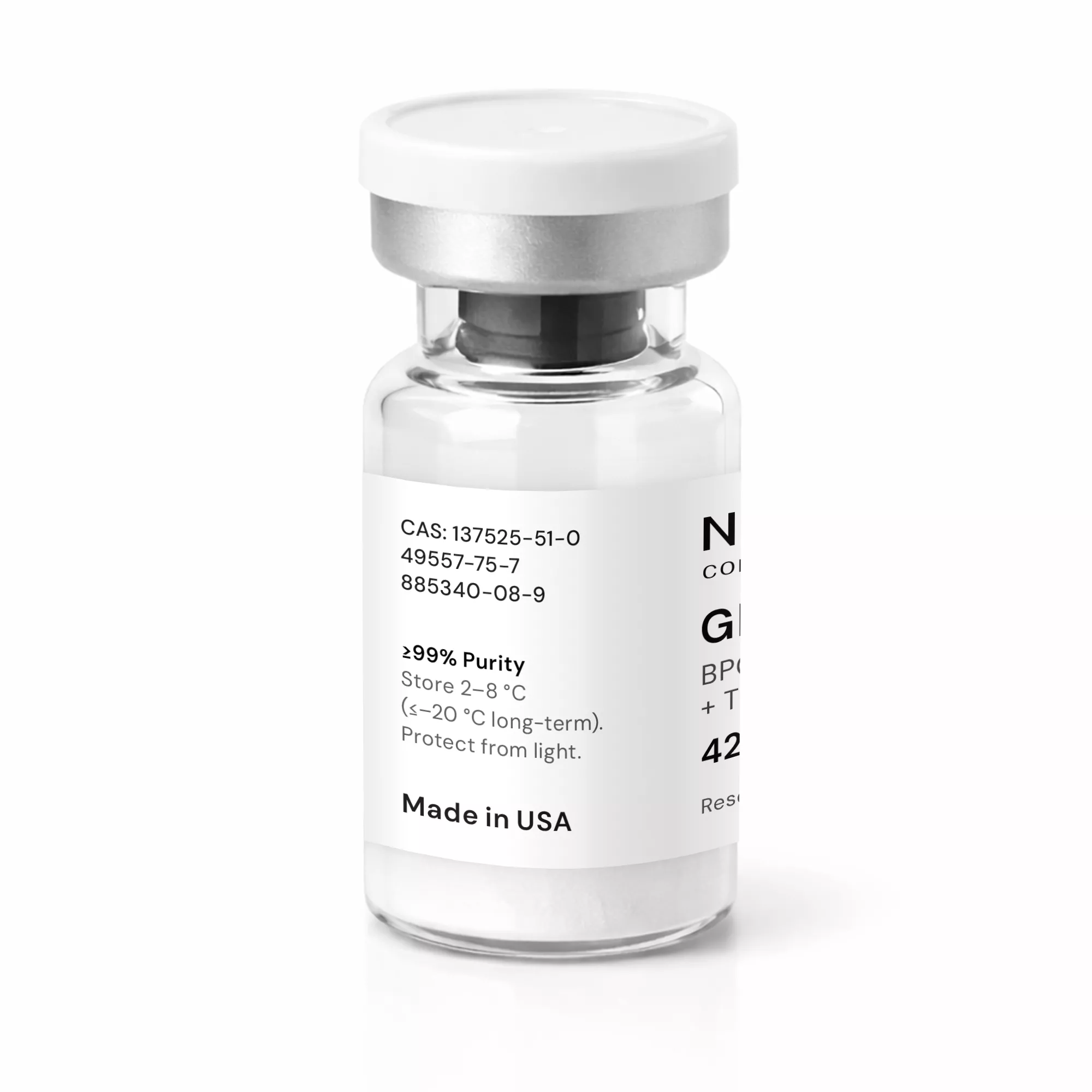
- CAS: 49557-75-7
- Molecular Weight: 340.38 g/mol
- Chemical Formula: C₁₄H₂4N₆O₄
- BPC-157: 5 mg
- CAS: 137525-51-0
- Molecular Weight: 1419.535 g/mol
- Chemical Formula: C₆₂H₉₈N₁₆O₂₂
- TB500 (TB-4): 10 mg
- CAS: 885340-08-9
- Molecular Weight: 889.0 g/mol
- Chemical Formula: C₃₈H₆₈N₁₀O₁₄
GHK-Cu is a copper-binding tripeptide studied for cellular signaling and extracellular matrix–related research. BPC-157 is a pentadecapeptide derived from a gastric protein fragment and examined in tissue-focused research models. TB500 is a synthetic thymosin-related peptide, with much of the peer-reviewed literature centered on thymosin beta-4, particularly in studies of cytoskeletal organization and cell migration.
A commonly referenced peptide sequence associated with thymosin-related research is:
Tyr–Asn–Trp–Asn–Ser–Phe–Gly–Leu–Arg–Phe–NH₂
GLOW is supplied as a high-purity lyophilized powder, with identity and purity typically verified using high-performance liquid chromatography (HPLC) and mass spectrometry (MS). The standardized presentation supports reproducibility, batch consistency, and accurate measurement across laboratory workflows.
What Does Scientific Research Say About GLOW GHK-Cu (27mg) / BPC-157 (5mg) / TB500 (10mg)?
Scientific literature has examined each peptide individually across preclinical and in vitro studies. Research on GHK-Cu focuses on cellular signaling and extracellular matrix activity, while BPC-157 and TB500 have been explored in models related to tissue repair and cytoskeletal organization.
When evaluated together, the blend allows researchers to study how multiple peptide pathways may operate simultaneously. As a result, some laboratories order GLOW peptide to support research involving complex biological interactions rather than isolated mechanisms.
What are the Storage Conditions for GLOW GHK-Cu (27mg) / BPC-157 (5mg) / TB500 (10mg)?
Unreconstituted vials should be stored at –20°C, protected from light and moisture, to maintain peptide stability during long-term storage.
After reconstitution, solutions are typically stored at 2–8°C and used within standard laboratory timeframes. Repeated freeze–thaw cycles should be avoided to preserve peptide integrity.
Are you looking to buy GLOW GHK-Cu (27mg) / BPC-157 (5mg) / TB500 (10mg) online?
If you’re looking to order GLOW GHK-Cu (27mg) / BPC-157 (5mg) / TB500 (10mg) online at wholesale prices, contact Medical Spa RX for guidance on how to do so.
This product is supplied strictly for laboratory research use only and is not approved for human or veterinary administration. It is not intended for diagnostic, therapeutic, or clinical applications. Any reference to biological activity or potential effects is based solely on preclinical or in vitro findings and should not be interpreted as validated clinical outcomes. Researchers are responsible for ensuring proper handling, storage, and disposal in accordance with institutional, federal, and international guidelines. By purchasing or using this material, the buyer confirms that they are a qualified researcher and that the product will be used exclusively in controlled research settings compliant with all applicable regulations.
Sources
https://pmc.ncbi.nlm.nih.gov/articles/PMC6073405
https://pubmed.ncbi.nlm.nih.gov/26236730
https://pubmed.ncbi.nlm.nih.gov/29998800
https://pubmed.ncbi.nlm.nih.gov/16583442