



Hexarelin (5mg) About This Product
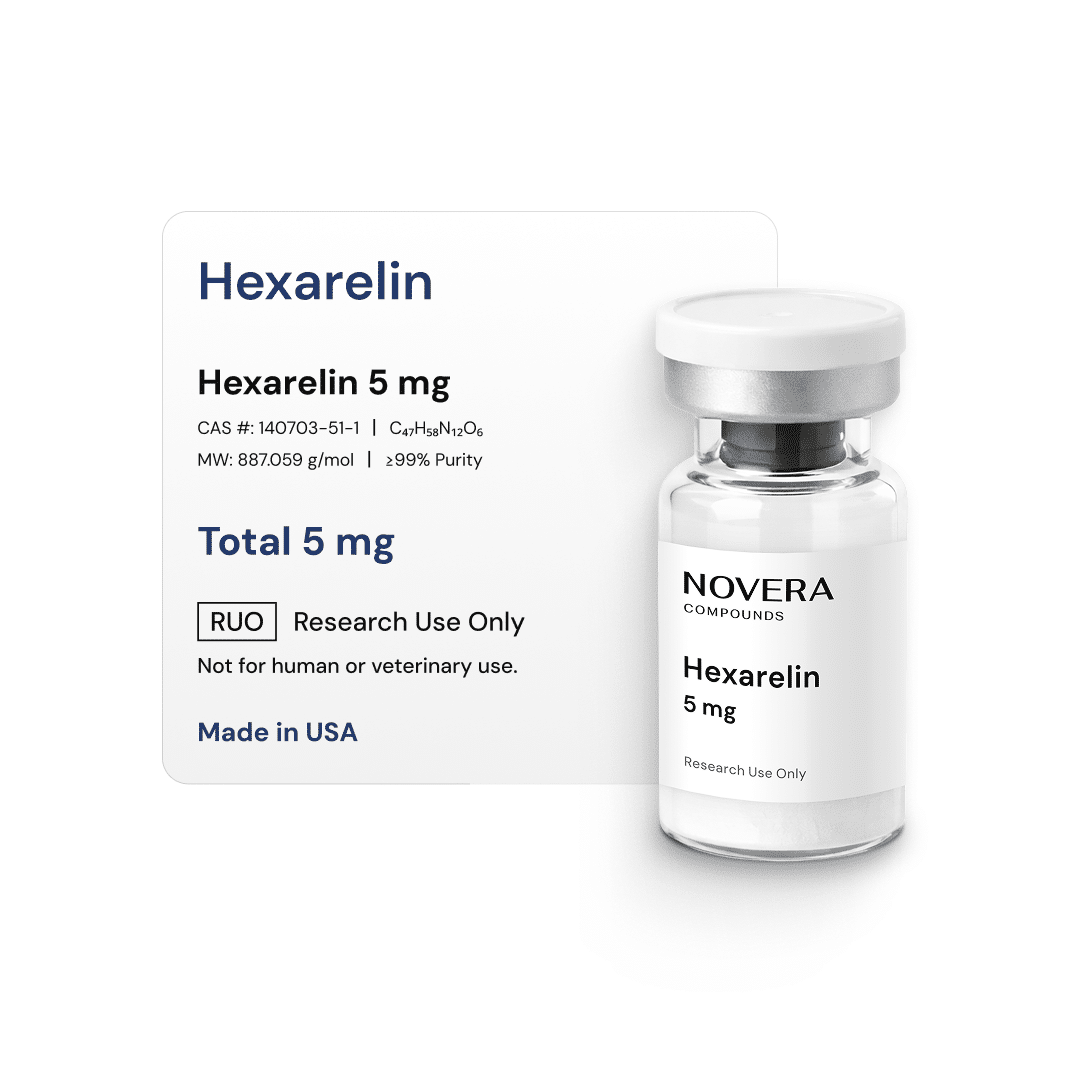
The hexarelin peptide is a synthetic hexapeptide growth hormone secretagogue (GHS) developed for controlled laboratory research examining endogenous growth hormone (GH) signaling. Laboratories that buy hexarelin peptide or order hexarelin peptide materials reference this compound for experimental studies involving short-acting GHS behavior and hormone-axis regulation. Hexarelin is structurally derived from growth hormone–releasing peptide-6 (GHRP-6) and contains the amino acid sequence His-D-2-methyl-Trp-Ala-Trp-D-Phe-Lys-NH₂.
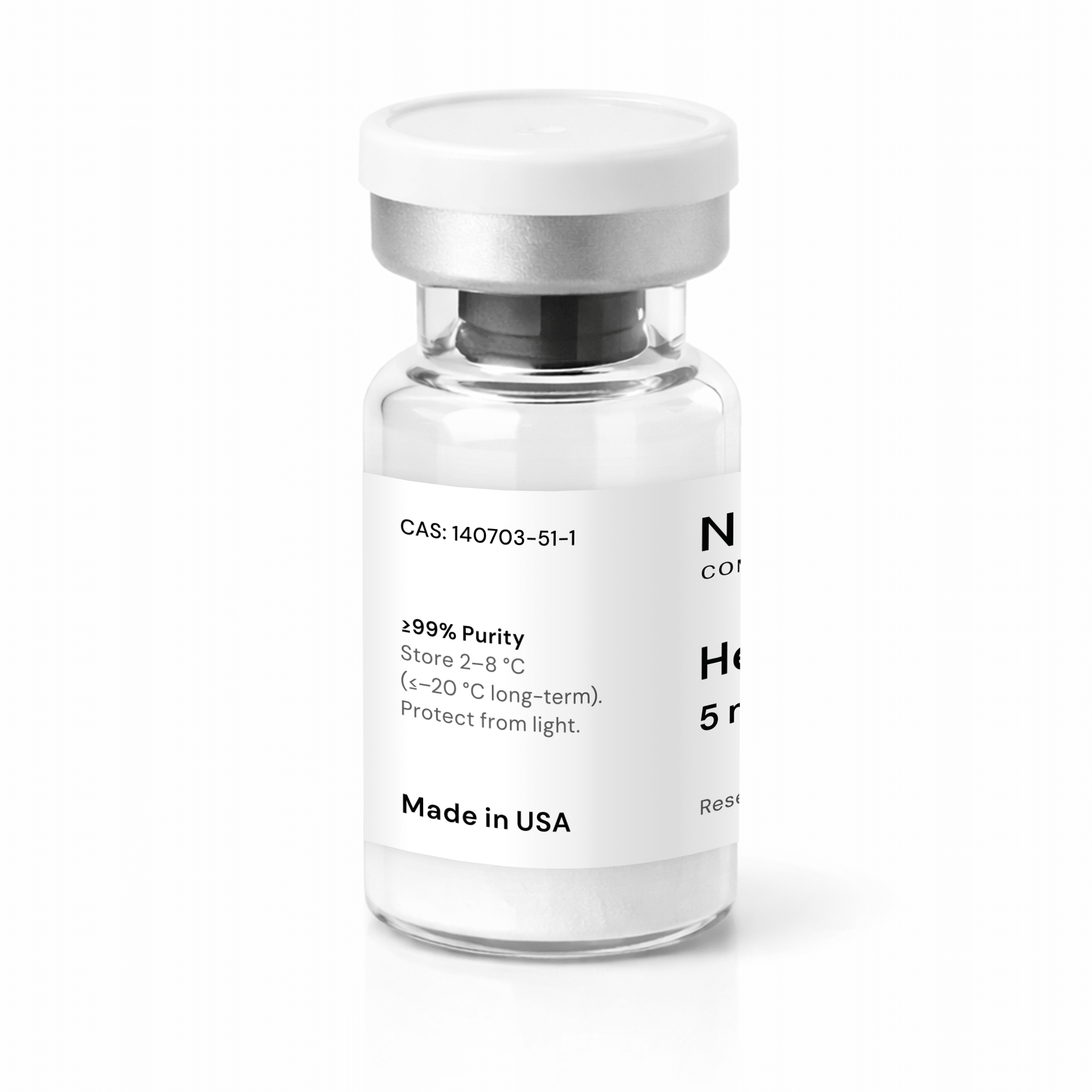
The peptide has a molecular weight of 887 Da and a molecular formula of C₄₇H₅₈N₁₂O₆ (CAS 140703-51-1). This product is supplied as a sterile lyophilized powder in 5 mg glass vials and is intended exclusively for laboratory research use.
In research settings, hexarelin has been examined in experimental models that evaluate growth hormone axis signaling, metabolic markers, and cellular response patterns. These investigations are limited to controlled laboratory and preclinical environments.
Hexarelin (5mg) Key Features and Benefits
- Chemical identity: Synthetic hexapeptide GHS
- Molecular weight: 887.04 g/mol
- Molecular formula: C₄₇H₅₈N₁₂O₆
- Purity: Commonly produced at ≥98%, verified by RP-HPLC
- Format: Supplied as a lyophilized powder in sealed glass vials
- Research focus: Studied in laboratory models assessing growth-hormone-axis signaling behavior
- Handling compatibility: Soluble in purified laboratory water for experimental preparation
For laboratory research use only.
Hexarelin (5mg) Mechanism & Research Applications
Hexarelin has been examined in laboratory research as a growth hormone secretagogue evaluated for its interaction with growth hormone secretagogue receptor (GHS-R1a) in experimental cell and animal models. In controlled systems, this interaction is used to study upstream signaling events associated with endogenous growth-hormone release.
Beyond endocrine signaling models, hexarelin has also been evaluated in experimental settings exploring non-endocrine cellular response patterns. These studies focus on intracellular signaling behavior and tissue-specific experimental responses rather than therapeutic outcomes.
Research applications include:
- Growth-hormone-axis signaling studies in controlled laboratory models
- Hormone-timing and secretion pattern investigations
- Metabolic and cellular signaling research systems
- Cardiac and neuroendocrine experimental models examining peptide–cell interactions
All applications described reflect controlled laboratory research contexts and do not imply clinical or therapeutic use.
Hexarelin (5mg) Dosing & Observed Effects in Research
Research protocols involving hexarelin vary by study design, species, and experimental objective. Published laboratory and preclinical research describes evaluation of microgram-per-kilogram dosing ranges in animal and translational models, with administration schedules adjusted according to assay requirements.
Reported laboratory observations include transient changes in growth-hormone-related biomarkers, signal-transduction markers, and other assay-specific experimental readouts. These findings are derived exclusively from controlled research environments and do not establish safety, efficacy, or clinical relevance.
Researchers who order hexarelin peptide materials are expected to define dose-response parameters appropriate to their specific experimental systems
Hexarelin (5mg) Storage, Safety & References
- Store lyophilized vials at ≤ –18 °C for long-term stability
- Short-term storage at controlled room temperature is acceptable during handling
- Keep vials sealed, dry, and protected from light
- Allow vials to equilibrate to room temperature before opening
- Reconstitute only with purified or bacteriostatic water using sterile technique
- Store reconstituted solutions at 2–8 °C and use within several days
- Aliquot when necessary and avoid repeated freeze–thaw cycles
Handle materials in accordance with institutional laboratory biosafety protocols. Review the Certificate of Analysis (CoA) and Safety Data Sheet (SDS) prior to use.
References
https://pubmed.ncbi.nlm.nih.gov/15361691
https://pmc.ncbi.nlm.nih.gov/articles/PMC4178518
https://pmc.ncbi.nlm.nih.gov/articles/PMC5659698
https://academic.oup.com/jcem/article/84/7/2489/2864389
https://pubmed.ncbi.nlm.nih.gov/21692501
Compliance Notice
This product is intended for laboratory research use only and is not approved for human or veterinary use.