




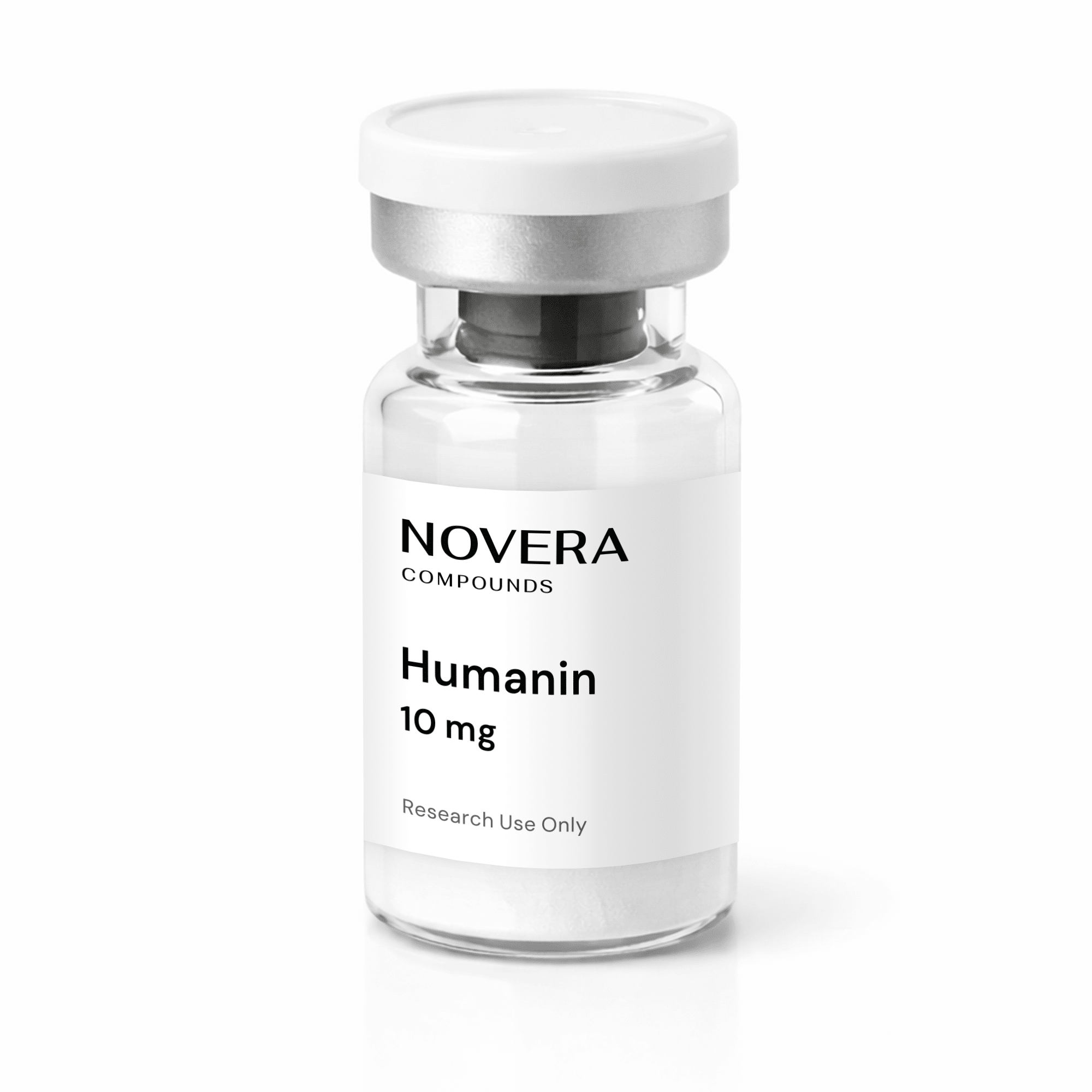
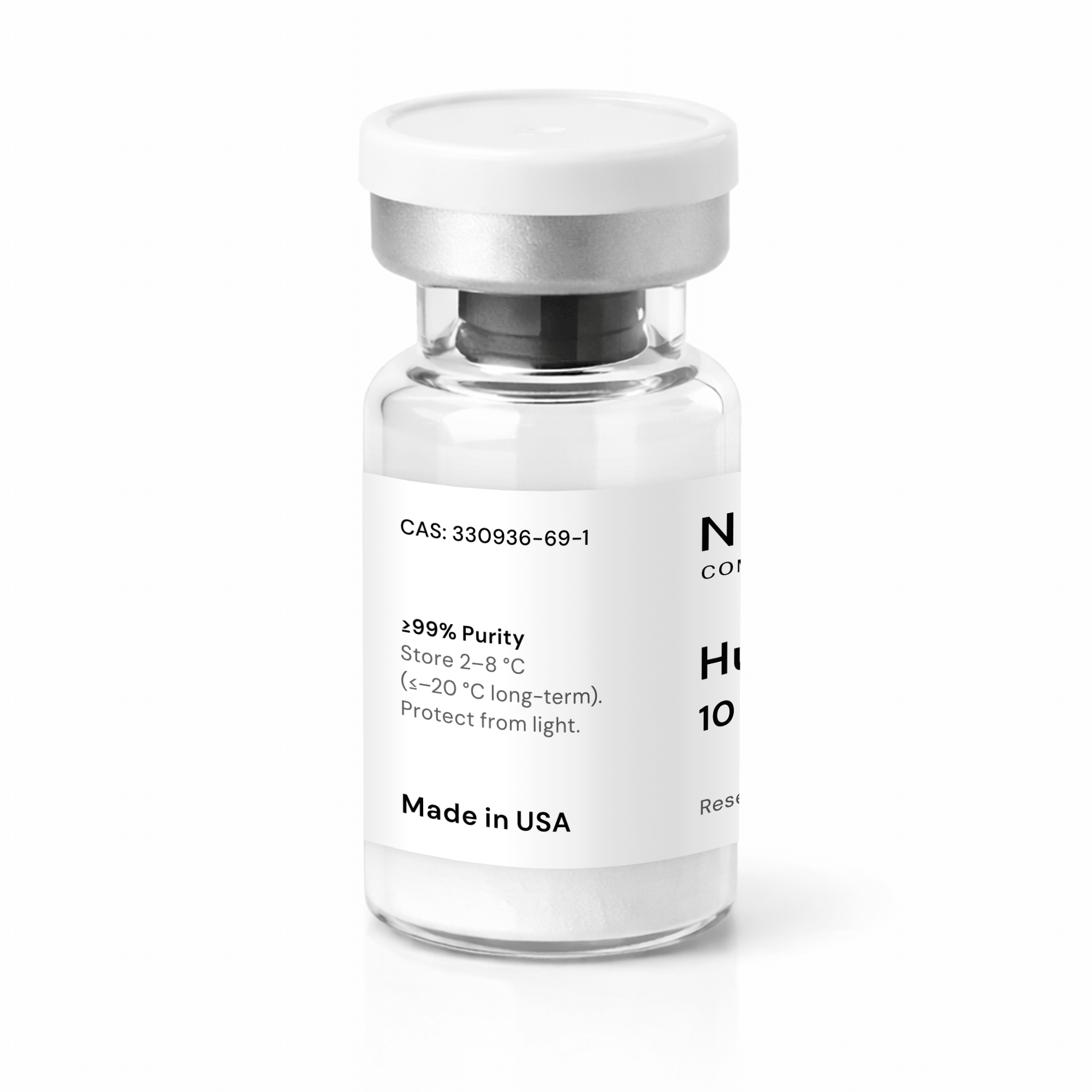
Humanin (10mg) About This Product
The humanin peptide is a naturally occurring mitochondrial-derived peptide (MDP) composed of 24 amino acids and encoded within the mitochondrial 16S ribosomal RNA gene. Laboratories that buy humanin peptide materials cite this compound for controlled laboratory research on mitochondrial signaling and cellular stress-response mechanisms. Humanin is conserved across several mammalian species, including humans, mice, and rats.
The peptide has a molecular weight of approximately 2,687.2 Da. This product is supplied as a lyophilized (freeze-dried) powder in 10 mg glass vials, with reported purity exceeding 98% as verified by analytical testing. In laboratory and preclinical research, humanin has been examined in experimental models that evaluate mitochondrial function and intracellular signaling under controlled conditions.
All investigations are conducted in laboratory settings.
Humanin (10mg) Key Features and Benefits
- Chemical identity: Mitochondrial-derived peptide (MDP) consisting of 24 amino acids
- Molecular weight: ~2,687.2 Da
- Purity: Commonly reported at >98%, verified by analytical methods
- Format: Supplied as a lyophilized powder in sterile glass vials
- Research focus: Studied in laboratory models examining mitochondrial signaling and cellular stress response
- Cellular interaction scope: Evaluated in experimental systems involving apoptosis-related signaling proteins
- Handling compatibility: Soluble in standard laboratory solvents such as sterile water, PBS, or DMSO
For laboratory research use only.
Humanin (10mg) Mechanism & Research Applications
Humanin has been studied in laboratory research as a mitochondrial-associated signaling peptide, evaluated for its interactions with intracellular proteins involved in cellular stress-response pathways. In controlled experimental systems, studies explore how humanin influences mitochondrial-related signaling behavior rather than acting through classical membrane receptors alone.
Research applications include:
- Mitochondrial signaling studies in cell culture models
- Cellular stress-response investigations under oxidative or metabolic challenge conditions
- Neural and retinal cell culture systems used for experimental observation
- Cardiovascular and metabolic research models assessing intracellular signaling markers
All applications described reflect controlled laboratory research contexts and do not imply clinical or therapeutic use.
Humanin (10mg) Dosing & Observed Effects in Research
Reported humanin dosing varies across experimental models and assay designs. In in vitro studies, humanin has been evaluated at sub-micromolar to low-micromolar concentrations, depending on cell type and experimental endpoint.
Preclinical animal research has explored a range of experimental dosing strategies using different delivery routes and study durations. These protocols are designed to assess mitochondrial signaling markers, cellular response patterns, and other assay-specific molecular readouts.
Reported observations in laboratory settings include changes in apoptosis-associated markers, mitochondrial activity indicators, and oxidative stress-related measurements. All findings are derived exclusively from controlled research environments and do not establish safety, efficacy, or clinical relevance.
Researchers who order humanin peptide materials are expected to define dosing parameters appropriate to their specific experimental systems.
Humanin (10mg) Storage, Safety & References
- Store lyophilized vials at –20 °C or colder
- Protect from light and moisture
- Reconstitute only with sterile water, PBS, or DMSO using aseptic technique
- Store reconstituted solutions at 2–8 °C for short-term use
- For longer storage, aliquot and freeze at –20 °C or –80 °C
- Avoid repeated freeze–thaw cycles
Handle materials in accordance with institutional laboratory biosafety protocols.
References
https://pmc.ncbi.nlm.nih.gov/articles/PMC3641182
https://pmc.ncbi.nlm.nih.gov/articles/PMC6916494
https://pubmed.ncbi.nlm.nih.gov/14561895
https://pmc.ncbi.nlm.nih.gov/articles/PMC2695794
https://www.frontiersin.org/journals/endocrinology/articles/10.3389/fendo.2021.683151/full
Compliance Notice
This product is intended for laboratory research use only and is not approved for human or veterinary use.