




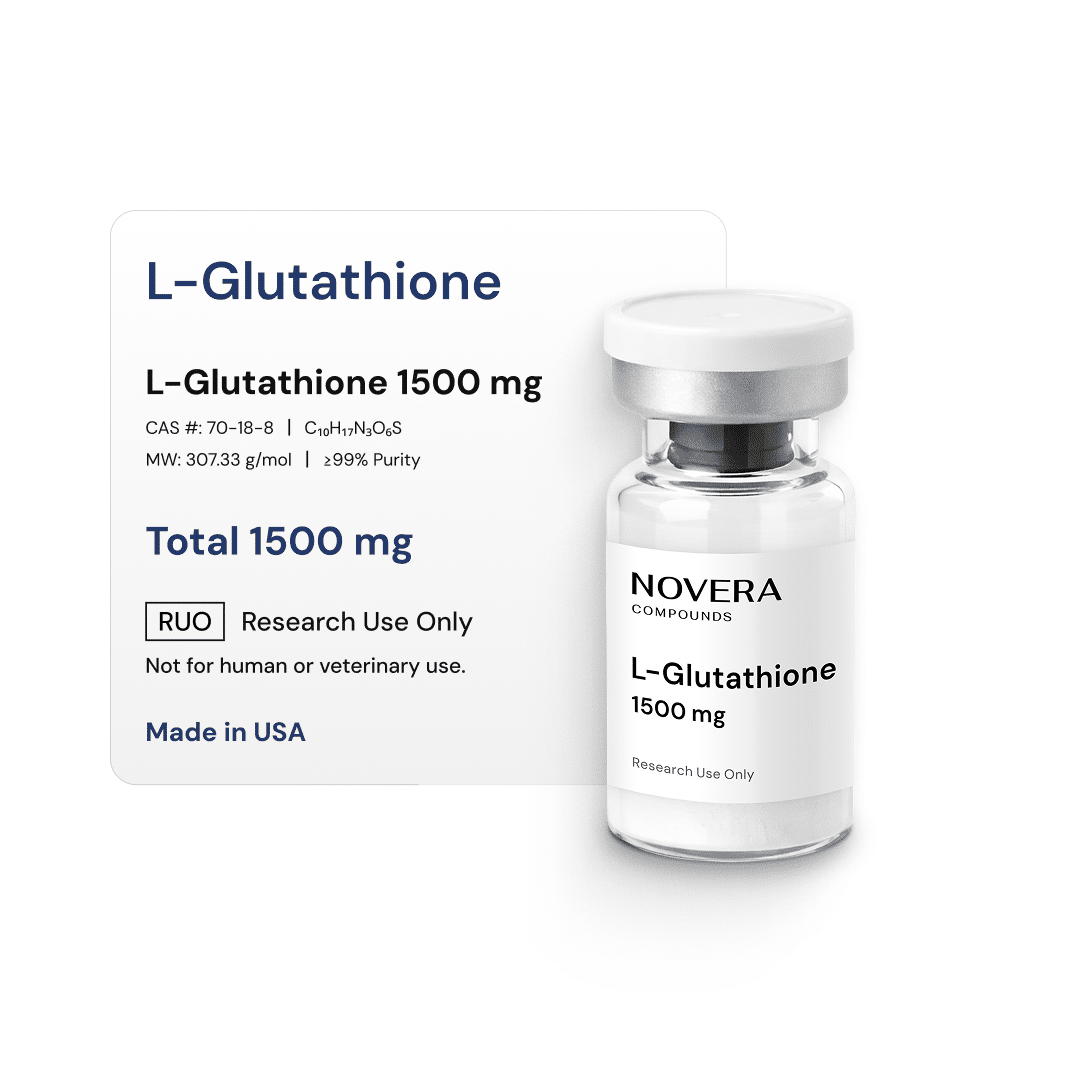

L-Glutathione About This Product
L-Glutathione(reduced glutathione, GSH) is a naturally occurring tripeptidecomposed of three amino acids—glutamic acid, cysteine, andglycine—connected by peptide bonds. With a molecular weight of 307.33 g/mol and the molecular formula C10H17N3O6S, L-Glutathione is a low-molecular-weight organic compound ubiquitously synthesized in eukaryotic cells.
This research peptide is provided as a high-purity lyophilized powder in a 10 mg vial for use in controlled laboratory research. L-Glutathione for research applications has been studied for its role as a primary intracellular antioxidant and redox regulator. This L-Glutathione antioxidant peptide participates in oxidative stress regulation, enzymatic detoxification pathways, redox homeostasis, and cellular protection mechanisms.
The cysteine thiol group (-SH) confers redox activity, enabling reversible oxidation-reduction cyclingbetween reduced (GSH) and oxidized (GSSG) states. Researchers use Glutathione for research into cellular redox buffering, metabolic homeostasis, and redox-dependent signaling in preclinical and in vitro systems.
L-Glutathione Key Features and Benefits
- L-Glutathione Peptide Research Formulation — Reduced tripeptide designed for investigating intracellular redox balance, antioxidant mechanisms, and cellular redox signaling in controlled laboratory settings
- High-Purity Lyophilized Powder — Research-grade purity verified using HPLC and mass spectrometry, ensuring reproducible experimental results and batch-to-batch consistency
- Naturally Occurring Tripeptide — Composed of glutamic acid, cysteine, and glycine with the distinctive γ-glutamyl linkage that confers resistance to peptidase degradation
- Redox Buffer Properties — The free thiol group enables direct electron donation and reversible GSH/GSSG cycling for oxidative stress modeling and redox assays
- Multiple Research Applications — Suitable for studies of cellular redox buffering, enzymatic detoxification pathways, protein folding quality control, ferroptosis signaling, and immune cell modulation
- Comprehensive Laboratory Use — Designed for in vitro cell culture studies, animal model research, redox assays, enzymatic studies, and protein folding experiments
- Stable Storage Format — Lyophilized powder maintains long-term stability and can be reconstituted for specific experimental protocols
- For Laboratory Research Use Only — Intended exclusively for qualified researchers conducting preclinical and experimental investigations
L-Glutathione Mechanism & Research Applications
L-Glutathione functions as a cellular redox regulator and primary thiol-based antioxidant in laboratory systems. The peptide’s unique structural feature—the γ-glutamyl linkage between glutamic acid and cysteine—provides resistance to degradation by conventional peptidases.
In research contexts, L-Glutathione has been investigated for its role in maintaining intracellular redox balance through reversible oxidation-reduction cycling between the reduced form (GSH) and oxidized form (GSSG).
Researchers have used L-Glutathione to explore multiple biochemical mechanisms in controlled experimental systems:
- Cellular Redox Buffering: L-Glutathione serves as a primary intracellular redox buffer, neutralizing reactive oxygen species (ROS) and reactive nitrogen species through direct electron donation. The GSH:GSSG ratio is widely used as an indicator of cellular redox state.
- Enzymatic Detoxification: The peptide participates in glutathione-dependent enzymatic pathways, including glutathione peroxidases, glutathione S-transferases, and glutathione reductase reactions, which have been studied in detoxification research.
- Protein Folding and Redox Homeostasis: L-Glutathione has been investigated in studies of endoplasmic reticulum protein folding, disulfide bond formation, and cellular redox maintenance in controlled laboratory systems.
- Specialized Cell Signaling Research: Laboratory investigations have examined L-Glutathione’s roles in ferroptosis signaling, neurochemical redox modulation, immune cell redox-dependent activation, and retinal and lens protein redox maintenance in cell culture and animal models.
These applications remain limited to preclinical experimental systems and do not constitute clinical claims.
L-Glutathione Dosing & Observed Effects in Research
L-Glutathione is typically employed in cell culture studies at nanomolar concentrations (variable by application), with biological activity commonly observed at very low molar concentrations depending on the specific assay system.
- Oral Dosing in Clinical Research: In human clinical studies examining glutathione supplementation, oral doses have ranged from 250 to 1,000 mg per day, administered as dietary supplementation over periods of 1 to 6 months. These studies focused on assessing blood glutathione levels, oxidative stress markers, immune function biomarkers, and skin-related properties as secondary outcomes. No serious adverse effects were reported in these supplementation studies.
Additionally, laboratory research has reported the following observations in controlled experimental systems:
- Redox Balance: Dose- and time-dependent increases in blood and cellular glutathione levels with oral supplementation at 250-1,000 mg/day over weeks to months
- Oxidative Stress Markers: Changes in biomarkers reflecting oxidative stress status, particularly in studies using 1,000 mg/day for extended durations (6 months)
- Cellular Redox State: Alterations in GSH:GSSG ratio in cell culture and animal models reflecting changes in redox status
- Tolerability: Minimal adverse effects reported in supplementation studies; minor transient effects occasionally noted (heaviness, skin moisture changes, flushing)
Furthermore, all reported observations are from preclinical laboratory studies or dietary supplementation research. L-Glutathione is not FDA-approved as a pharmaceutical drug and is available only as a dietary supplement ingredient. Oral supplementation studies examined changes in blood glutathione levels and related biomarkers, not therapeutic efficacy for any condition.
L-Glutathione Storage, Safety & References
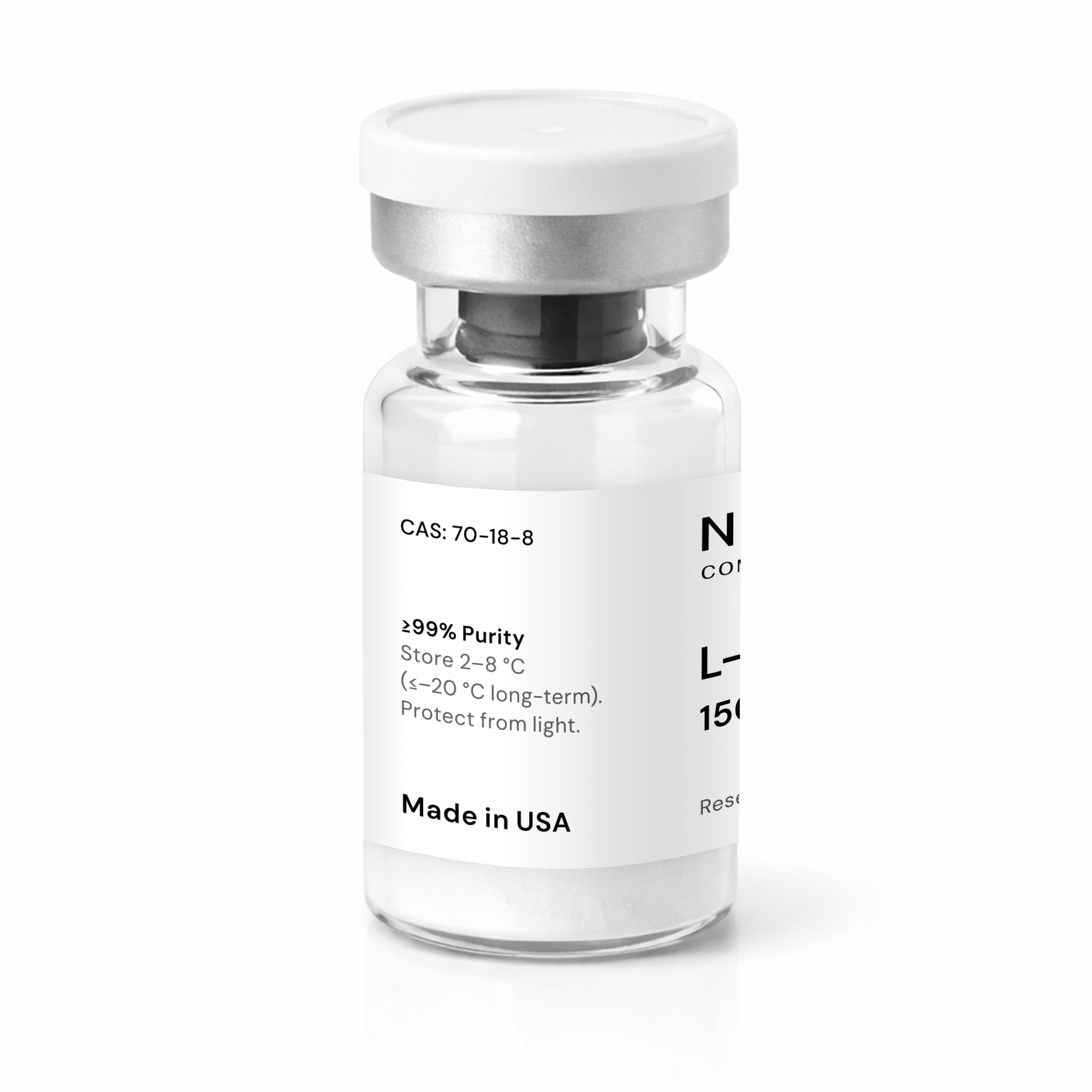
- Storage Instructions: Store L-Glutathione lyophilized powder at –20°C or lower in a tightly sealed, light-protected container for long-term stability. For short-term use (days to weeks), room temperature storage (15–25°C) is acceptable. Once reconstituted with sterile, RNase-/DNase-free water or appropriate buffer at neutral pH, maintain refrigeration at 2–8°C and use within 5–7 days. Avoid multiple freeze-thaw cycles after reconstitution to preserve peptide integrity.
- Laboratory Safety: Follow standard laboratory safety protocols, including appropriate personal protective equipment (PPE), sterile handling techniques, and aseptic conditions during handling and reconstitution. Dispose of unused material in accordance with local chemical and biological waste regulations.
Regulatory Status
L-Glutathione is recognized by the FDA as Generally Recognized as Safe (GRAS) for use as a dietary supplement ingredient. It is NOT approved by the FDA for use in sterile pharmaceutical formulations or compounded injectables. The FDA has cautioned compounders against incorporating L-Glutathione in sterile drug preparations due to the ingredient being intended for dietary supplement use only.
L-Glutathione is available for laboratory research use only and is not approved for clinical, therapeutic, or human medical use.
References
https://pubmed.ncbi.nlm.nih.gov/18796312
https://www.sciencedirect.com/science/article/abs/pii/S0304416512002632
https://pubmed.ncbi.nlm.nih.gov/30342710
https://pubmed.ncbi.nlm.nih.gov/28853742
https://pubmed.ncbi.nlm.nih.gov/28490897
https://pubchem.ncbi.nlm.nih.gov/compound/Glutathione
Compliance Notice
This product is intended for laboratory research use only and is not approved for human or veterinary use.