




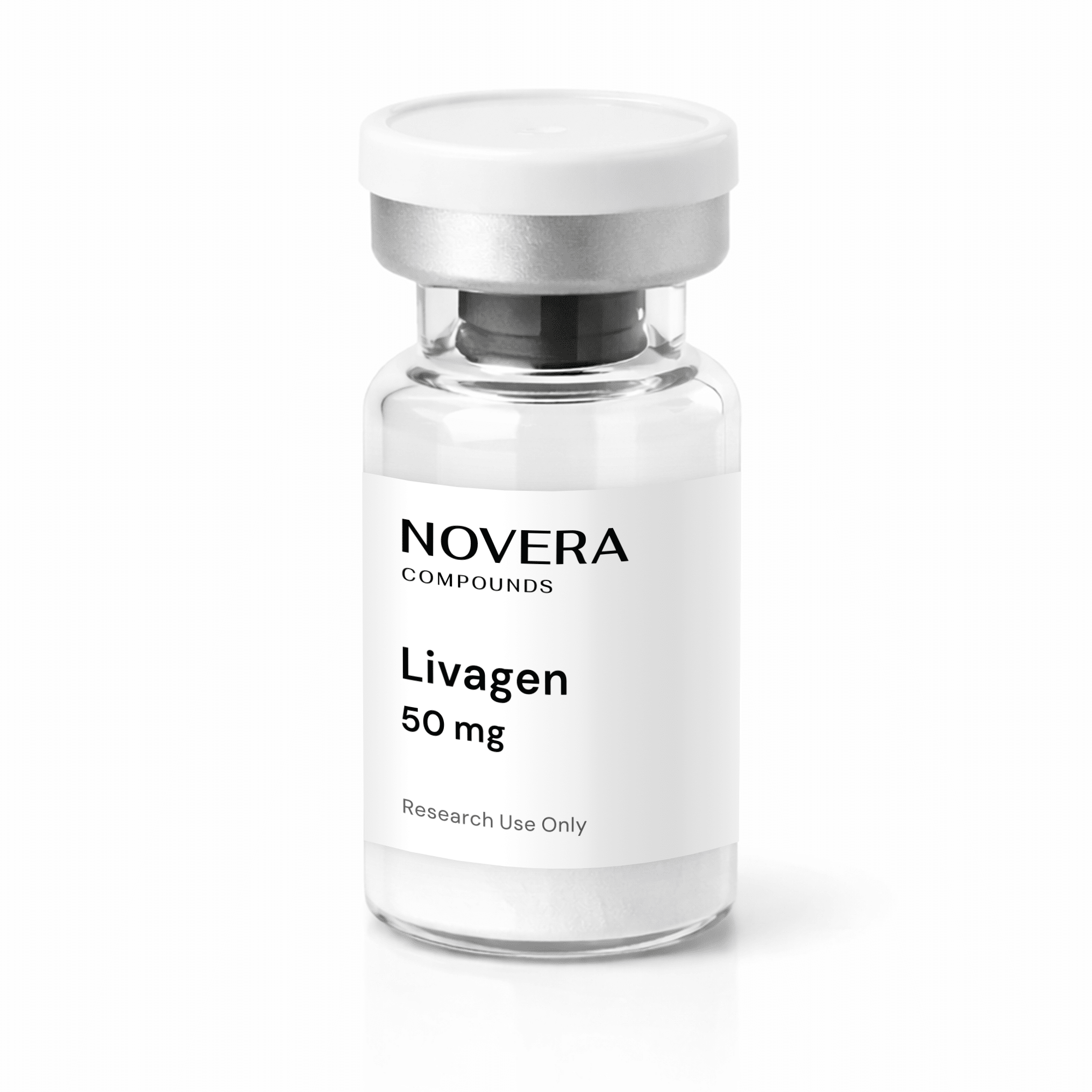
Livagen (50mg) About This Product
Livagen (50mg) is a synthetic tetrapeptide bioregulator composed of lysine, glutamic acid, aspartic acid, and alanine (Lys-Glu-Asp-Ala), developed for laboratory research investigating peptide-mediated regulation of nuclear chromatin organization and gene expression programs in experimental systems. Unlike metabolic or hepatic signaling peptides, Livagen is studied for its influence on genome accessibility and transcriptional control at the nuclear level.
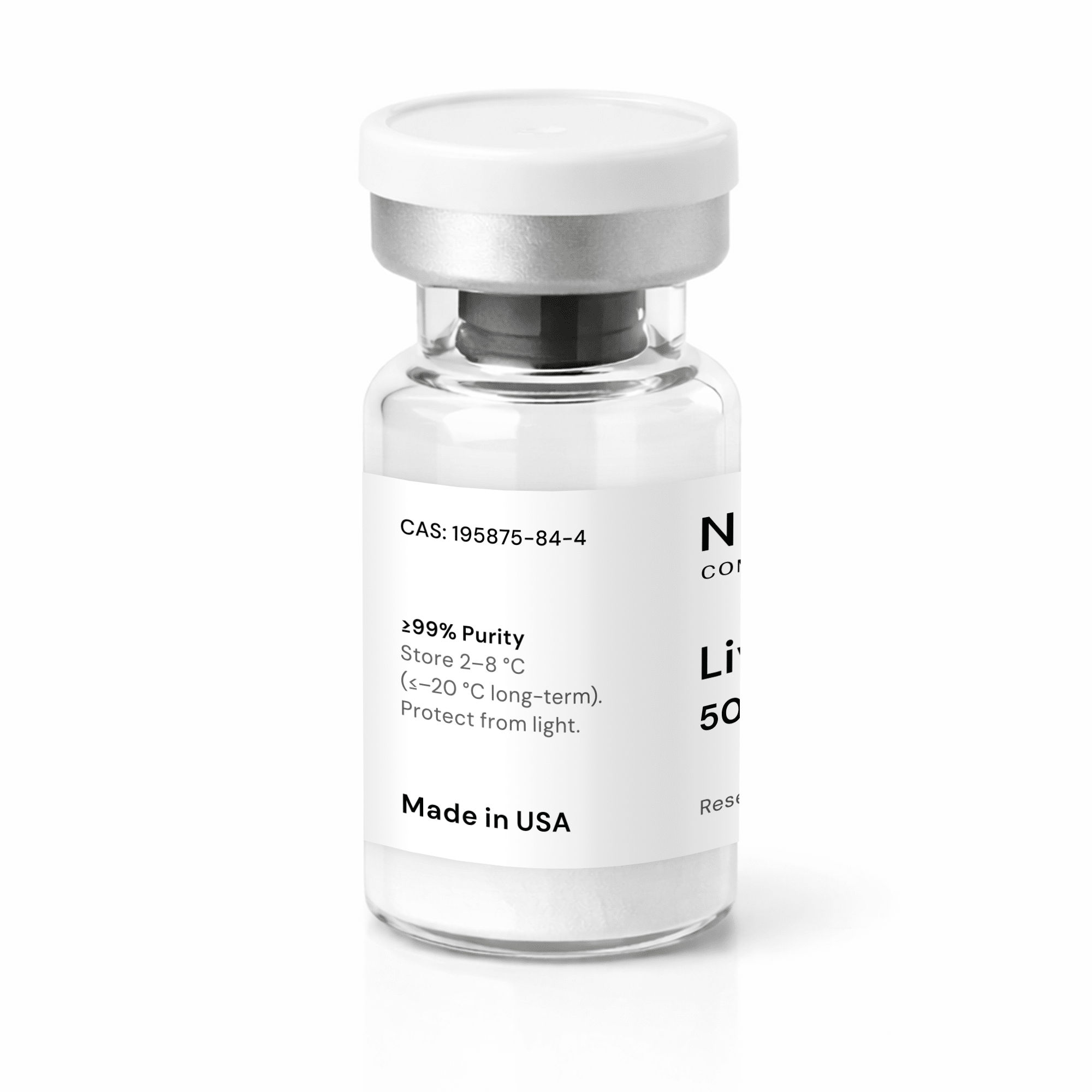
The Livagen peptide has a molecular weight of 461.5 g/mol and molecular formula C₁₈H₃₁N₅O₉. It is catalogued as PubChem CID 87919683 and CAS Number 195875-84-4. As a compact, charged tetrapeptide, Livagen is used to examine sequence-dependent effects on chromatin accessibility, transcriptional regulation, and nucleoprotein complex interactions.
This product is supplied as a high-purity, lyophilized powder in a sealed research-grade vial, supporting consistent handling, accurate dosing, and reproducibility. Laboratories that buy Livagen peptide commonly employ it in cellular, enzymatic, and animal-based preclinical research models focused on chromatin-linked regulation.
Livagen (50mg) Key Features and Benefits
- Chromatin Decondensation Research Tool: Investigated for effects on higher-order DNA packaging and transcriptional accessibility
- Tetrapeptide Bioregulator (Lys-Glu-Asp-Ala): Short, charged sequence enabling nucleoprotein interactions
- Lymphocyte Transcriptional Regulation Probe: Studied in immune cell chromatin remodeling and gene expression
- Ribosomal Gene Activation Research: Examined for rRNA biogenesis and protein synthetic capacity
- Nucleolar Activity Modulator: Characterized using NOR activity and acrocentric chromosome association assays
- Multi-System Research Compatibility: Suitable for lymphocyte preparations, enzyme assays, animal models, and aging paradigms
Livagen (50mg) Mechanism & Research Applications
Livagen functions as a peptide bioregulator investigated for its ability to influence higher-order DNA packaging and chromatin organizational states in experimental cell systems. In eukaryotic cells, genomic DNA is hierarchically compacted—from nucleosomes to larger chromatin domains—governing which genomic regions remain accessible to transcription factors and RNA polymerase.
The balance between euchromatin (loosely packed, transcriptionally active) and heterochromatin (densely packed, transcriptionally repressed) determines gene expression potential. Chromatin decondensation increases the accessibility of previously constrained genomic regions, thereby enabling activation of gene sets that are suppressed under baseline conditions.
Experimental studies have characterized Livagen as influencing chromatin organizational patterns, particularly in lymphocyte-enriched cell preparations, promoting decondensation-associated shifts in transcriptional activity. Reported observations include activation of genomic loci associated with ribosomal biogenesis and protein synthetic capacity, reflecting changes in nucleoprotein packaging that modulate gene expression at a systems level.
Laboratory investigations commonly utilize lymphocyte-enriched populations as tractable models for studying chromatin-mediated transcriptional regulation. These systems include B-cell and T-cell lineages, allowing examination of gene activation programs, cytokine transcription networks, and proliferation responses under defined stimulation conditions.
Within this framework, chromatin accessibility shifts represent upstream regulatory events that shape immune-relevant transcriptional circuits, linking nuclear organization to functional cellular outputs in controlled in vitro environments.
Primary Research Domains of Livagen
- Chromatin State Modulation in Lymphocyte Populations: Investigation of chromatin condensation/decondensation phenotypes using cytological markers, nucleolar organizing region (NOR) activity, and transcriptional profiling assays.
- Gene Expression Shifts and Nucleolar Activity: Studies of ribosomal gene transcription, rRNA biogenesis markers, and activation of previously repressed genomic loci.
- Cellular Functional Outputs Downstream of Chromatin Remodeling: Evaluation of cytokine transcription profiles, proliferation indices, and stress-response gene programs in immune cells.
- Enzyme Activity Assays and Peptide Metabolism: Examination of peptidase activity, including enkephalin-degrading enzyme pathways and endogenous peptide turnover dynamics.
- Neuroimmune and Gastrointestinal Signaling in Animal Models: Exploration of μ- and δ-opioid receptor signaling in gastric mucosal protection models, including nitric oxide and prostaglandin mediator measurements.
Preclinical Research Summary
- Lymphocyte Chromatin Remodeling and Transcriptional Activation: Preclinical studies report chromatin decondensation phenotypes, altered transcriptional profiles, and increased nucleolar activity in lymphocyte-based systems.
- Genome Organization and Cardiovascular-Related Research Models: Research programs evaluate genomic stability markers, NOR activity, heterochromatin patterns, and acrocentric chromosome associations using lymphocyte assays.
- Peptidase Activity and Endogenous Opioid Peptide Signaling: Biochemical investigations examine enkephalin-degrading enzyme activity and opioid receptor signaling in rodent gastric protection paradigms.
- Chromatin State and Cellular Aging Paradigms: Laboratory aging models explore relationships between chromatin remodeling, genome stability, and DNA repair-associated readouts.
Livagen (50mg) Dosing & Observed Effects in Research
Published research employs model-specific experimental dosing approaches, adjusted for species, study design, and exposure duration. All studies are conducted under controlled laboratory and preclinical conditions. Below are the commonly measured research endpoints:
Chromatin & Transcriptional Readouts
- Chromatin condensation/decondensation phenotypes
- Euchromatin and heterochromatin state markers
- NOR activity indices and acrocentric chromosome associations
- Transcriptional profiling and rRNA biogenesis markers
Cellular Functional Outputs
- Protein synthesis capacity measurements
- Cytokine transcription profiles
- Proliferation and cell-cycle indices
- Stress-response gene activation
Enzymatic & Signaling Pathways
- Peptidase activity (enkephalin-degrading enzymes)
- μ- and δ-opioid receptor signaling readouts
- Nitric oxide and prostaglandin mediator production
- Gastrointestinal barrier function parameters
All findings derive exclusively from controlled laboratory and preclinical animal research systems.
Livagen (50mg) Storage, Safety & References
Store Livagen (50mg) in its lyophilized form at 2–8°C, protected from light and moisture. Reconstituted solutions should be prepared using sterile laboratory techniques and handled in accordance with institutional research protocols, minimizing repeated freeze–thaw cycles.
This product is intended solely for qualified researchers. Laboratories that order Livagen peptide must adhere to standard laboratory safety and disposal guidelines.
References
https://pubmed.ncbi.nlm.nih.gov/12533768
https://pubmed.ncbi.nlm.nih.gov/16705247
https://pubmed.ncbi.nlm.nih.gov/12942748
https://pubmed.ncbi.nlm.nih.gov/15085253
Compliance Notice
This product is intended for laboratory research use only and is not approved for human or veterinary use.