




What Are the Purported Benefits of MGF IGF-1Ec (5mg)?
MGF peptide, also known as Mechano Growth Factor C-terminal, is widely studied for its role as the body’s early responder to muscle damage. Unlike systemic IGF-1 variants, MGF is produced locally in muscle tissue in response to mechanical stress, making it a focal point in regeneration research.
Key areas of scientific interest include:
- Satellite Cell Activation: MGF is best known for activating muscle satellite (stem) cells, which are essential for repairing damaged fibers and initiating new tissue growth.
- Accelerated Muscle Repair: Research models show that MGF signals the earliest phase of muscle remodeling immediately after strain or injury.
- Hypertrophy Support: By expanding the available stem cell pool, MGF provides the foundation for later anabolic signaling.
- Neuroprotective Potential: Emerging data from 2025 suggest that MGF may protect neurons following ischemic events.
- Bone and Cartilage Research: Studies indicate that MGF may promote chondrocyte migration and proliferation, supporting ongoing research into joint and connective tissue repair.
These unique properties continue to drive interest among researchers looking to buy MGF peptide for advanced recovery and regeneration studies.
What is the Chemical Makeup of MGF IGF-1Ec (5mg)?
MGF IGF-1Ec is a naturally occurring splice variant of the IGF-1 gene. Although it shares IGF-1’s mature core structure, its defining feature is a unique C-terminal “E-domain” that contributes to its distinct regenerative behavior.
- Peptide Type: IGF-1Ec splice variant
- Unique Feature: C-terminal E-domain created by exon five frame-shifting
- Amino Acid Length: 24 amino acids (C-terminal E-domain)
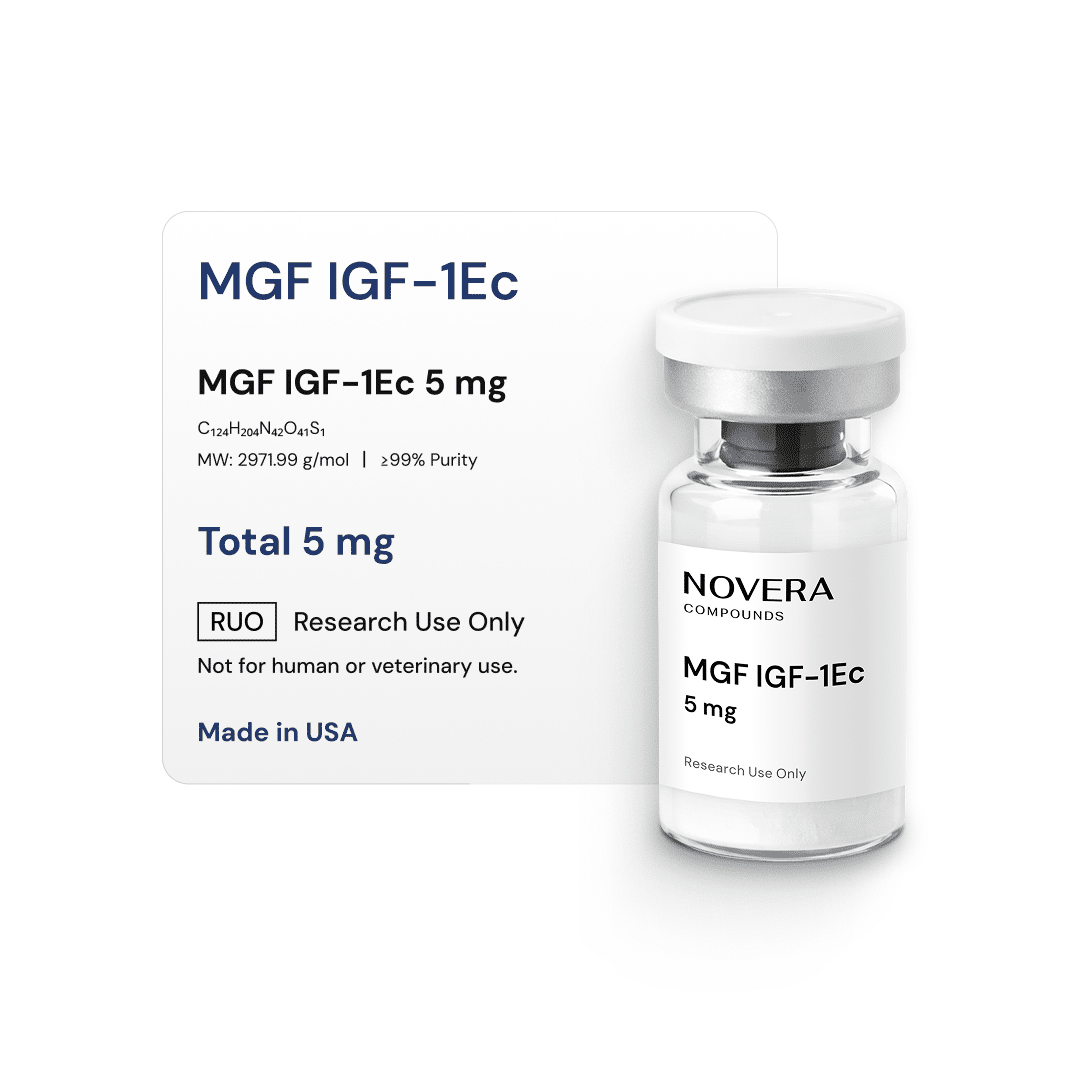
- Molecular Formula: C₁₂₄H₂₀₄N₄₂O₄₁S₁
- Molecular Weight: 2971.99 g/mol
- Human C-Terminal Sequence: Tyr-GIn-Pro-Pro-Ser-Thr-Asn-Lys-Asn-Thr-Lys-Ser-GIn-Arg-Arg-Lys-Gly-Ser-Thr-Phe-Glu-Glu-Arg-Lys-Cys
This specialized molecular structure is what differentiates MGF from other IGF-based peptides and contributes to its selective biological activity.
What Does Scientific Research Say About MGF IGF-1Ec (5mg)?
The scientific literature emphasizes that MGF differs from systemic IGF-1 analogs.
- Ultra-Short Half-Life: Native MGF is rapidly degraded in circulation, with a half-life of just minutes, which limits systemic exposure.
- MGF vs. IGF-1 LR3: MGF is often described as the “repair signal”, initiating stem cell activation, while IGF-1 LR3 promotes protein synthesis and tissue growth at later stages.
- PEG-MGF Development: To address its rapid breakdown, many studies now explore PEGylated MGF (PEG-MGF), which extends bioactivity from minutes to multiple days.
- Distinct Signaling Pathway: Evidence suggests that MGF may act through a distinct receptor pathway from IGF-1R, therebyenabling cell proliferation without immediate differentiation.
These findings explain why researchers continue to order MGF peptide for studies focused on early-stage regeneration rather than systemic anabolic signaling.
What are the Storage Conditions for MGF IGF-1Ec (5mg)?
MGF is a delicate peptide that requires proper handling to preserve its stability and effectiveness.
Lyophilized (Powder)
- Freezer (–20°C): Up to 2 years
- Refrigerated (2°C–8°C): 6–12 months
- Room Temperature (20°C–25°C): 1–2 weeks (shipping only)
Reconstituted Solution
- Refrigerator (2°C–8°C): 5–7 days
Handling Best Practices
- Reconstitute using bacteriostatic water (e.g., 2 mL per 5 mg vial)
- Do not shake—gently roll the vial to mix
- Protect from UV exposure using amber vials or original packaging
- Do not refreeze after reconstitution, as ice crystals can damage peptide structure
Proper storage and handling are essential for researchers who purchase MGF peptide to ensure reproducible, reliable experimental outcomes.
Are you looking to buy MGF IGF-1Ec (5mg) online?
If you’re looking to order MGF IGF-1Ec (5mg) online at wholesale prices, contact Medical Spa RX for guidance on how to do so.
This product is supplied strictly for laboratory research use only and is not approved for human or veterinary administration. It is not intended for diagnostic, therapeutic, or clinical applications. Any reference to biological activity or potential effects is based solely on preclinical or in-vitro findings and should not be interpreted as validated clinical outcomes. Researchers are responsible for ensuring proper handling, storage, and disposal in accordance with institutional, federal, and international guidelines. By purchasing or using this material, the buyer confirms that they are a qualified researcher and that the product will be used exclusively in controlled research settings compliant with all applicable regulations.
Sources
https://pubmed.ncbi.nlm.nih.gov/21354439
https://pubmed.ncbi.nlm.nih.gov/20130113
https://pubmed.ncbi.nlm.nih.gov/16144956