





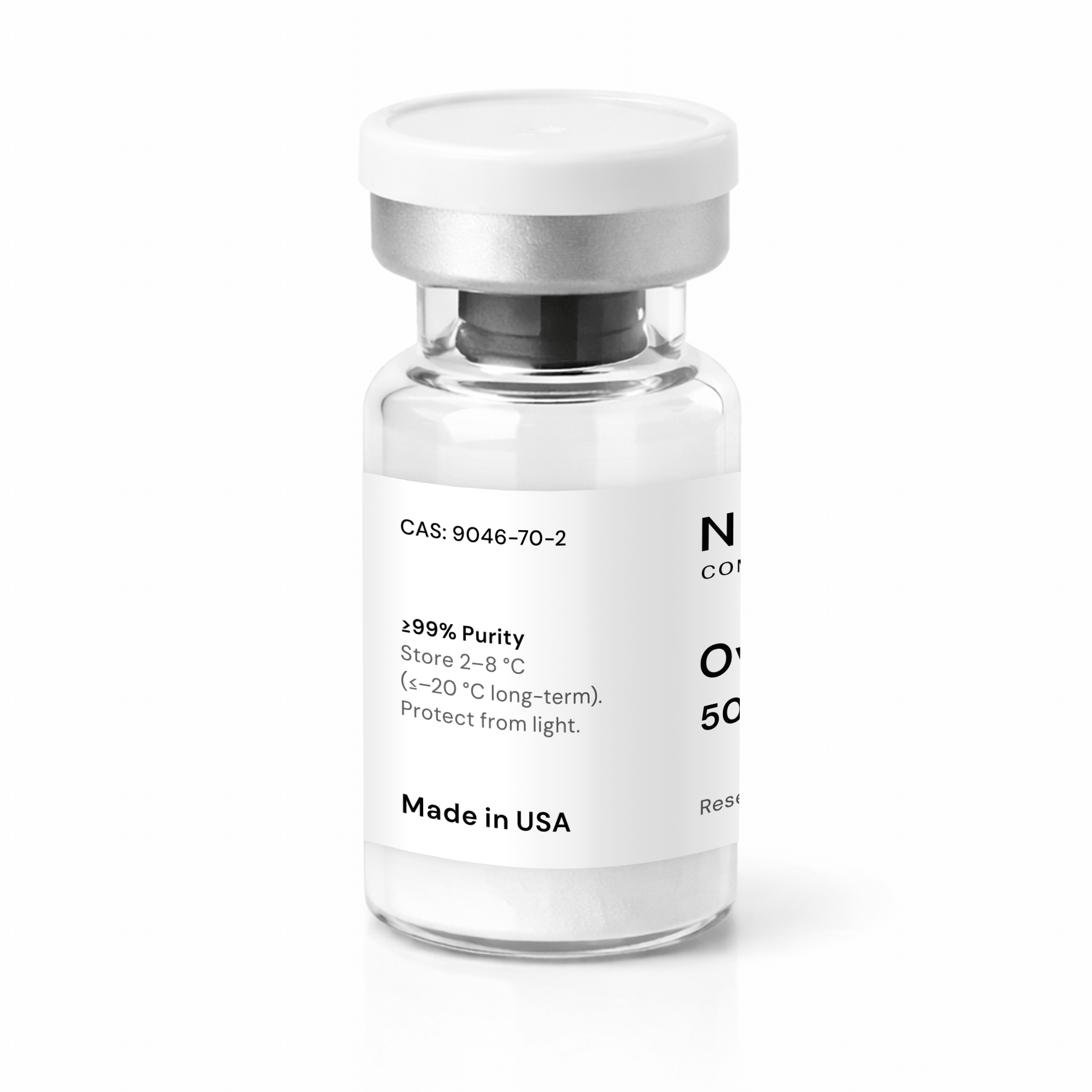


Ovagen (50mg) About This Product
Ovagen peptide is a synthetic tripeptide composed of glutamic acid, aspartic acid, and leucine (Glu–Asp–Leu; EDL) with a molecular weight of 375.37 g/mol and a molecular formula of C₁₅H₂₅N₃O₈. It belongs to the Khavinson family of peptide bioregulators developed at the St. Petersburg Institute of Bioregulation and Gerontology. Ovagen is classified as an ultrashort peptide, a group studied for efficient cellular uptake and nuclear access in experimental models.
Ovagen has been examined for tissue-specific regulatory activity, primarily in the liver, gastrointestinal tract, and kidneys. Research has explored how this tripeptide enters cells via peptide transport systems and interacts with nuclear structures involved in gene regulation.
In laboratory settings, Ovagen has been investigated for its role in epigenetic regulation, including modulation of DNA methylation patterns associated with cellular aging and tissue function. The product is supplied as a 50 mg lyophilized powder, intended for controlled laboratory reconstitution. Researchers who buy Ovagen peptide commonly use it in in vitro systems or preclinical animal models focused on aging biology and organ-specific function.
Ovagen (50mg) Key Features and Benefits
- High Purity (≥95–98%): Research-grade peptide suitable for analytical and preclinical investigations
- Lyophilized Powder Format: Freeze-dried to support long-term stability under recommended storage conditions
- Defined Molecular Composition: Precisely characterized amino acid sequence and molecular weight for reproducibility
- Tissue-Focused Research Use: Studied primarily in liver, gastrointestinal, and kidney research models
- Epigenetic Research Utility: Investigated for effects on DNA methylation and age-related gene expression patterns
- High Aqueous Solubility: Readily soluble in sterile water and common laboratory buffers
- Common Research Supply Size: Frequently selected by laboratories that order Ovagen peptide for extended study protocols
For laboratory research use only.
Ovagen (50mg) Mechanism & Research Applications
Ovagen has been studied as a peptide bioregulator with epigenetic activity in aging and damaged tissues. In experimental models, the tripeptide has been observed to enter cells via peptide transport systems and reach the nucleus, where it has been investigated for its potential to influence gene transcription. Rather than acting through systemic signaling, Ovagen has been studied for localized cellular effects.
Reported research applications include:
- DNA Methylation Modulation: Examined for normalization of age-associated DNA methylation patterns in hepatocytes and gastrointestinal mucosal cells
- Cell Proliferation Regulation: Studied for changes in expression of Ki-67 and reduced markers associated with cellular aging and apoptosis, including p53, p16, and p21
- Liver Research Models: Investigated in studies examining hepatocyte regeneration and detoxification-related gene expression
- Gastrointestinal Barrier Function: Explored for effects on intestinal mucosal integrity under experimental stress conditions
- Kidney Research Applications: Studied in models of age-related kidney decline, ischemia–reperfusion injury, and drug-induced nephrotoxicity
- Cellular Aging Studies: Used to examine mechanisms related to slowed cellular senescence in primary cultured cells
Ovagen (50mg) Dosing & Observed Effects in Research
Research use of Ovagen varies by model system and experimental objective. In in vitro cell culture studies, concentrations ranging from 0.05 ng/mL to 20 ng/mL have been applied in primary kidney and liver cell cultures. These studies assessed proliferation and apoptosis markers and longevity-associated proteins by immunocytochemistry.
Observed in vitro findings include increased Ki-67 expression and reduced expression of p53, p16, and p21. Enhanced Sirtuin-6 synthesis has also been reported, particularly in aged cell cultures, alongside a delayed onset of culture-associated cell death relative to untreated controls.
In in vivo rodent studies, intraperitoneal administration of 3 μg/kg has been reported in aged rats using 10-day protocols. Similar dosing has been examined in ischemia–reperfusion injury and drug-induced nephropathy models.
Reported preclinical observations include:
- Changes in urine output and sodium handling in aged animals
- Preservation of renal filtration markers
- Reduced oxidative stress and altered antioxidant enzyme activity
- Functional recovery in kidney injury models under controlled experimental conditions
No standardized human dosing has been established. All reported data derive exclusively from laboratory and animal research.
Ovagen (50mg) Storage, Safety & References
Store lyophilized Ovagen at –18°C to –20°C, protected from light and moisture. Short-term room temperature exposure during handling is acceptable, but long-term storage should remain frozen.
After reconstitution, store solutions at 4°C for short-term use or –20°C to –80°C for extended storage. Avoid repeated freeze–thaw cycles by preparing aliquots. Handle using standard laboratory safety and aseptic procedures.
References
https://pmc.ncbi.nlm.nih.gov/articles/PMC8619776
https://pmc.ncbi.nlm.nih.gov/articles/PMC9323678
https://pmc.ncbi.nlm.nih.gov/articles/PMC10046148
https://pmc.ncbi.nlm.nih.gov/articles/PMC6624906
https://pmc.ncbi.nlm.nih.gov/articles/PMC9032300
Compliance Notice
This product is intended for laboratory research use only and is not approved for human or veterinary use.