




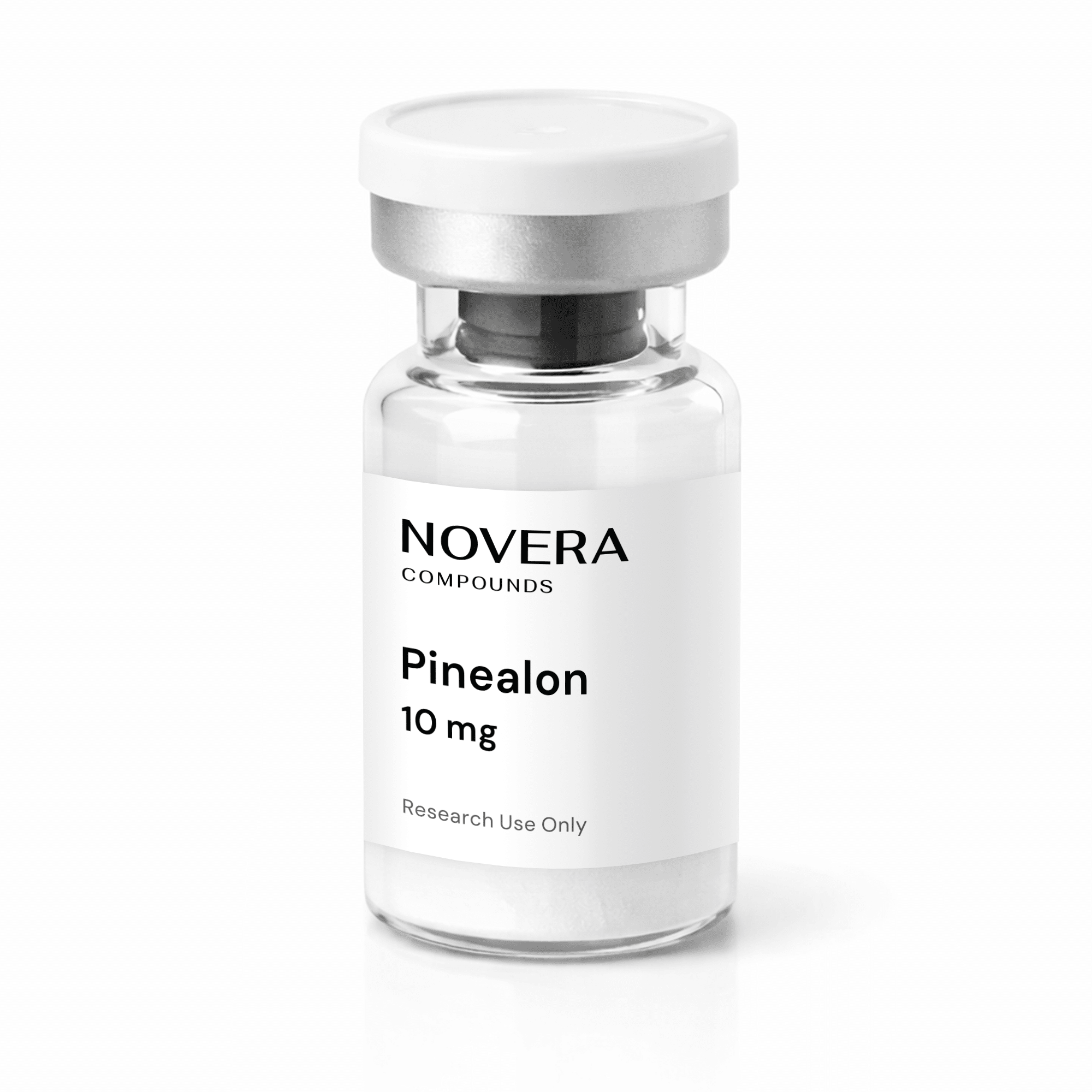
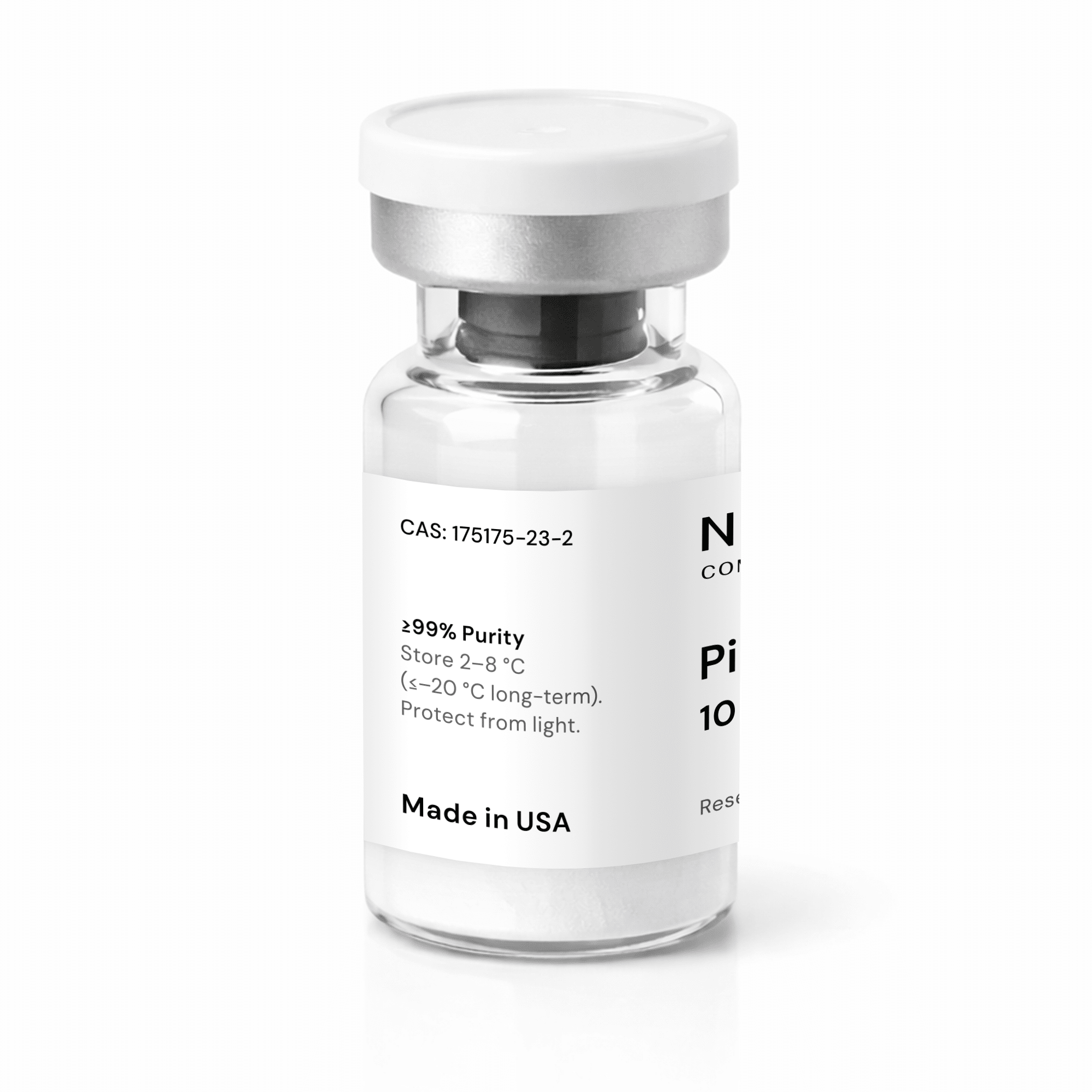
Pinealon (10mg) About This Product
Pinealon (10mg) is a synthetic tripeptide composed of glutamic acid, aspartic acid, and arginine (EDR). It has a low molecular weight of approximately 418 Daltons and molecular formula C₁₅H₂₆N₆O₈, supporting stability and predictable handling in laboratory environments. The Pinealon peptide originates from peptide research programs examining short regulatory sequences involved in cellular signaling. Preclinical studies demonstrate its influence on neuroprotective signaling pathways, regulation of energy metabolism, and maintenance of neural cell homeostasis under controlled experimental conditions.
This product is supplied as a high-purity, lyophilized powder in a sealed vial intended for laboratory use. Pinealon has been studied in cellular regulation and age-related research models, particularly in experimental settings that examine gene expression, cellular resilience, and peptide-mediated signaling behavior.
Pinealon (10mg) Key Features and Benefits
- High-purity peptide suitable for laboratory research
- Supplied as a 10 mg lyophilized powder for precise reconstitution
- Studied in research involving cellular regulation and gene expression
- Short tripeptide structure supports stability and reproducibility
- Suitable for in vitro and preclinical research environments
- Secure vial packaging to maintain peptide integrity
- Also known as Glutamylaspartylarginine or T-33 peptide
- Commonly selected by laboratories that buy Pinealon peptide
- For laboratory research use only
Pinealon (10mg) Mechanism & Research Applications
Pinealon is being investigated for its potential to penetrate cellular and nuclear membranes and directly interact with DNA, modulating transcriptional regulation. Unlike many peptide compounds that act through membrane-bound receptors, Pinealon does not rely on classical receptor-mediated signaling pathways.
Experimental research employs fluorescence-labeled peptide studies in cultured cells to demonstrate nuclear translocation, along with in-vitro DNA binding assays to examine sequence-specific interactions. These approaches support investigation of transcriptional regulation, chromatin dynamics, epigenetic modulation, and gene expression control in controlled laboratory settings.
Research applications often focus on evaluating peptide-mediated regulation of gene expression in neural, muscular, and epithelial cell models. Experimental systems examine transcriptional profiles and cellular responses to oxidative stress, hypoxia, and metabolic perturbations. Investigated signaling mechanisms include caspase-linked cascades involved in cell death regulation, redox-sensitive pathways governing oxidative balance, mitochondrial-associated signaling networks, and cell-cycle modulation under stress conditions.
Research also explores how Pinealon influences epigenetic processes and chromatin-associated gene-regulatory mechanisms, as well as modulates oxidative stress responses, free-radical regulation, and cellular viability under challenging conditions.
Pinealon (10mg) Dosing & Observed Effects in Research
Published studies on Pinealon describe experimental dosing ranges that vary by research model, exposure duration, and study objectives. Dosing protocols are designed to observe cellular or molecular responses rather than systemic outcomes.
Observed effects in research settings are reported as changes in gene expression, transcriptional activity, signaling pathway activation, cellular proliferation, and stress-response markers, measured under experimentally controlled conditions. These findings support ongoing investigation and comparative studies by laboratories that order Pinealon peptide for controlled experimental analysis.
Pinealon (10mg) Storage, Safety & References
Pinealon (10mg) should be stored in its lyophilized form at 2–8°C and protected from light and moisture to maintain stability. Reconstituted solutions should be prepared using sterile laboratory techniques and handled according to institutional protocols, with care taken to avoid repeated freeze–thaw cycles.
This product is intended for use by trained professionals in controlled laboratory environments and should be handled in accordance with standard laboratory safety procedures.
References
https://pubmed.ncbi.nlm.nih.gov/22117547
https://pubmed.ncbi.nlm.nih.gov/21978084
https://pubmed.ncbi.nlm.nih.gov/22567179
https://pubmed.ncbi.nlm.nih.gov/24909721
https://pubmed.ncbi.nlm.nih.gov/25051764
Compliance Notice
This product is intended for laboratory research use only and is not approved for human or veterinary use.