




What Are The Purported Benefits Of PNC-28 (20mg)?
PNC-28 (20 mg) is a synthetic research peptide studied for its selective activity in cancer-cell models. It is widely discussed in preclinical oncology research due to its potential to interact with tumor-cell membrane targets and trigger rapid cell death pathways in certain experimental settings.
Key areas of interest in the literature include:
- Differential Activity in Tumor vs. Non-Transformed Cell Models: PNC-28 has been studied for its ability to affect cancer cells, while showing limited activity against non-transformed cells under certain laboratory conditions.
- Necrosis-Related Mechanism: Unlike many compounds studied for apoptosis-related pathways, PNC-28 has been investigated for its ability to induce rapid membrane disruption and necrotic cell death in tumor models.
- Broad Preclinical Interest: Research has explored PNC-28 across multiple human tumor cell lines, including pancreatic, breast, and sarcoma cell lines.
- HDM-2 Membrane Expression and p53-Independence: PNC-28 has been studied in cancer cell systems, including those with compromised or absent p53 function. Research suggests its activity is mediated through membrane-expressed HDM-2 rather than through canonical p53-dependent pathways, making it of interest in models where p53-dependent responses are impaired.
These findings are based on preclinical and experimental research and should not be interpreted as evidence of established clinical efficacy.
What Is The Chemical Makeup Of PNC-28 (20mg)?
PNC-28 is a 27-amino-acid chimeric peptide, meaning it combines two functional peptide segments into one molecule. It is derived from a p53-related sequence linked to a cell-penetrating penetratin sequence, which is used in research to support cellular entry.
Structural Components
- p53-derived domain: Includes a fragment corresponding to the MDM-2/HDM-2 binding region of the p53 protein
- Penetratin domain: A membrane-translocating sequence derived from the Antennapedia homeodomain
Technical Data
- Sequence: Glu-Thr-Phe-Ser-Asp-Leu-Trp-Lys-Leu-Leu-Lys-Lys-Trp-Lys-Met-Arg-Arg-Asn-Gln-Phe-Trp-Val-Lys-Val-Gln-Arg-Gly
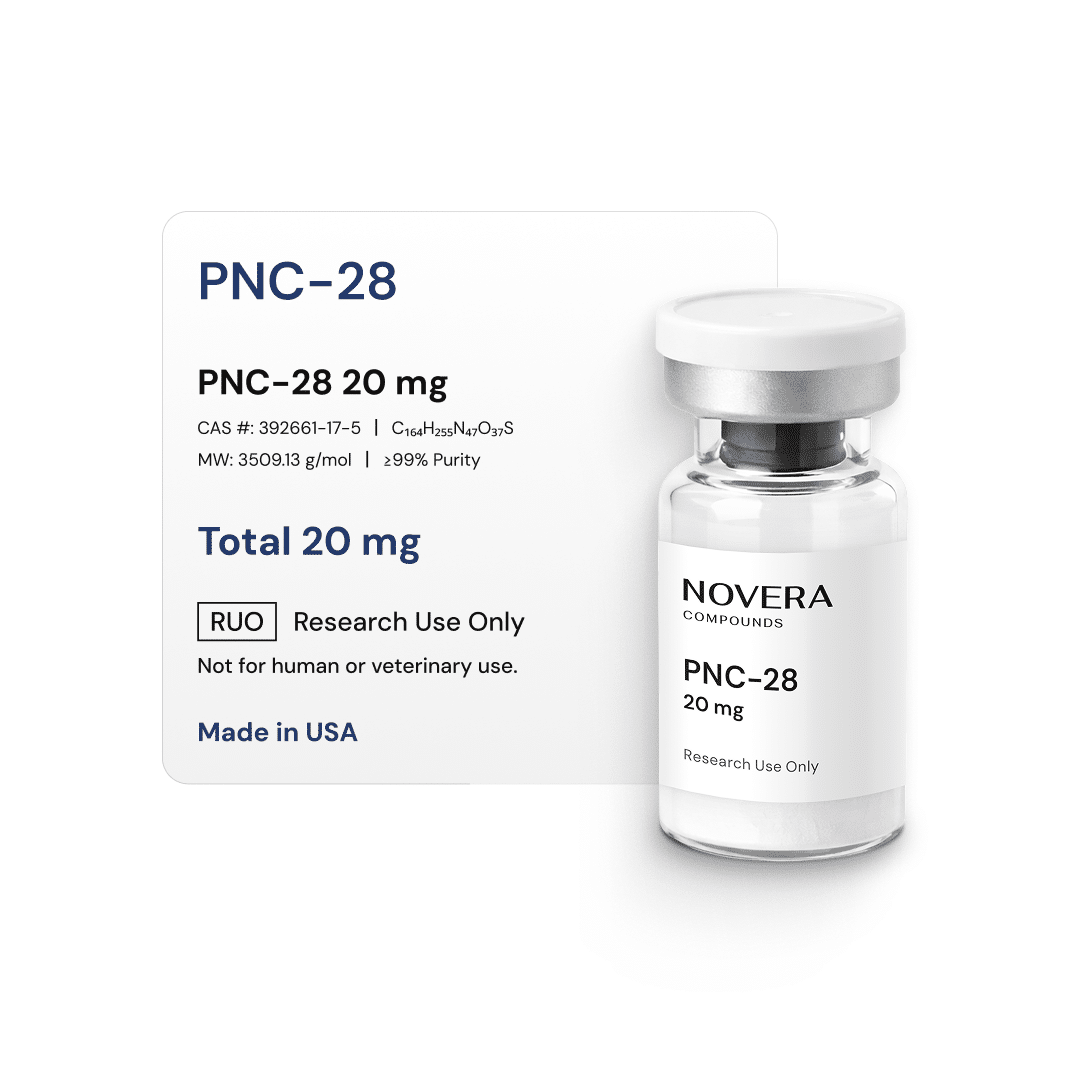
- CAS Number: 392661-17-5
- Subcategory: Research & Oncology Peptides
- Molecular Formula: C₁₆₄H₂₅₅N₄₇O₃₇S
- Molecular Weight: 3509.13 g/mol
This structural design is one reason PNC-28 is frequently studied in peptide oncology research, especially in experiments focused on peptide-cell membrane interactions.
What Does Scientific Research Say About PNC-28 (20mg)?
Published preclinical research describes PNC-28 as a peptide of interest because of its proposed membrane-targeting mechanism in certain tumor cells. Studies have explored how PNC-28 may bind to HDM-2/MDM-2-associated targets on cancer-cell membranes, thereby contributing to rapid membrane disruption.
Key Research Themes
- Pore Formation / Membrane Disruption: Electron microscopy-based studies have reported ring-like assemblies consistent with membrane pore formation in tumor cell models following peptide exposure.
- Rapid Cytotoxic Response in Models: Experimental findings suggest cell death can occur over short timeframes (minutes to hours) in susceptible cancer-cell systems.
- Animal Model Observations: Some preclinical studies (including xenograft models) have reported tumor-response findings following local or systemic administration in research settings.
- Research Status: PNC-28 remains an experimental peptide investigated in laboratory and preclinical oncology studies, and it should be presented as a research compound rather than a therapeutic product.
What Are The Storage Conditions For PNC-28 (20mg)?
Proper storage is important for maintaining the stability and integrity of PNC-28 (20 mg), particularly because the peptide contains tryptophan (W), which can increase sensitivity to oxidation and light exposure.
Recommended Storage Guidelines
- Lyophilized Powder (Unreconstituted)
- Refrigerated (4°C): Recommended for long-term stability.
- Frozen (-20°C to -80°C): Best for long-term preservation.
- Reconstituted Solution (Liquid)
- Refrigerated (2°C to 8°C): For short-term use, minimize degradation over time.
- Frozen (-20°C): Can be stored for short periods; avoid repeated freeze-thaw cycles.
For best handling, store PNC-28 (20 mg) in a light- and heat-protected environment, and use low-temperature storage whenever possible for long-term preservation. Always follow supplier-specific storage instructions if provided, as formulation and packaging may affect stability.
Are you looking to buy PNC-28 (20mg) online?
If you’re looking to order PNC-28 (20mg) online at wholesale prices, contact Medical Spa RX for guidance on how to do so.
This product is supplied strictly for laboratory research use only and is not approved for human or veterinary administration. It is not intended for diagnostic, therapeutic, or clinical applications. Any reference to biological activity or potential effects is based solely on preclinical or in-vitro findings and should not be interpreted as validated clinical outcomes. Researchers are responsible for ensuring proper handling, storage, and disposal in accordance with institutional, federal, and international guidelines. By purchasing or using this material, the buyer confirms that they are a qualified researcher and that the product will be used exclusively in controlled research settings compliant with all applicable regulations.
Sources
- Bowne WB, Sookraj KA, Vishnevetsky M, et al. The penetratin sequence in the anticancer PNC-28 peptide causes tumor cell necrosis rather than apoptosis of human pancreatic cancer cells. Ann Surg Oncol. 2008;15(12):3588-3600. doi:10.1245/s10434-008-0147-0
- Michl J, Scharf B, Schmidt A, et al. PNC-28, a p53-derived peptide that is cytotoxic to cancer cells, blocks pancreatic cancer cell growth in vivo. Int J Cancer. 2006;119(7):1577-1585. doi:10.1002/ijc.22029
- Sarafraz-Yazdi E, Mumin S, Cheung D, et al. PNC-27, a Chimeric p53-Penetratin Peptide Binds to HDM-2 in a p53 Peptide-like Structure, Induces Selective Membrane-Pore Formation and Leads to Cancer Cell Lysis. Biomedicines. 2022;10(5):945. Published 2022 Apr 20. doi:10.3390/biomedicines10050945
- National Center for Biotechnology Information. PubChem Compound Summary for CID 16158363, Pnc-28. https://pubchem.ncbi.nlm.nih.gov/compound/Pnc-28