




What Are the Purported Benefits of Retatrutide (60 mg)?
There are currently no documented or clinically supported benefits associated with a 60 mg dose of Retatrutide. All published and ongoing clinical trials have tested doses up to 12 mg only. In pharmacological research, higher dosing does not necessarily improve outcomes, particularly with high-potency peptide therapies.
At therapeutic levels, Retatrutide achieves near-maximal activation of its target receptors. A hypothetical 60 mg dose could overstimulate these pathways rather than enhance therapeutic effects. Researchers have cautioned that such exposure may sharply increase the risk of severe gastrointestinal side effects, dehydration, and cardiovascular strain linked to glucagon receptor activation.
What Is the Chemical Makeup of Retatrutide (60 mg)?
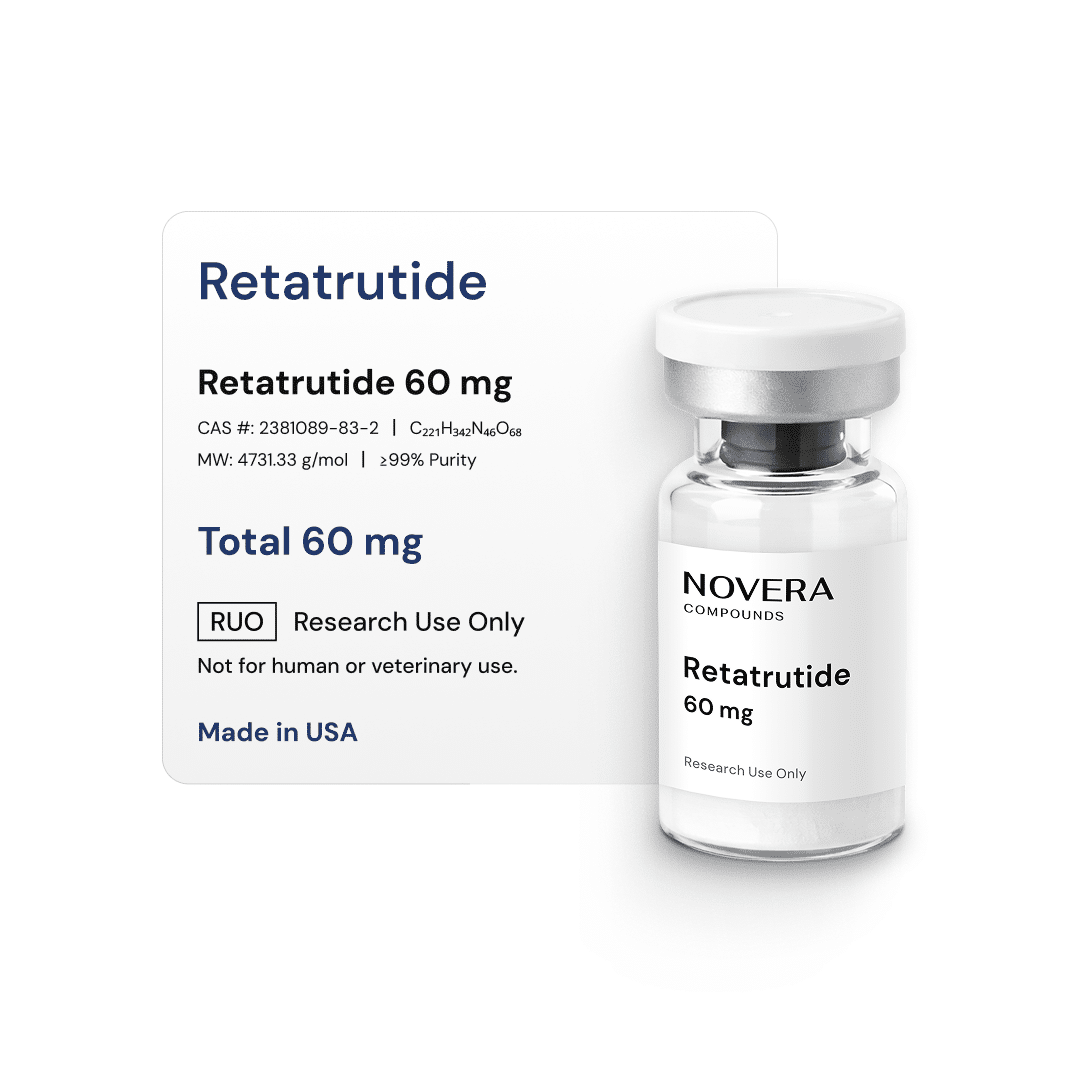
The chemical composition of Retatrutide peptide remains constant across concentrations. It is a synthetic triple-agonist peptide engineered for metabolic receptor activation.
Key characteristics include:
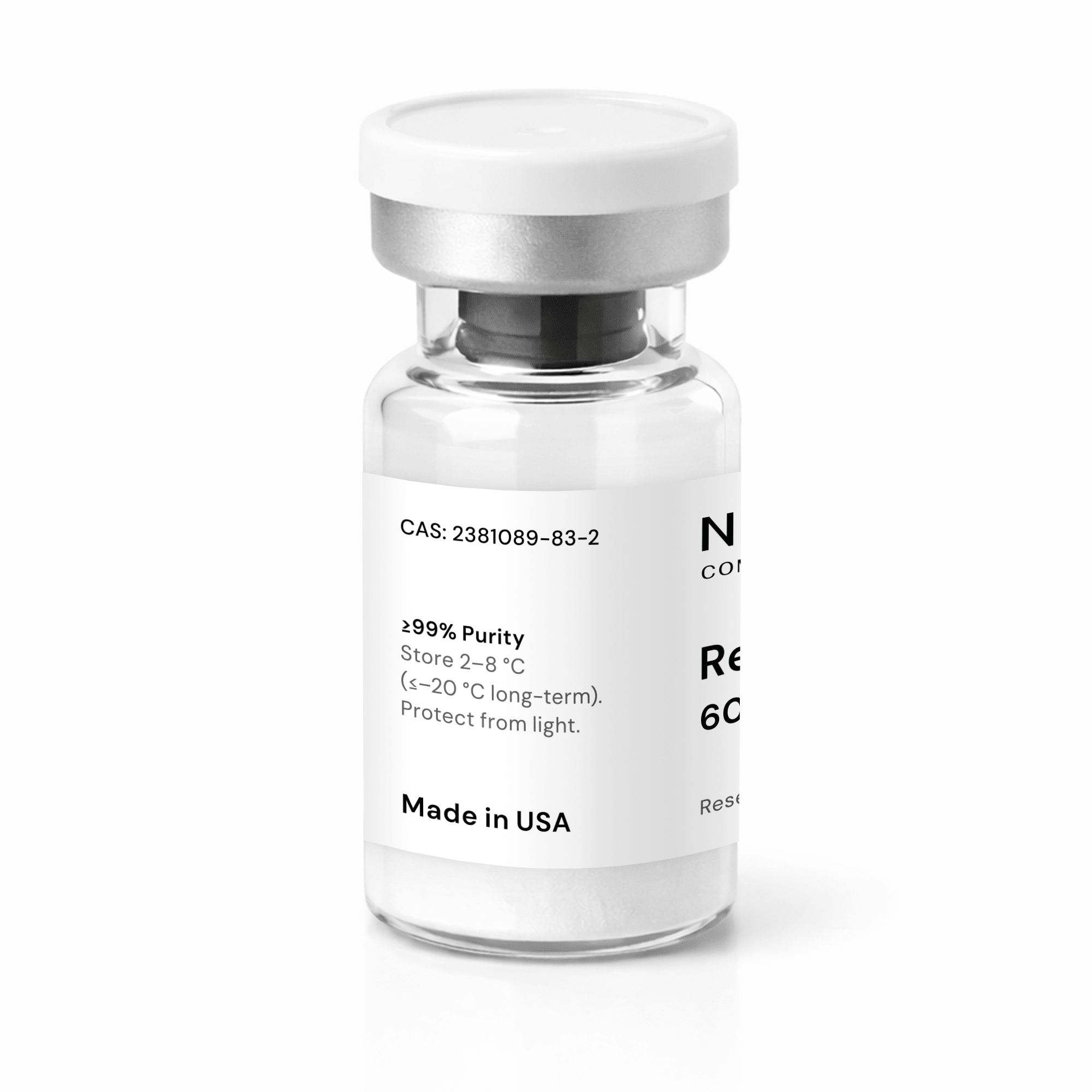
- CAS: 2381089-83-2
- Peptide Sequence: Tyr-{Aib}-Gln-Gly-Thr-Phe-Thr-Ser-Asp-Tyr-Ser-Ile-{α-Me-Leu}-Leu-Asp-Lys-{diacid-C20-gamma-Glu-(AEEA)-Lys}-Ala-Gln-{Aib}-Ala-Phe-Ile-Glu-Tyr-Leu-Leu-Glu-Gly-Gly-Pro-Ser-Ser-Gly-Ala-Pro-Pro-Pro-Ser-NH2 (Sodium salt)
- Peptide Structure: 39–amino acid synthetic chain
- Molecular Formula: C₂₂₁H₃₄₂N₄₆O₆₈
- Molecular Weight: 4845.444 g/mol
- Receptor Targets: GLP-1, GIP, and glucagon receptors
- Potency Profile: High, relative to other incretin-based agents
What Does Scientific Research Say About Retatrutide (60 mg)?
No current scientific literature supports the investigation or use of Retatrutide at 60 mg.
- Phase 2 Trial Data: The highest tested dose was 12 mg, which resulted in average weight loss exceeding 24%. Side effects increased with dose escalation, indicating a clear dose-dependent risk profile.
- Phase 3 TRIUMPH Trials: Ongoing trials continue to use 12 mg as the upper limit, reinforcing this as the maximum research-backed dose.
- Safety Position: Neither Eli Lilly nor independent investigators have endorsed higher doses. 60 mg formulations fall outside the scope of established clinical research and may present serious safety concerns.
What Are the Storage Conditions for Retatrutide (60 mg)?
Retatrutide is supplied as a lyophilized powder, which offers greater stability than aqueous solutions when stored correctly.
Unreconstituted (Lyophilized) Retatrutide
- Store in sealed, light-protected vials
- −20°C recommended for long-term storage
- 2–8°C acceptable for shorter-term use
- Short room-temperature exposure is suitable for brief handling or transport when light and humidity are controlled
Reconstituted Solutions
- Store at 2–8°C
- Use within about 30–45 days, according to internal protocols
- Avoid freezing, as ice crystals can damage the peptide structure
Both forms should be protected from light, moisture, and temperature fluctuations. Keeping vials in their original packaging and limiting repeated warming and cooling help preserve potency and support reliable results in metabolic research.
Are you looking to buy Retatrutide (60 mg) online?
If you’re looking to order Retatrutide (60 mg) online at wholesale prices, contact Medical Spa RX for guidance on how to do so.
This product is supplied strictly for laboratory research use only and is not approved for human or veterinary administration. It is not intended for diagnostic, therapeutic, or clinical applications. Any reference to biological activity or potential effects is based solely on preclinical or in-vitro findings and should not be interpreted as validated clinical outcomes. Researchers are responsible for ensuring proper handling, storage, and disposal in accordance with institutional, federal, and international guidelines. By purchasing or using this material, the buyer confirms that they are a qualified researcher and that the product will be used exclusively in controlled research settings compliant with all applicable regulations.
Sources
https://pubmed.ncbi.nlm.nih.gov/37366315
https://www.nature.com/articles/s41591-024-03018-2
https://pubmed.ncbi.nlm.nih.gov/37385280
https://pmc.ncbi.nlm.nih.gov/articles/PMC12304053