






What Are the Purported Benefits of Selank (5 mg)?
Selank (also known as Selanc) is a synthetic regulatory peptide known for its anxiolytic and nootropic properties. Selank has been researched for its ability to support emotional balance and cognitive function without causing sedation or dependency, which are common concerns with conventional anti-anxiety agents. Research on this peptide has focused on the following areas:
- Anxiety modulation, linked to its interaction with the GABAergic system, which may help promote calmness and stress adaptability
- Cognitive support, with studies suggesting benefits for attention, memory, and learning while preserving mental clarity
- Mood balance, potentially influenced by serotonin and dopamine signaling pathways
- Neuroprotective activity, including research showing increased expression of brain-derived neurotrophic factor (BDNF)
- Immune system interaction, related to its structural similarity to tuftsin, a naturally occurring immunomodulatory peptide
Because of these studied mechanisms, Selank continues to attract interest among those who buy Selank peptide for research applications in stress regulation, cognition, and neurobiological processes.
What is the Chemical Makeup of Selank (5 mg)?
Selank is a synthetic heptapeptide derived from tuftsin, a natural peptide fragment from human immunoglobulin G (IgG). It is engineered for greater metabolic stability and biological activity.
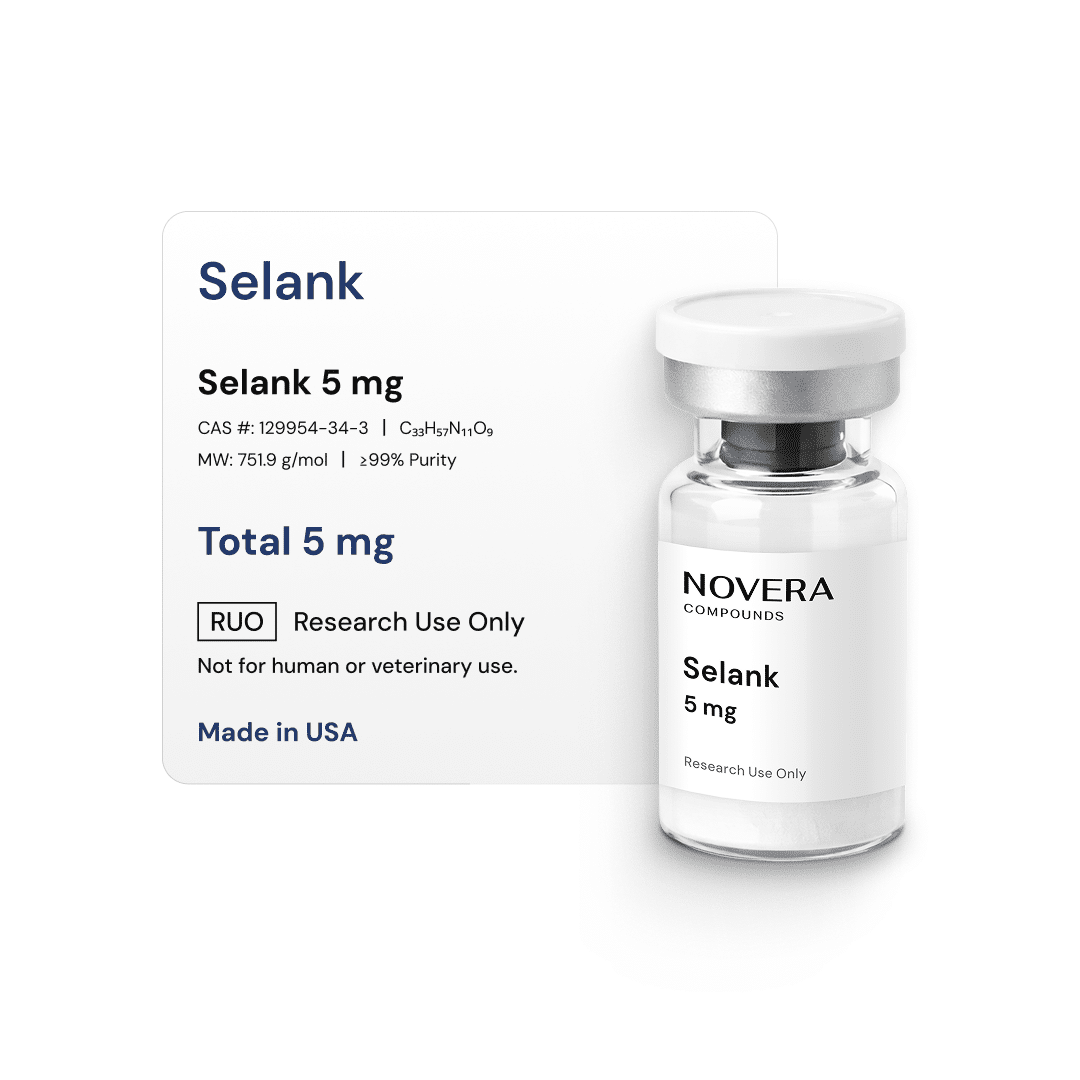
- CAS Number: 129954-34-3
- Amino Acid Sequence: Thr-Lys-Pro-Arg-Pro-Gly-Pro
- Peptide Classification: Heptapeptide (7 amino acids)
- Molecular Formula: C₃₃H₅₇N₁₁O₉
- Molecular Weight: 751.9 g/mol
This optimized structure enables Selank peptide to remain bioactive longer than natural tuftsin, improving its suitability for controlled research applications.
What Does Scientific Research Say About Selank (5 mg)?
Most published research on Selank comes from Russian clinical studies, where the compound has been extensively evaluated for its mechanism of action and safety profile.
Key findings include:
- GABA Modulation: Selank acts as a positive allosteric modulator of GABAₐ receptors, enhancing natural inhibitory signals without causing sedation or dependency
- Neurotransmitter Effects: Selank modulates monoamines like serotonin and dopamine, supporting mood stabilization, motivation, and attention
- Neuroimmune Link: As a tuftsin analog, Selank may reduce pro-inflammatory cytokines, offering insights into its role in neuroimmune regulation
These characteristics continue to attract researchers seeking to order Selank peptide for studies on anxiety, cognition, and immunomodulation.
What Are the Storage Conditions for Selank (5 mg)?
For routine handling, keep Selank (Selanc) at 2–8 °C and return vials promptly to refrigerated storage after each use to minimize cumulative room-temperature exposure. For long-term storage, keep at <=–20 °C and avoid unnecessary temperature cycling (repeated warming/cooling) to help preserve peptide integrity. Protect from light throughout storage and handling (for example, keep vials in original packaging or a light-blocking container) to reduce light-driven degradation risk.
Are you looking to buy Selank (5mg) online?
If you’re looking to order Selank (5mg) online at wholesale prices, contact Medical Spa RX for guidance on how to do so.
This product is supplied strictly for laboratory research use only and is not approved for human or veterinary administration. It is not intended for diagnostic, therapeutic, or clinical applications. Any reference to biological activity or potential effects is based solely on preclinical or in-vitro findings and should not be interpreted as validated clinical outcomes. Researchers are responsible for ensuring proper handling, storage, and disposal in accordance with institutional, federal, and international guidelines. By purchasing or using this material, the buyer confirms that they are a qualified researcher and that the product will be used exclusively in controlled research settings compliant with all applicable regulations.
Sources
https://pubmed.ncbi.nlm.nih.gov/18454096
https://pubmed.ncbi.nlm.nih.gov/11550013
https://pubmed.ncbi.nlm.nih.gov/26924987