




SS-31 About This Product
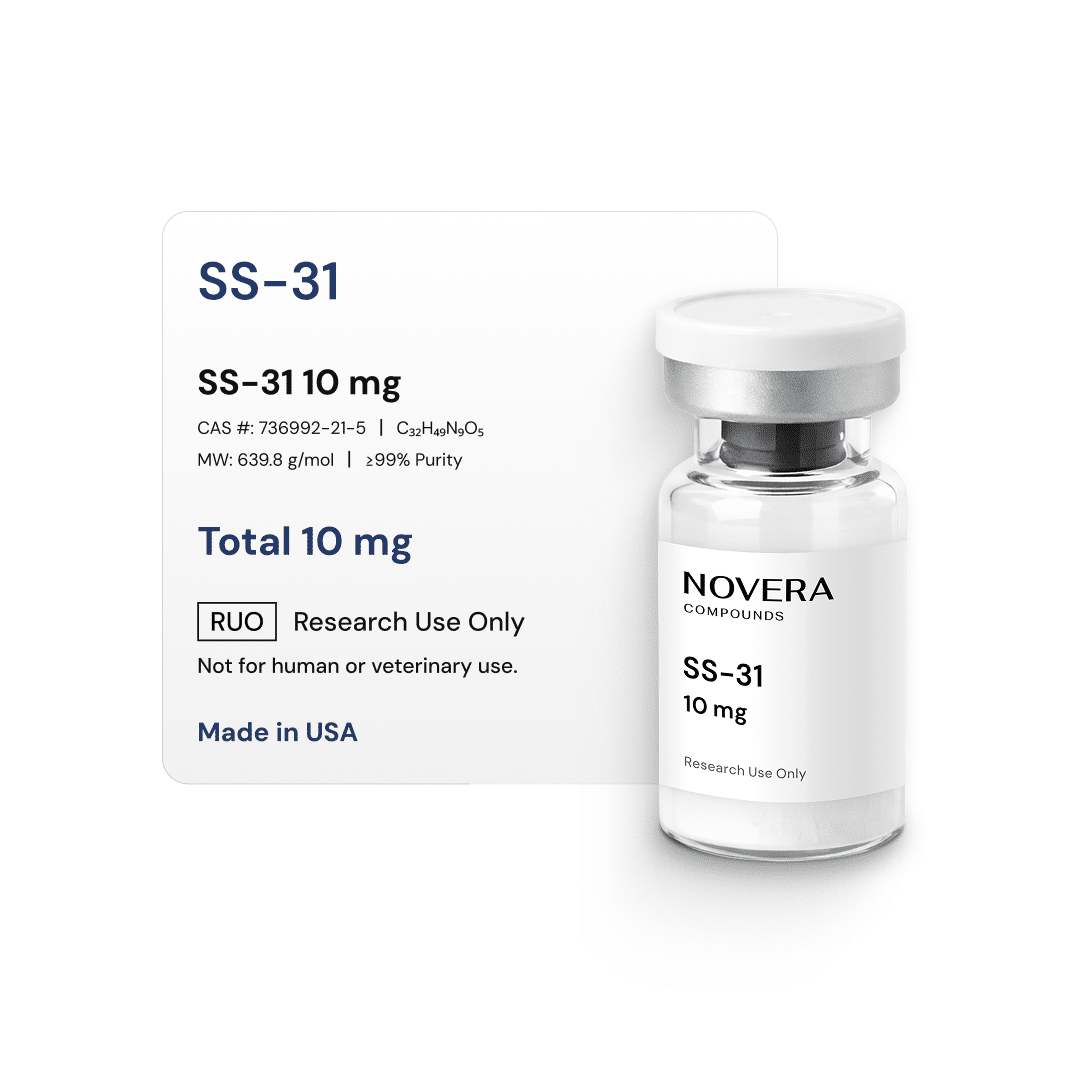
SS-31 is a tetrapeptide designed for laboratory research exploring how molecules interact with the cell’s energy-producing structures, the mitochondria. Its sequence is D-Arg-2,6-dimethylTyr-Lys-Phe-NH₂, where the 2,6-dimethyltyrosine (Dmt) residue plays a key role in free-radical scavenging activity. The peptide has a molecular weight of ~639.8 g/mol and is produced in high-purity, research-grade form.
This SS-31 peptide is supplied as a lyophilized powder in sealed vials for stability and easy storage. Researchers use SS-31 to investigate oxidative stress, mitochondrial behavior, cellular aging, and energy-related functions under controlled laboratory conditions. Studies examining SS-31 for research often focus on how the peptide interacts with mitochondrial membranes and responds to cellular stress environments.
SS-31 Key Features and Benefits
- High-purity SS-31 suitable for metabolic and mitochondrial research
- Lyophilized format for long-term stability and flexible reconstitution
- Has been studied for its effects on oxidative stress, mitochondrial structure, and cellular energy balance
- Suitable for in vitro, ex vivo, and nonclinical model systems
- Packaged in sterile vials to reduce contamination risk
- Consistent quality across batches, supporting reproducible experiments
- Stable under recommended cold-storage conditions
Researchers looking to buy SS-31 often use it in controlled studies examining energy production and mitochondrial function.
SS-31 Mechanism & Research Applications
The SS-31 mitochondria peptide has been studied across a wide range of mitochondrial and cell-stress responses. Research indicates that SS-31 functions through several coordinated mechanisms:
- Free Radical Scavenging: Its 2,6-dimethyltyrosine (Dmt) residue directly neutralizes reactive oxygen species (ROS) by forming stable tyrosine radicals that then couple into di-tyrosine structures.
- Cardiolipin Binding: SS-31 selectively binds to cardiolipin, a phospholipid found on the inner mitochondrial membrane, helping stabilize mitochondrial structure and support electron transport chain organization.
- Support of ATP Production: Studies show it may help maintain mitochondrial efficiency by reducing electron leakage and supporting steady ATP synthesis.
- Mitochondrial Dynamics: It has been researched for its ability to reduce excessive mitochondrial fragmentation, promote fusion, and support pathways linked to mitochondrial biogenesis.
Because of these properties, SS-31 is used to study oxidative balance, cellular metabolism, mitochondrial integrity, and aging-related processes.
SS-31 Dosing & Observed Effects in Research
In published research, dosing varies based on the experimental design:
- In vitro: Low micromolar concentrations are commonly used to study oxidative stress, mitochondrial binding, or peptide-membrane interactions.
- Animal models: Dosing is typically adjusted based on body weight and exposure duration to observe systemic mitochondrial effects, cellular energy markers, or oxidative responses.
Reported research findings include changes in mitochondrial membrane behavior, oxidative markers, and cellular energy measurements. These observations apply only to controlled laboratory settings and are not associated with therapeutic outcomes.
SS-31 Storage, Safety & References
- Store lyophilized SS-31 at –20°C or below, protected from light and moisture.
- Reconstituted solutions should be kept refrigerated and used within protocol-defined time frames.
- Avoid repeated freeze–thaw cycles to maintain stability.
- Handle using standard PPE (gloves, lab coat, eye protection) and follow institutional guidelines for safe disposal.
Sources
https://pmc.ncbi.nlm.nih.gov/articles/PMC9192202
https://www.nature.com/articles/s41598-018-34251-8
https://pmc.ncbi.nlm.nih.gov/articles/PMC11989705
https://academic.oup.com/hmg/article/26/8/1483/2982370
https://www.biorxiv.org/content/10.1101/2024.07.11.603085v1.full.pdf