




What Are the Purported Benefits of Tirzepatide (120 mg)?
Tirzepatide is a synthetic 39–amino acid peptide conjugated with a C20 fatty diacid moiety, engineered as a dual glucose-dependent insulinotropic polypeptide (GIP) and glucagon-like peptide-1 (GLP-1) receptor co-agonist. It is designed to activate both GIP and GLP-1 receptors with specific binding affinities: GIP receptor affinity comparable to native GIP, and GLP-1 receptor affinity approximately 5-fold weaker than native GLP-1, resulting in an imbalanced agonist profile that favors GIP receptor activation.
In preclinical models, the tirzepatide peptide is investigated to understand how dual incretin receptor agonism influences glucose homeostasis, insulin secretion, glucagon modulation, gastric motility, and satiety signaling in controlled experimental systems.
As a dual incretin receptor agonist, tirzepatide serves as a research tool for multi-target receptor signaling in metabolic regulation. Research applications include evaluating how complementary GIP and GLP-1 receptor activation modulates glucose-dependent insulin secretion, glucagon suppression, and energy balance in integrated biological systems. All findings remain investigational and are presented strictly in a research context, without implying therapeutic or clinical efficacy.
What is the Chemical Makeup of Tirzepatide (120 mg)?
Tirzepatide’s sequence includes two aminoisobutyric acid (Aib) residues at positions 2 and 13 (non-natural amino acids that enhance proteolytic resistance), an N-terminal tyrosine (Tyr1), and a C-terminal amidation for stability.
The peptide is conjugated with a monosubstituted C20 fatty acid (icosanedioic acid) via a glutamic acid spacer with two 2-(2-aminoethoxy)ethoxyacetic acid (AEEA) linker units attached at lysine 20 (Lys20), which extends plasma half-life to ~5 days (116.7 hours) through increased albumin binding.
- Peptide length: 39 amino acids
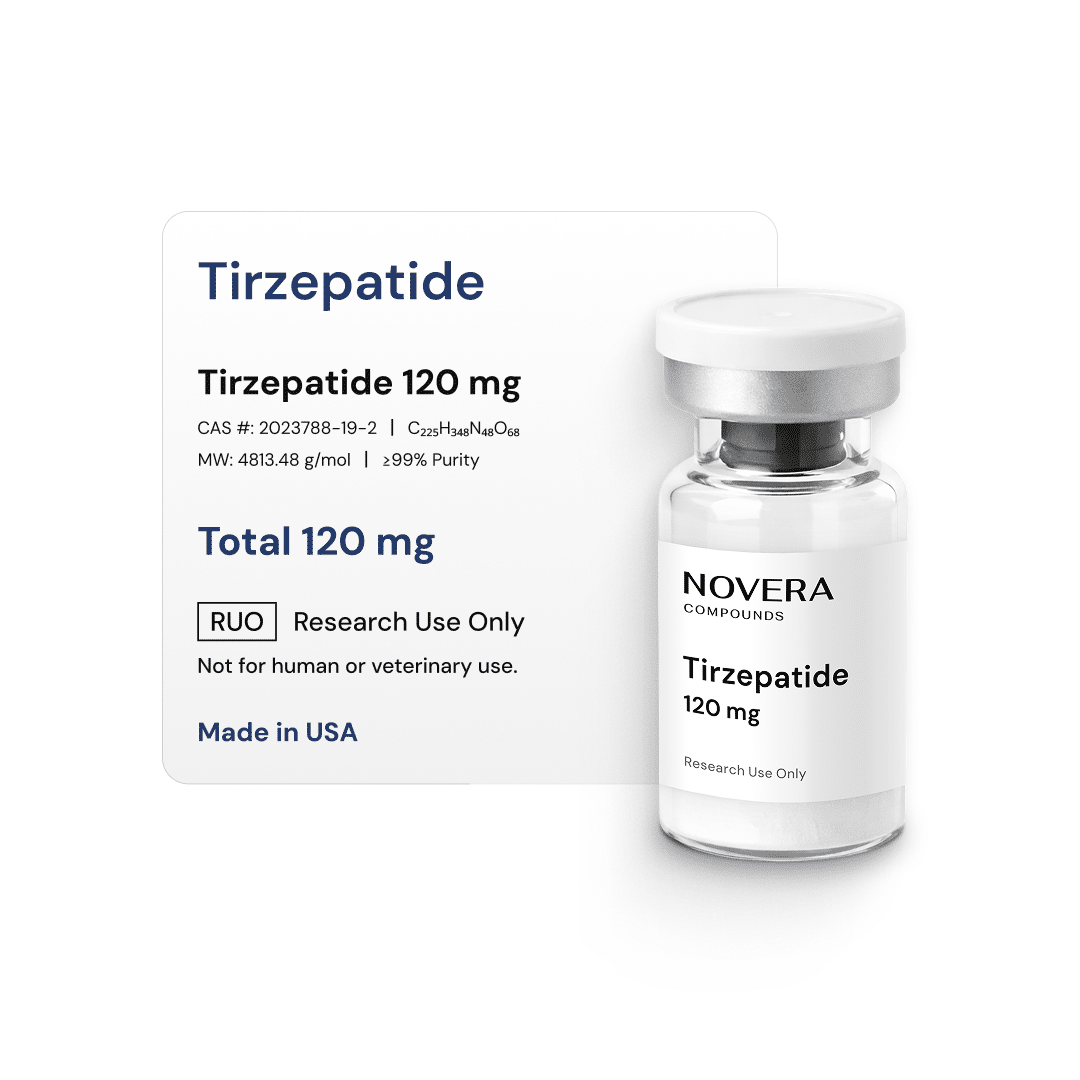
- Molecular weight: 4813.48 g/mol
- Chemical formula: C₂₂₅H₃₄₈N₄₈O₆₈
- CAS: 2023788-19-2
- Synonyms: P1206, LY3298176, tirzepatida, tirzepatidum, OYN3CCI6QE
- Peptide sequence: Tyr-Aib-Glu-Gly-Thr-Phe-Thr-Ser-Asp-Tyr-Ser-Ile-Aib-Leu-Asp-Lys-Ile-Ala-Gln-Lys(C20)-Ala-Phe-Val-Gln-Trp-Leu-Ile-Ala-Gly-Gly-Pro-Ser-Ser-Gly-Ala-Pro-Pro-Pro-Ser-NH2
Tirzepatide is supplied as a high-purity (>99%) GMP-grade API in lyophilized powder form for stability during storage and transport. Product identity, purity, and potency are confirmed using HPLC, mass spectrometry (MS), and amino acid analysis. Researchers who buy tirzepatide peptide can use this standardized format to support precise measurement and reproducibility in cell-based receptor signaling assays, glucose homeostasis models, insulin secretion studies, and other preclinical investigations.
What Does Scientific Research Say About Tirzepatide (120 mg)?
Scientific investigations of Tirzepatide focus on its mechanism as a dual incretin receptor agonist and on structure–activity relationships governing GIP and GLP-1 receptor binding selectivity and potency. In preclinical systems, Tirzepatide is used to evaluate how simultaneous GIP and GLP-1 receptor activation influences glucose-dependent insulin secretion, glucagon modulation, gastric emptying, satiety signaling, and energy expenditure.
Research Applications
- GIP/GLP-1 receptor binding and selectivity: Characterization of dual agonist binding affinities, receptor occupancy, and structure–activity relationships for GIP versus GLP-1 receptors.
- Cell-based receptor signaling assays: Measurement of cAMP accumulation, PKA activation, and downstream transcriptional responses in GIPR- or GLP-1R–expressing cells.
- Glucose homeostasis and insulin secretion models: Evaluation of glucose-dependent insulin secretion, glucagon modulation, and glucose tolerance in pancreatic islet systems and intact animal models.
- Metabolic remodeling and energy expenditure: Investigation of effects on body weight, adipose tissue distribution, energy expenditure, and tissue-level glucose utilization.
- Comparative efficacy studies: Head-to-head preclinical comparisons with single GLP-1 receptor agonists (e.g., semaglutide) to explore potential advantages of dual receptor activation.
What Are the Storage Conditions for Tirzepatide (120 mg)?
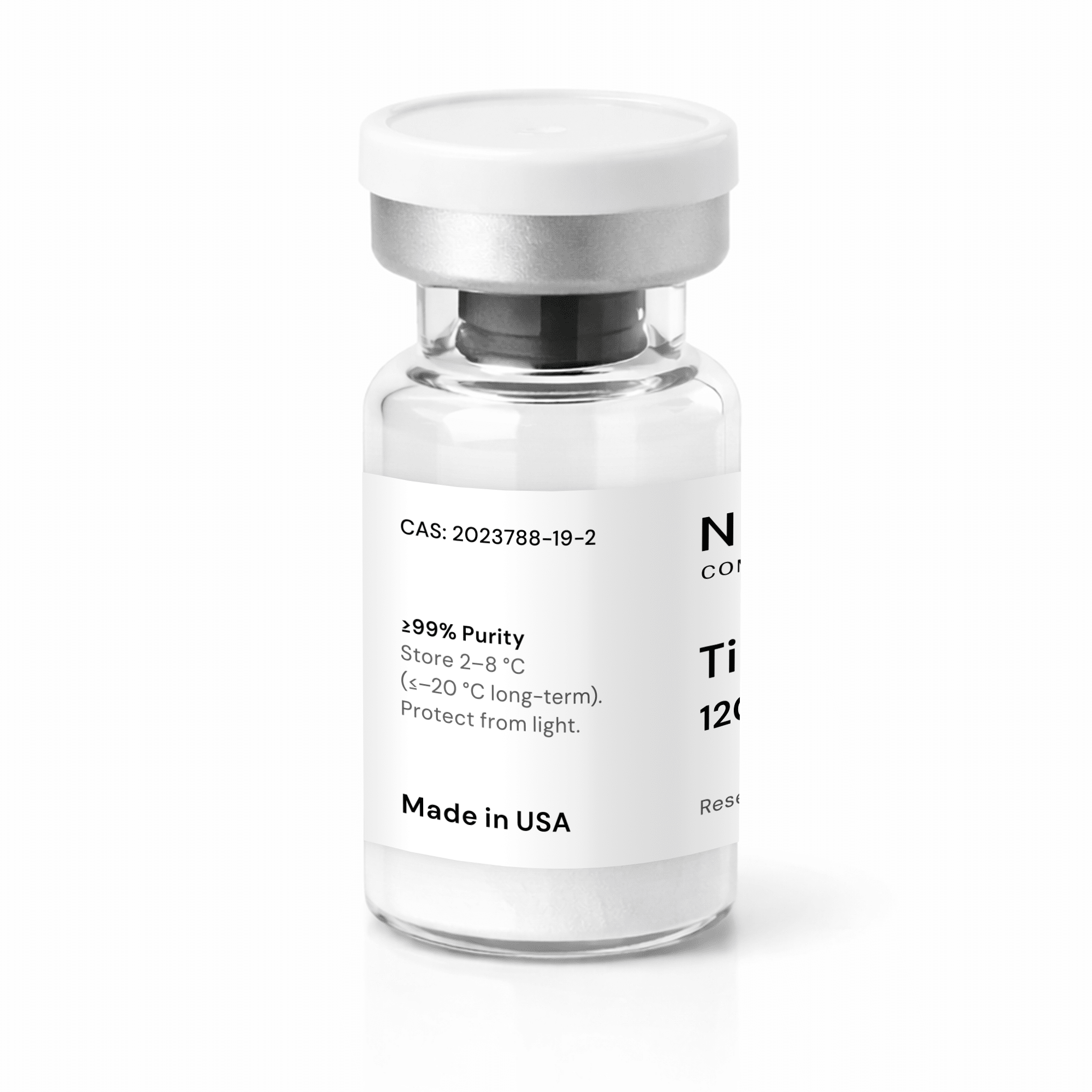
After reconstitution in an appropriate diluent (e.g., sterile water, PBS, Tris buffer, or assay-specific buffer), solutions are typically stored at 2–8 °C and used within 24–48 hours in accordance with laboratory best practices. Avoid repeated freeze–thaw cycles; for longer workflows, aliquot reconstituted solutions and store at <=-20 °C while documenting freeze–thaw events to monitor potential loss of activity.
Are you looking to buy Tirzepatide (120 mg) online?
If you’re looking to order Tirzepatide (120 mg) online at wholesale prices, contact Medical Spa RX for guidance on how to do so.
This product is supplied strictly for laboratory research use only and is not approved for human or veterinary administration. It is not intended for diagnostic, therapeutic, or clinical applications. Any reference to biological activity or potential effects is based solely on preclinical or in vitro findings and should not be interpreted as validated clinical outcomes. Researchers are responsible for ensuring proper handling, storage, and disposal in accordance with institutional, federal, and international guidelines. By purchasing or using this material, the buyer confirms that they are a qualified researcher and that the product will be used exclusively in controlled research settings compliant with all applicable regulations.
Sources
https://www.pnas.org/doi/10.1073/pnas.2116506119
https://pmc.ncbi.nlm.nih.gov/articles/PMC9438179
https://pmc.ncbi.nlm.nih.gov/articles/PMC9149770/https://pmc.ncbi.nlm.nih.gov/articles/PMC9396640/