




Tirzepatide 5mg – About This Product
Tirzepatide peptide is a synthetic 39-amino acid linear peptidecreated through chemical synthesis and conjugated to a C20 fatty diacid moiety (eicosanedioic acid). The C20 chainis attached via a hydrophilic linker system (γ-glutamic acid and bis-aminodiethoxyacetyl linker) connected to lysine at position 20. The peptide sequence incorporates aminoisobutyric acid (Aib) residues at positions 2 and 13, which contribute to albumin binding affinity and extended circulating half-life.
Notably, Tirzepatide functions as a dual GIP and GLP-1 receptor agonist, with greater affinity and potency at the glucose-dependent insulinotropic polypeptide receptor (GIPR) compared to the glucagon-like peptide-1 receptor (GLP-1R).
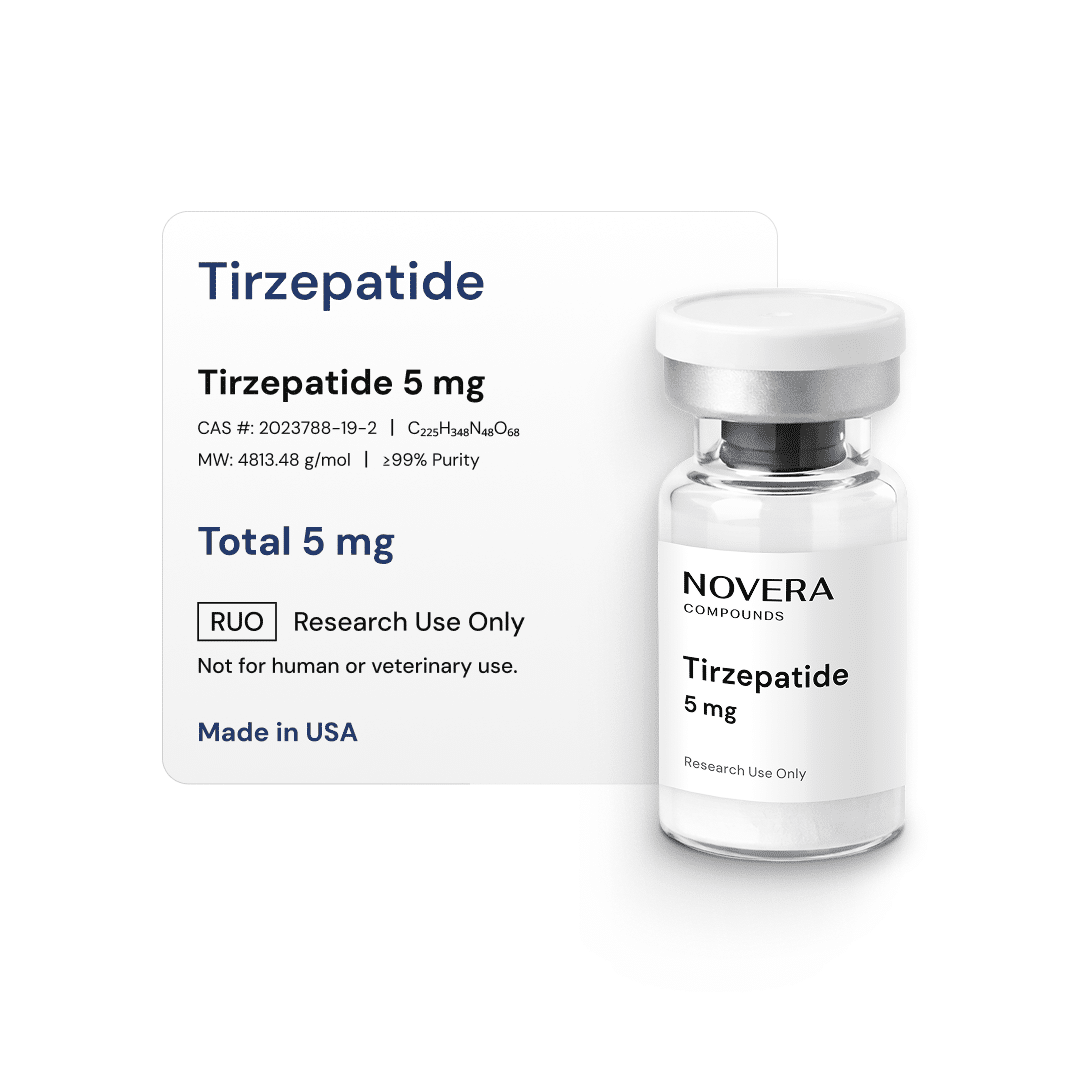
With a molecular weight of 4810.52 g/moland the molecular formula C225H348N48O68, tirzepatide is provided as a lyophilized (freeze-dried) white to off-white powder with ≥98% purity (verified by HPLC). This research-grade formulation is used in controlled studies investigating metabolic regulation, glucose homeostasis, hormonal signaling pathways, and dual incretin receptor physiology.
Tirzepatide 5mg – Key Features and Benefits
Tirzepatide dual agonistrepresents a valuable research tool for investigations into incretin receptor biology and metabolic regulation.
- High Purity: ≥98% purity verified by HPLC/MS, ensuring reliable and reproducible results across research applications.
- Dual Agonist Profile: Functions as a full agonist at the GIP receptor with pharmacology comparable to native GIP, while demonstrating biased agonism at the GLP-1 receptor (preferential cAMP signaling over β-arrestin recruitment), which reduces receptor desensitization and internalization.
- Extended Half-Life: The C20 fatty diacid chain and Aib residues support prolonged albumin binding and circulating time, enabling extended observation periods in dose-escalation research protocols.
- Lyophilized Stability: Supplied as a freeze-dried powder in sealed vials for convenient storage at recommended temperatures with a long shelf life under proper conditions.
- Dose-Escalation Flexibility: The 5mg vial format supports stepwise dose-escalation protocols commonly used in metabolic research, with higher-dose formulations also available.
- Research Applications: Used to investigate glucose metabolism, insulin secretion, appetite regulation, lipid metabolism, gastric motility, and neuroendocrine signaling pathways.
- For Laboratory Research Use Only: Those who wish to buy tirzepatide must know it is designed for controlled laboratory environments and compliant research practices with no therapeutic applications.
Tirzepatide 5mg – Mechanism & Research Applications
Tirzepatide for research has been investigated for its dual receptor agonism, which distinguishes it from single-receptor GLP-1 agonists. The peptide’s mechanism involves:
- Pancreatic Beta-Cell Modulation: Activation of both GIPR and GLP-1R enhances glucose-dependent insulin secretion from pancreatic β-cells through distinct but complementary signaling pathways. Research demonstrates that simultaneous GIP and GLP-1 activation produces a greater insulin response than either pathway alone.
- Appetite and Satiety Regulation: Dual receptor activation engages hypothalamic appetite-regulating centers through integrated GIPR and GLP-1R signaling, potentially producing enhanced anorexigenic effects compared to single-receptor agonism.
- Lipid and Metabolic Homeostasis: Studies examine dose-dependent effects on plasma triglycerides, adipose tissue function, hepatic glucose production, and systemic metabolic flexibility, with evidence suggesting GIP contributes notably to lipid regulation and white adipose tissue effects.
- Gastrointestinal Function: Research explores modulation of gastric emptying and nutrient absorption patterns through dual incretin signaling.
- Imbalanced Potency as a Pharmacological Strategy: The differential potency at GIPR (high) versus GLP-1R (moderate, with biased signaling) represents a targeted pharmacological design intended to maximize GIP effects while maintaining tolerable GLP-1 responses in preclinical and clinical research contexts.
Tirzepatide 5mg – Dosing & Observed Effects in Research
Similar to Tirzepatide 10 mg peptide, 5mg has been studied across a range of doses using established dose-escalation protocols. Human studies have employed stepwise weekly dose escalation starting at 2.5 mg (initiation dose)and escalating by 2.5 mg increments every 4 weeks, progressing through 5 mg, 7.5 mg, 10 mg, 12.5 mg, and up to 15 mg weekly (maximum dose in clinical trials).
The 5 mg dose represents an intermediate research dose within this escalation scheme. Meanwhile, in clinical research, Tirzepatide 5 mg serves as a middle-range doseto examine dose-response relationships and biological effects in human subjects with metabolic conditions.
Furthermore, across research settings, tirzepatide has been associated with dose-dependent modifications in glucose handling, enhanced insulin secretion, suppressed glucagon release, reduced fasting triglyceride concentrations, improvements in insulin sensitivity markers (HOMA2-IR), andalterations in body composition.
In preclinical studies, dual GIP/GLP-1 receptor activation has been observed to produce metabolic effects that exceed those of single-receptor agonism. These observations remain within controlled research environments and represent experimental findings, not therapeutic claims or clinical outcomes.
Tirzepatide 5mg – Storage, Safety & References
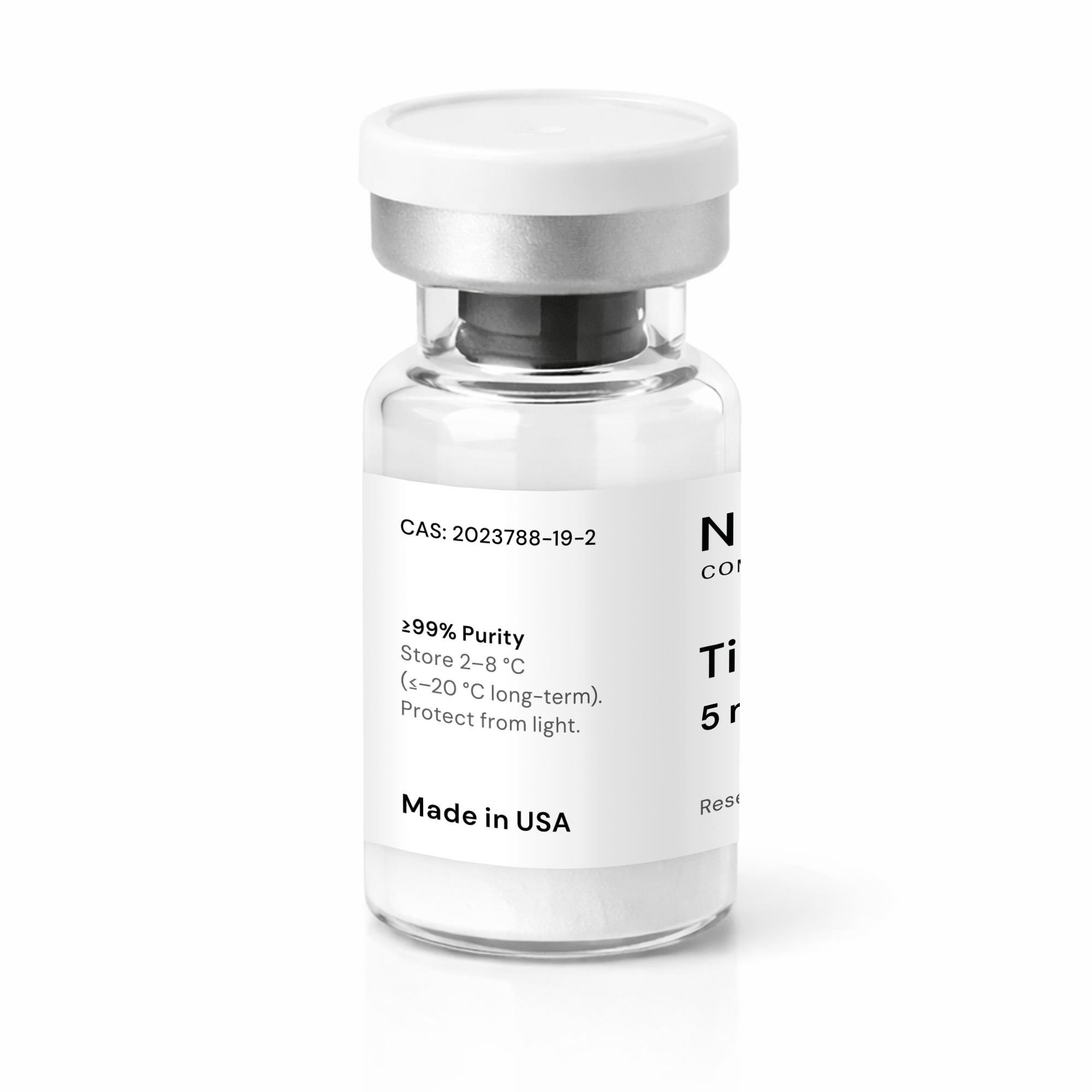
Store lyophilized powder (unreconstituted )in sealed vials at2–8°C (36–46°F), protected from light and moisture, until the printed expiration date. This is the primary and recommended storage condition. Moreover, Tirzepatide may be kept atroom temperature (up to 30°C/86°F) for brief periodsnot exceeding 21 days if necessary, after which it should be returned to refrigeration.
Notably, freezing of lyophilized tirzepatide is not recommended, as it can compromise peptide integrity and reduce purity. If tirzepatide has been frozen, it should not be used. Additionally, after reconstitution, store the solutions at 2–8°Cand use themwithin 28–30 daysto maintain peptide stability. Avoid repeated freeze-thaw cycles of reconstituted solutions.
Researchers must always use standard laboratory PPE, including gloves, eye protection, and lab coa,t when handling peptides. Dispose of unused materials according to institutional biosafety guidelines and applicable regulations. Always consult the Safety Data Sheet (SDS) provided with the product for comprehensive safety information and handling procedures.
References
https://pubmed.ncbi.nlm.nih.gov/36050763
https://go.drugbank.com/drugs/DB15171
https://insight.jci.org/articles/view/140532
https://d-nb.info/1273168186/34
https://www.accessdata.fda.gov/drugsatfda_docs/nda/2024/217806Orig1s000PharmR.pdf
https://pdb101.rcsb.org/global-health/diabetes-mellitus/drugs/incretins/drug/tirzepatide/tirzepatide
https://www.tandfonline.com/doi/full/10.1080/14656566.2024.2436595
https://www.ncbi.nlm.nih.gov/books/NBK585056
https://www.pnas.org/doi/10.1073/pnas.2116506119
https://www.sciencedirect.com/science/article/pii/S1751991825000816
Compliance Notice
This product is intended for laboratory research use only and is not approved for human or veterinary use.