




Vilon (50mg) About This Product
The Vilon peptide is a synthetic dipeptide composed of L-lysine and L-glutamic acid (L-Lys–L-Glu). It is studied in laboratory research as part of the Khavinson bioregulator peptide group, with investigations focused on gene expression modulation, chromatin organization, and cellular regulation.
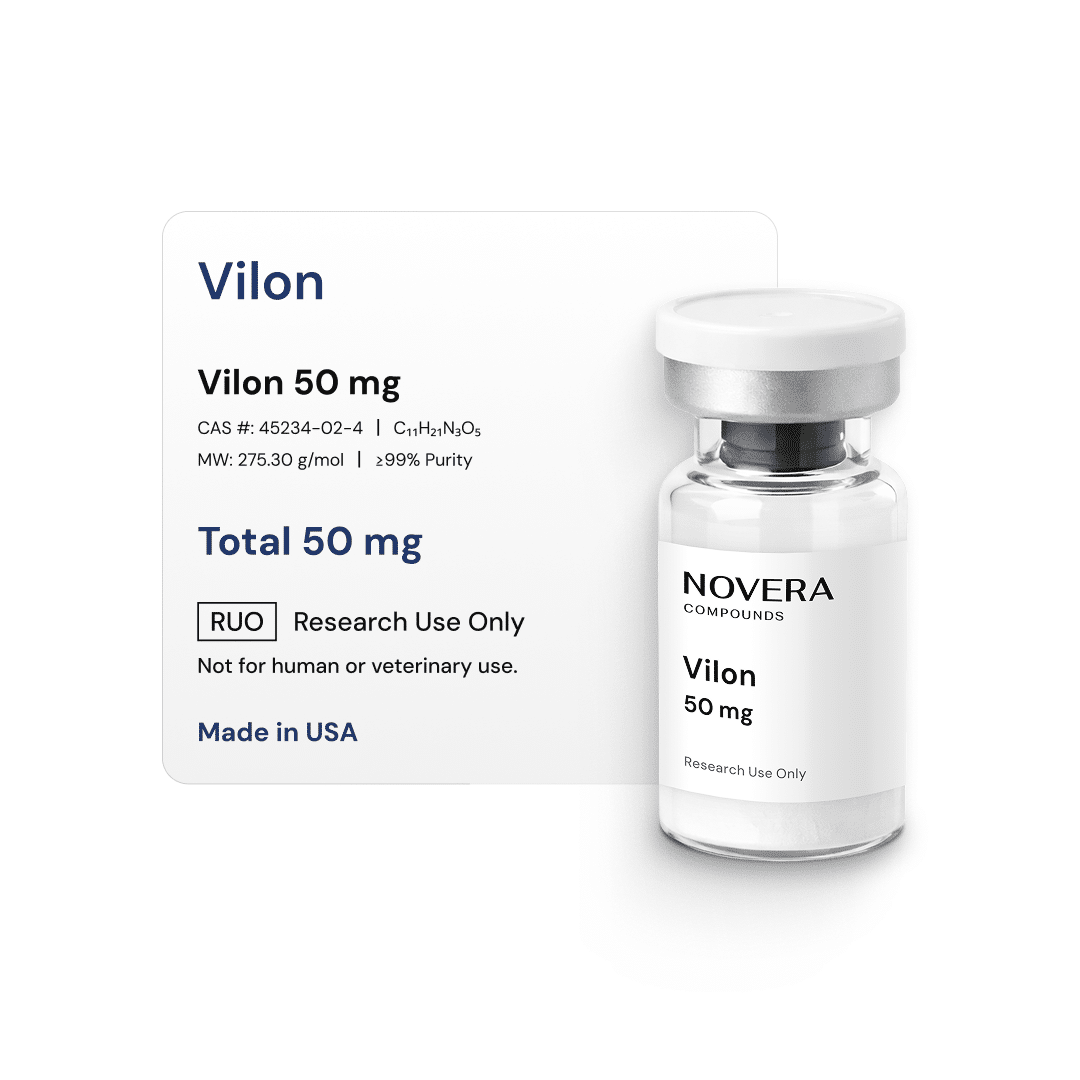
With a molecular weight of 257.30 g/mol and molecular formula C₁₁H₂₁N₃O₅, Vilon represents one of the shortest bioactive peptides examined in preclinical research systems. It is supplied as a 50 mg lyophilized powder, manufactured to ≥99% purity, with identity and purity verified by HPLC and mass spectrometry.
In controlled laboratory models, Vilon has been examined for its associations with epigenetic regulation, transcriptional control, immune-cell signaling, and age-associated cellular changes. Research has primarily involved in vitro cell systems and established animal models, without clinical or therapeutic intent.
Vilon (50mg) Key Features and Benefits
- Synthetic dipeptide research formulation composed of L-Lys–L-Glu
- Ultra-high purity (≥99%), verified by HPLC and mass spectrometry
- Minimal molecular structure, supporting studies of direct cellular interaction and intracellular penetration
- Well-defined chemical profile, including:
- Molecular weight: 257.30 g/mol
- Molecular formula: C₁₁H₂₁N₃O₅
- PubChem CID: 7010502
- Alternative names: Lysylglutamate, normophthal, lysylglutamic acid
- Research applications in epigenetics, chromatin biology, immune signaling, microvascular biology, and preclinical aging models
- Lyophilized format optimized for stability, storage, and precise experimental handling
This is available exclusively to qualified investigators who order Vilon peptide for approved laboratory research
Vilon (50mg) Mechanism & Research Applications
Vilon is investigated as a research tool for epigenetic and transcriptional regulation. In experimental systems, the peptide has been linked to changes in chromatin organization, particularly shifts between heterochromatin and euchromatin, which affect transcriptional accessibility.
Chromatin organization serves as a central determinant of transcription-factor and RNA-polymerase access to DNA. Condensed chromatin (heterochromatin) generally restricts transcriptional initiation, whereas less condensed chromatin (euchromatin) is more permissive for transcription. In immune-cell systems, shifts in chromatin accessibility can alter cytokine-gene expression programs, differentiation-associated transcriptional signatures, and activation-state transitions.
Immunology-Linked Signaling Nodes
In immune-cell preparations examined in vitro and ex vivo, Vilon has been studied for its association with changes in interleukin-2 (IL-2) gene expression in splenocyte models and for effects on thymus-derived cell populations in culture. These observations position Vilon as a tool compound for probing transcriptional control nodes that integrate chromatin state with cytokine-signaling gene expression.
Components of the IL-2 signaling pathway are commonly used as readouts of activation-state transcriptional programming, given IL-2’s central role in lymphocyte signaling circuitry and downstream gene-regulatory cascades.
Primary Research Applications
- Chromatin biology & epigenetics: Evaluation of chromatin accessibility and transcriptional reactivation
- Immunology & cytokine regulation: Analysis of immune-cell activation markers and IL-2 gene expression
- Gene-expression profiling: Transcriptomic assessment of peptide-associated transcriptional shifts in rodent models
- Age-associated cellular research: Investigation of gene-expression variability and cellular homeostasis in aging models
- Tumor biology & oncology research (preclinical): Investigation of peptide-associated modulation of tumor growth kinetics, immune surveillance, and tumor-adjacent transcriptional programs in established animal models
- Microvascular biology & extracellular-matrix signaling — assessment of signaling mediators implicated in microvessel permeability, tissue remodeling, and stress responses in cardiovascular and renal models
Oncology-Related Mechanistic Readouts (Preclinical)
In rodent tumor models, Vilon has been examined for associations with altered tumor growth dynamics and survival-related endpoints under controlled experimental conditions. Mechanistic interpretation commonly emphasizes changes in immune-surveillance signaling, transcriptional reprogramming in tumor-adjacent tissues, and broader gene-expression networks that influence the proliferation–apoptosis balance in vivo.
Age-Associated Phenotypes in Rodent Models
Separate preclinical studies evaluate Vilon in rodent models that measure age-associated changes in functional readouts and lifespan metrics. Interpretation in these systems emphasizes transcriptional regulation, chromatin accessibility, and systems-level gene-expression drift associated with advancing age, rather than clinical translation.
Vilon (50mg) Dosing & Observed Effects in Research
In cell culture systems, Vilon is commonly studied at concentrations ranging from 0.01–100 ng/mL, with exposure durations defined by the experimental design.
In rodent research protocols, reported use includes:
- Subcutaneous administration of 5–10 mg for 5–10 consecutive days, with repeat cycles spaced 3–6 months apart
- Alternative protocols using 0.1 μg subcutaneously for 5 consecutive days per month in aging-model studies
Reported preclinical observations include:
- Chromatin remodeling, including heterochromatin-to-euchromatin transitions
- Gene-expression modulation involving immune-related pathways (notably IL-2)
- Lymphocyte proliferation and differentiation markers
- Immune-cell activation changes, including intracellular signaling shifts
- Increased sister chromatid exchange frequency in aging lymphocyte cultures
These findings are based solely on laboratory and animal studies. No FDA-approved indications exist. Interpretation should remain constrained to the specific experimental systems, endpoints, and model organisms described in the literature. Effects of Vilon are highly context-dependent and may vary across experimental models, tissue types, and research applications.
Vilon (50mg) Storage, Safety & References
Store Vilon (50mg) as a lyophilized powder at 2–8°C, protected from light and moisture, with vials kept tightly sealed. Reconstitution should be performed under aseptic laboratory conditions using sterile solvents appropriate to the protocol. Reconstituted solutions should be stored at 2–8°C and used within protocol-defined timeframes. Avoid repeated freeze–thaw cycles.
Standard laboratory safety practices apply, including gloves, lab coats, and eye protection, and waste is disposed of in accordance with institutional and regulatory guidelines.
Vilon is supplied exclusively for controlled preclinical research by qualified investigators. Laboratories that buy Vilon peptide are responsible for ensuring compliance with all applicable regulations and institutional policies.
References
https://pubmed.ncbi.nlm.nih.gov/15105581
https://pubmed.ncbi.nlm.nih.gov/16705247
https://pubmed.ncbi.nlm.nih.gov/12447482
https://pubmed.ncbi.nlm.nih.gov/23486604
https://pubmed.ncbi.nlm.nih.gov/10944717
Compliance Notice
This product is intended for laboratory research use only and is not approved for human or veterinary use.