



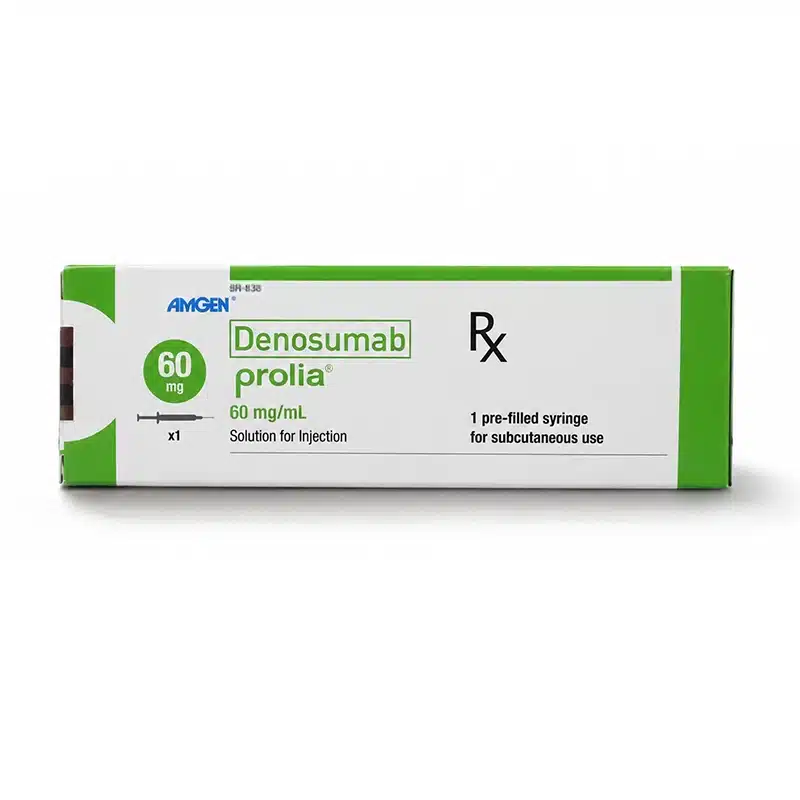
Prolia® (denosumab) is a fully human IgG2 monoclonal antibody developed by Amgen, indicated for postmenopausal women with osteoporosis at high risk for fracture, glucocorticoid-induced osteoporosis, and increasing bone mass in patients at high risk for fracture receiving hormone ablation therapy for prostate or breast cancer. Supplied as a 60mg/mL single-dose prefilled syringe, this Prolia® injection is administered subcutaneously every six months by a healthcare professional. Licensed professionals looking to buy Prolia® may contact Medical Spa Rx customer service for ordering guidance.
Product Specifications
| Specification | Details |
| Product Name | Prolia® 60mg |
| Active Ingredient | denosumab |
| Strength | 60mg/mL |
| Dosage Form | Single-dose prefilled syringe; subcutaneous injection |
| Molecular Type | Fully human IgG2 monoclonal antibody |
| Manufacturer | Amgen Inc. |
| FDA Approval Date | June 2010 |
| Regulatory Status | Prescription-only biologic medicine |
| Storage Requirements | Refrigerate at 2°C to 8°C in the original carton; protect from light; do not freeze (see storage section for room-temperature excursion guidance) |
| Intended Use | Osteoporosis and bone-loss management |
Prolia® Side Effects & Safety Considerations
Prolia® is associated with both common and serious adverse reactions that require clinical monitoring throughout treatment and after discontinuation.
Common Side Effects of Prolia®
The common Prolia® side effects reported in pivotal clinical trials are generally manageable but should be reviewed with patients before initiating therapy. The frequency and severity of adverse reactions may vary depending on age, comorbidities, concurrent therapies, and baseline fracture risk.
Common side effects of Prolia® include:
- Back pain
- Pain in extremity
- Musculoskeletal pain
- Hypercholesterolemia
- Cystitis
Serious Risks & Monitoring
Hypocalcemia is one of the most clinically significant risks associated with denosumab therapy. The current Prolia® prescribing information includes a boxed warning specifically for patients with advanced chronic kidney disease. Before initiating Prolia® in this population, clinicians should evaluate for CKD-mineral and bone disorder using intact parathyroid hormone, serum calcium, 25(OH) vitamin D, and 1,25(OH)₂ vitamin D. Patients with pre-existing renal impairment or inadequate calcium and vitamin D intake also require close ongoing monitoring throughout therapy.
How long after a Prolia® injection do side effects start? Onset varies depending on the specific adverse event. Hypocalcemia may manifest within the first few days to weeks following administration, making early post-injection monitoring essential for high-risk patient populations.
- Osteonecrosis of the Jaw (ONJ): Reported in patients receiving Prolia®, particularly following invasive dental procedures or concurrent oncology treatment. A routine oral exam should be performed before treatment initiation; a dental exam with preventive dentistry is recommended in patients with risk factors for ONJ.
- Atypical Femoral Fractures: Rarely associated with prolonged antiresorptive therapy. Patients reporting new or persistent thigh or groin pain should be evaluated promptly.
- Serious Skin and Soft-tissue Infections (e.g., cellulitis): Also reported with denosumab therapy and should be considered in any patient presenting with skin changes during treatment.
Practitioners also encounter questions about less common adverse effects. Regarding hair loss, alopecia is listed as a common adverse reaction in the EU Summary of Product Characteristics, while it is not listed among the most common adverse reactions in the U.S. osteoporosis prescribing information summary; practitioners should consult the prescribing information relevant to their jurisdiction.
Regarding malignancy, new malignancies were reported in clinical trials, but a causal relationship to denosumab exposure has not been established. Healthcare professionals should review the full prescribing information and assess individual patient risk factors before initiating therapy.
Rebound Bone Loss After Discontinuation
Discontinuation of Prolia® without transition therapy may result in rapid increases in bone turnover, substantial BMD decline, and elevated vertebral fracture risk. Follow-on antiresorptive therapy is commonly recommended to mitigate this rebound effect, and a long-term osteoporosis management plan should be in place before stopping treatment.
For complete safety, contraindication, and drug interaction data, healthcare professionals should consult the full prescribing information issued by Amgen. For buying Prolia® online, contact our support staff to receive guidance and recommendations.
How Does Prolia® Injection Work in Bone Protection?
Prolia® injection works by inhibiting receptor activator of nuclear factor kappa-B ligand (RANKL), a cytokine essential for osteoclast formation, activation, and survival. Osteoclasts are the specialized cells responsible for bone resorption — the process through which bone tissue is broken down, and minerals are released into circulation.
By binding specifically to RANKL, denosumab prevents its interaction with the RANK receptor found on osteoclast precursors and mature osteoclasts. This interruption suppresses osteoclast-mediated bone destruction, reduces overall skeletal turnover, and allows bone mineral density to be preserved and improved over time.
In conditions associated with estrogen withdrawal, corticosteroid exposure, or androgen suppression, RANKL activity is upregulated, accelerating osteoclast-driven bone breakdown — making targeted RANKL inhibition particularly relevant across Prolia®’s approved indications.
Clinical evidence has demonstrated significant reductions in vertebral, hip, and non-vertebral fractures among postmenopausal women and other high-risk groups receiving Prolia® therapy.¹
Is Prolia® a Bisphosphonate?
No. Prolia® is not a bisphosphonate. Bisphosphonates bind directly to bone mineral and impair osteoclast function through an intracellular mechanism, and their effects persist in the skeleton after discontinuation. Prolia® is a biologic therapy that neutralizes RANKL at the extracellular level; its effect on bone remodeling reverses once treatment is stopped, which underlies the risk of rebound bone loss described in the safety section above.
This pharmacological distinction may influence treatment decisions in patients who cannot tolerate oral bisphosphonates or who require an alternative long-term fracture-prevention strategy.
What Is Prolia® Used For?
Prolia® is a prescription medicine indicated for several osteoporosis-related conditions associated with accelerated bone resorption and elevated fracture risk.
Postmenopausal Osteoporosis
Postmenopausal osteoporosis develops as declining estrogen levels accelerate bone resorption and reduce bone density. Prolia® is indicated for postmenopausal women with osteoporosis at high risk for fracture and has demonstrated clinically meaningful reductions in vertebral, non-vertebral, and hip fractures during long-term treatment.¹ This medicine, used to treat osteoporosis and reduce risk for fracture, is particularly well-supported in patients with prior fragility fractures, low BMD, or intolerance to other antiresorptive therapies.
Bone Loss During Hormone Ablation Therapy
Patients undergoing hormone ablation therapy for prostate or breast cancer frequently experience accelerated bone loss due to endocrine suppression. Prolia® is indicated to increase bone mass in men at high risk for fracture receiving androgen deprivation therapy for nonmetastatic prostate cancer, and in women at high risk for fracture receiving adjuvant aromatase inhibitor therapy for breast cancer. These indications address fracture risk while supporting continuity of cancer-related treatment plans, making Prolia® one of the most clinically relevant options for men with osteoporosis or elevated skeletal risk associated with treatments for prostate cancer.
Glucocorticoid-Induced Osteoporosis
Chronic glucocorticoid therapy significantly impairs bone formation and increases resorption. Prolia® is approved for men and women at high risk for fracture who are initiating or continuing systemic glucocorticoids at a daily dosage equivalent to prednisone 7.5mg or greater and expected to remain on glucocorticoids for at least 6 months.
Healthcare providers evaluating options to buy osteoporosis medicine for eligible patient populations should confirm appropriate patient selection, pre-treatment calcium and renal status, and that treatment continuity planning is in place.
How Is Prolia® Administered?
The recommended injection sites are the abdomen, upper thigh, and upper arm, using the 60mg (1mL) single-dose prefilled syringe administered subcutaneously every six months. Prolia® should be administered by a healthcare professional.
Because Prolia® affects calcium metabolism and bone remodeling, calcium supplementation of at least 1,000mg daily and at least 400 IU of vitamin D daily intake are recommended throughout treatment. Pre-existing hypocalcemia must be corrected before therapy begins, and patients with advanced chronic kidney disease require evaluation for CKD-mineral and bone disorder before treatment decisions are made, given the boxed warning for severe hypocalcemia in this population.
Dosage & Injection Sites
The standard dosage is 60mg administered subcutaneously every six months. Recommended injection sites include:
- Abdomen
- Upper thigh
- Upper arm
If a dose is missed, it should be administered as soon as possible. Subsequent injections should then be scheduled six months after the delayed dose. A routine oral exam is recommended before treatment initiation, given the risk of osteonecrosis of the jaw.
Storage & Refrigeration Requirements
Prolia® must be stored refrigerated at 2°C to 8°C in the original carton to protect from light. Do not freeze or shake. If removed from the refrigerator, the prefilled syringe may be kept at room temperature (up to 25°C / 77°F) in its original carton but must be used within 14 days under U.S. FDA guidelines.
If not used within these respective timeframes, the product must be discarded.
Product Overview & Comparisons
Jubbonti vs Prolia®
Jubbonti (denosumab-bbdz) was approved by the FDA in March 2024 as an interchangeable biosimilar to U.S.-licensed Prolia® and is marketed by Sandoz. It has the same dosage form, route, dosing regimen, and presentation as Prolia® and is approved as an interchangeable biosimilar for the corresponding U.S. reference-product uses. When evaluating Jubbonti vs Prolia®, clinicians should consider formulary availability, manufacturer support programs, procurement pathways, and institutional biosimilar substitution policies.
Evenity vs Prolia®
Evenity® (romosozumab) and Prolia® belong to different therapeutic classes. Prolia® reduces bone resorption through RANKL inhibition, while Evenity® targets sclerostin to simultaneously stimulate bone formation and decrease bone resorption. Evenity® is generally used for patients with severe osteoporosis or very high fracture risk who require rapid BMD improvement. When evaluating Evenity vs Prolia®, therapy selection should be guided by fracture history, cardiovascular risk, BMD goals, and the overall long-term management strategy.
Regulatory Status & Prescription Classification
Prolia® received initial U.S. approval from the Food and Drug Administration in June 2010 for osteoporosis-related indications and was authorized in the European Union in May 2010.
Prolia® is a prescription-only biologic medicine; applicable dispensing and procurement rules depend on local law and practice setting. Regulatory status is subject to change; practitioners should verify current local prescribing and procurement requirements before use. Licensed professionals sourcing biologic osteoporosis therapies through authorized channels should confirm that regulatory and cold-chain handling requirements are met when buying online.