



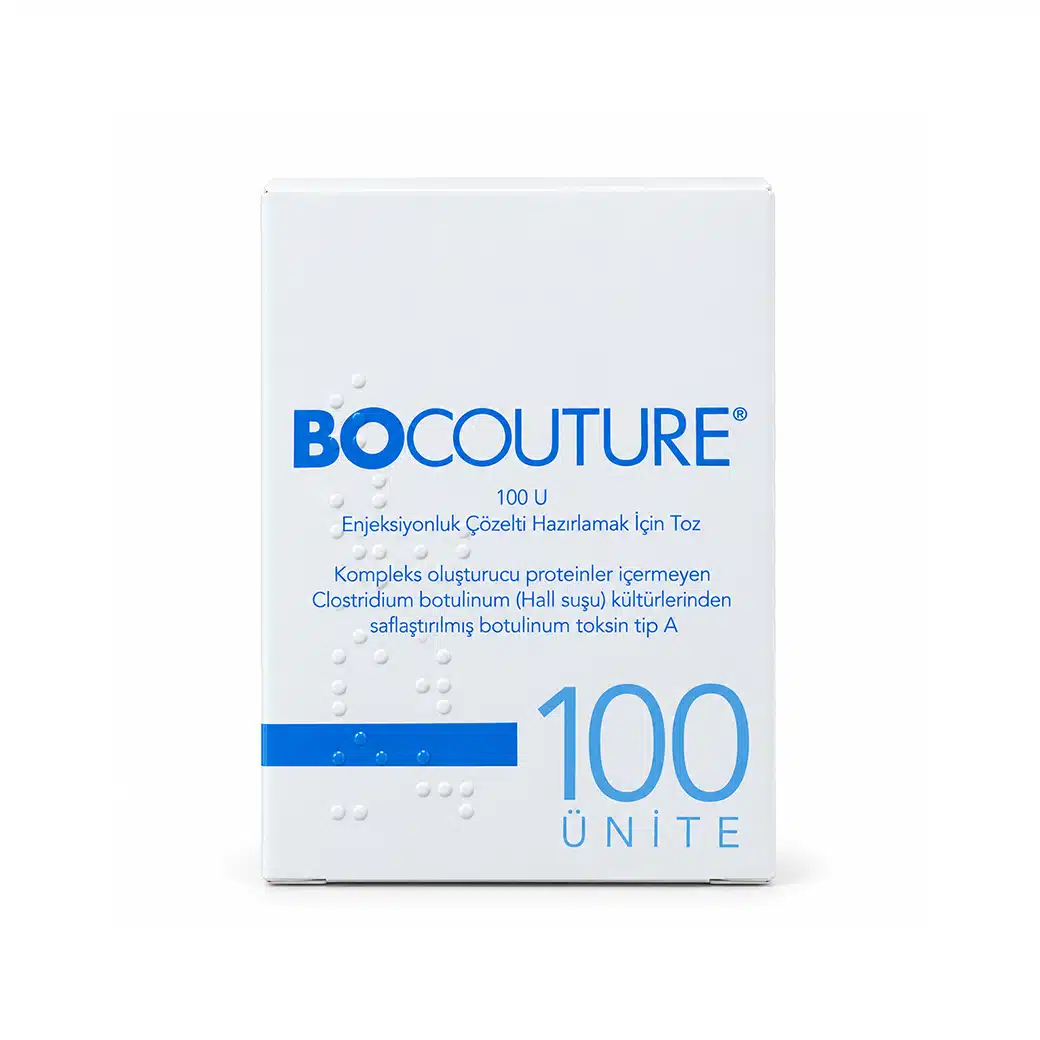
BOCOUTURE® 100 units is a prescription-only botulinum toxin type A from Merz Pharma, administered by intramuscular injection to improve eligible upper facial lines [1]. One vial can accommodate a standard combined treatment of glabellar, lateral canthal, and forehead lines, with effects lasting up to four months. Decisions to buy BOCOUTURE® 100 units should follow an assessment of patient suitability, intended dosing, and applicable regulatory requirements.
BOCOUTURE® 100 Units: Product Specifications
- Active Ingredient: IncobotulinumtoxinA, a botulinum toxin type A free from complexing proteins [1]
- Regulatory Status: Prescription-only medicine [1]
- Molecular Type: 150 kD neurotoxin protein (Clostridium botulinum, Hall strain) [1]
- Strength: 100 units, supplied as a single vial
- Dosage Form: Powder for solution for injection; intramuscular use [1]
- Manufacturer: Merz Pharma GmbH & Co. KGaA, Germany
- UK Marketing Authorisation Holder: Merz Pharmaceuticals GmbH [1]
- Storage Requirements: Unopened: do not store above 25°C; shelf life three years. Reconstituted: use immediately; chemical and physical stability demonstrated for 24 hours at 2–8°C [1]
- Intended Use: Glabellar, lateral canthal, and horizontal forehead lines in adults under 65 years [1]
- Pack and Origin: 1 × 100 units vial; Turkey purchase region, non-English carton; 32 g; 60 × 90 × 30 mm
How BOCOUTURE® 100 Units Works — Mechanism at a Glance
BOCOUTURE® inhibits signaling at the neuromuscular junction. After entering a cholinergic nerve terminal, its 150 kD neurotoxin cleaves SNAP-25, preventing acetylcholine release and temporarily reducing contraction in the treated muscle. Neuromuscular function normally recovers as nerve terminals regenerate and reconnect over three to four months [1].
The product is purified to remove complexing proteins found in some botulinum toxin preparations. This reduces the accompanying clostridial protein load, but it does not eliminate the possibility of neutralizing antibodies or establish superior long-term clinical outcomes. The SmPC recommends using the lowest effective dose and observing the appropriate treatment intervals [1].
Before the Needle: Screening Candidates for BOCOUTURE® 100 U
Before scheduling treatment, clinicians should review the patient’s indication, medical history, medications, and previous botulinum toxin exposure [1]. Key checks include:
- Eligibility: Confirm moderate to severe glabellar, lateral canthal, or forehead lines that have an important psychological impact. The licensed indication applies to adults younger than 65; the product has not been studied in patients under 18 [1].
- Contraindications: Exclude hypersensitivity to the formulation, generalized muscle-activity disorders such as myasthenia gravis or Lambert-Eaton syndrome, and infection or inflammation at the intended injection site [1].
- Additional Precautions: Review any history of swallowing difficulties or aspiration, pregnancy, breastfeeding, bleeding disorders, and anticoagulant use [1].
- Medication Review: Aminoglycosides, spectinomycin, and certain muscle relaxants may intensify the toxin’s effects, while 4-aminoquinolines may reduce them [1].
- Treatment History: Document previous toxin formulations, doses, response, and treatment dates. Intervals must not be shorter than three months [1].
Planning One Patient Visit Before You Buy BOCOUTURE® 100 Units
A standard three-area session requires 54–64 units: 20 for glabellar lines, 24 for lateral canthal lines, and 10–20 for the forehead. Increasing the glabellar dose to 30 units raises the combined total to 64–74 units [1]. Because each reconstituted vial is limited to one patient and one treatment session, discard unused solution.
A 50-unit vial may suit a limited-area visit, whereas the 100-unit vial accommodates the standard three-area plan. Some two-area treatments also exceed 50 units: 30 units for the glabellar area plus 24 units for crow’s feet totals 54 units. Expected discard should be considered alongside the BOCOUTURE® 100 units price when comparing vial strengths. Practitioners can check for wholesale buying options after assessing typical doses and single-patient wastage.
When evaluating whether to buy BOCOUTURE® 100 units online, practitioners should establish whether the specific presentation is authorized in their jurisdiction and supported by appropriate documentation. Medical Spa Rx can provide general information about these verification requirements.
BOCOUTURE® 100 Units Dilution and Injection Technique
Reconstitution with saline uses a 0.9% sodium chloride solution for injection, and the SmPC allows two volumes [1]:
- Adding 2.5 mL of saline produces 4 units per 0.1 mL, a concentration suitable for the 4-unit injection sites described in the SmPC [1].
- Using 2 mL produces 5 units per 0.1 mL. The injection volume must be adjusted to deliver the prescribed dose [1].
During reconstitution, gently add the saline to minimize foaming. Discard the vial if its vacuum does not draw in the diluent [1]. Mix by slowly swirling and inverting rather than shaking. The solution must be clear and colorless, without particles, before use [1]. Use immediately; the SmPC distinguishes chemical and physical stability from microbiological handling requirements.
Injection sites follow the SmPC landmarks [1]:
- Glabellar Lines: five sites (two per corrugator, one in the procerus), in the medial portion of the corrugator and in the muscle’s central belly, at least 1 cm above the bony orbital rim. Firm pressure applied below the orbital edge limits diffusion.
- Crow’s Feet: three sites per side. The first sits about 1 cm lateral to the orbital rim, and the other two about 1 cm above and below it.
- Forehead Lines: five horizontally aligned sites at least 2 cm above the orbital rim.
Intramuscular administration uses a thin, sterile 30–33G needle, with approximately 0.04–0.1 mL delivered at each injection site [1]. Placement must account for neighboring muscles: injections near the levator palpebrae superioris or upper orbicularis oculi can increase the risk of eyelid ptosis, while diffusion toward the zygomaticus major or lower forehead region may contribute to lip or brow ptosis, respectively [1].
After the Injection: Onset, Duration and When to Retreat
Treatment response develops gradually and varies by facial area. Glabellar line changes are generally noticeable after 2–3 days, while lateral canthal and forehead line improvement typically appears within the first week. Maximum effect is observed around day 30, with benefits lasting up to four months [1].
In a phase III study of 111 participants, 12 units per side given with the 3-point injection scheme produced 69.9% responders versus 21.4% with placebo at week 4, judged by an independent rater on standardized photographs. That figure applies only to that dose and scheme [1].
Treatment intervals must not be shorter than three months [1]. Follow-up should document treatment response, duration of benefit, adverse effects, and whether the previously selected dose remained appropriate. The minimum interval is a safety threshold, not an automatic schedule for every patient.
If no effect is apparent after one month, reassess the dose, injection technique, suitability, and possible neutralizing antibodies before planning further treatment. Any repeat course must still observe the minimum three-month interval [1].
Safety and Regulatory Considerations When You Buy BOCOUTURE® 100 Units
Adverse Effects and Patient Monitoring
Reported reactions differ by treatment area. Headache and lateral eyebrow elevation may occur after glabellar treatment, while eyelid edema, dry eye, and injection-site hematoma are common with lateral canthal treatment. Combined upper-face sessions may also cause headache or hematoma, while eyelid or brow ptosis is less common [1].
Patients should seek immediate medical attention for swallowing, speech, or breathing difficulties that develop after treatment. Botulinum toxin effects can spread beyond the injection site, and the U.S. XEOMIN® label carries a boxed warning addressing this risk [2].
Potency units vary by botulinum toxin formulation. When researching where to buy botulinum toxin injections, practitioners should compare approved indications and dosing instructions rather than assuming equivalent units across products [1].
Prescription Status, Packaging, and Handling
BOCOUTURE® is a prescription-only medicine that must be administered by an appropriately qualified healthcare practitioner [1]. In the United States, incobotulinumtoxinA is approved as XEOMIN®; BOCOUTURE® is not FDA-approved, and product labeling varies by jurisdiction [2].
This SKU is described as having Turkish-language packaging, which does not establish authorization for use in another country. When buying online, clinicians should confirm the applicable labeling, batch information, expiry date, and product documentation.
Clinics considering whether to buy BOCOUTURE® 100 units wholesale should also verify regulatory status and documented handling conditions. The UK SmPC requires storing unopened vials at temperatures not exceeding 25°C [1].
The BOCOUTURE® 100 units price does not establish whether a particular pack is authorized for use in a given jurisdiction.
Citations
[1] Merz Pharmaceuticals GmbH. BOCOUTURE 100 Units Powder for Solution for Injection: Summary of Product Characteristics. Electronic Medicines Compendium, updated 22 Jan. 2026, https://www.medicines.org.uk/emc/product/7418/smpc.
[2] Merz Pharmaceuticals, LLC. XEOMIN (IncobotulinumtoxinA) for Injection: Prescribing Information. Revised June 2026. DailyMed, updated 10 July 2026, https://dailymed.nlm.nih.gov/dailymed/drugInfo.cfm?setid=ccdc3aae-6e2d-4cd0-a51c-8375bfee9458.


Reviews
There are no reviews yet.