
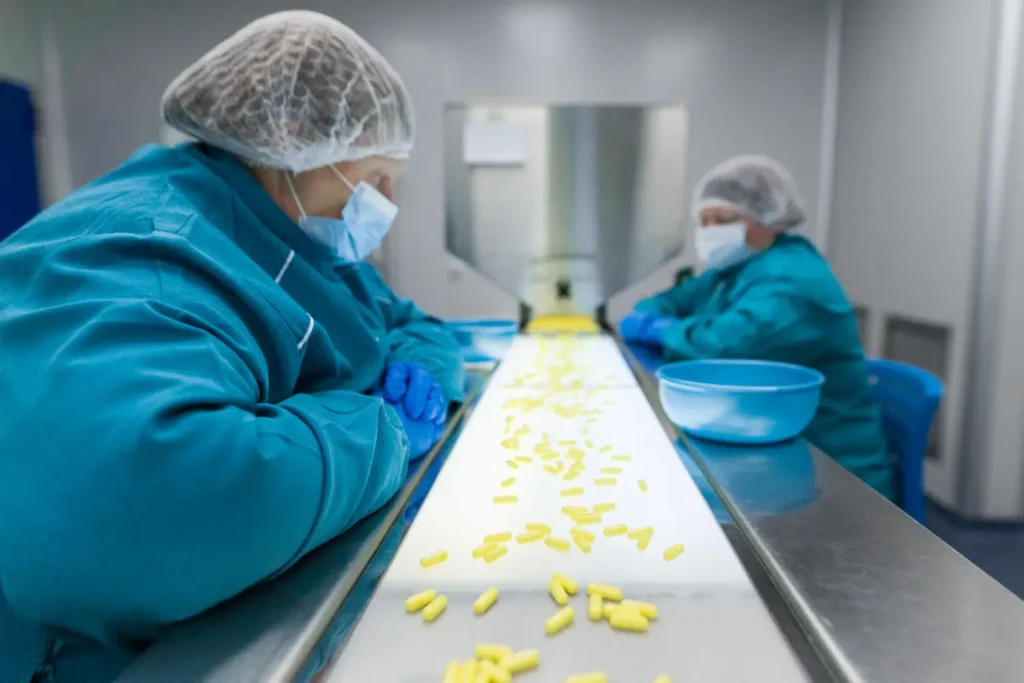
KPV peptide capsules are one of the more consistently studied delivery formats for this alpha-MSH-derived tripeptide, largely because KPV’s three-residue structure fits a transporter mechanism the intestine already uses. While larger peptide chains break down before absorption, KPV’s small size lets it use PepT1, a solute transporter specific to di- and tri-peptides, which is why the literature treats KPV peptide oral capsules as a serious research route rather than a formulation shortcut. This piece walks through what the current research actually documents.
For professionals researching this peptide category, Medical SpaRX can provide sourcing information on KPV peptide and related melanocortin-derived research compounds. Practitioners who want to buy KPV peptide can also review the current research picture below before making sourcing decisions.
This article will explore why oral capsule delivery is mechanistically distinctive for KPV, what the literature records about tripeptide bioavailability, what colitis and IBD research shows for oral administration, how capsule delivery sits alongside injection and topical routes, and what formulation-specific safety observations exist.
Key Takeaways
- KPV’s tripeptide structure lets it use PepT1, a di/tripeptide transporter the intestine already expresses, and one upregulated in inflamed colonic tissue. That mechanism is why oral capsule delivery is a viable research route for KPV, whereas it would not be for most peptides.
- Preclinical colitis models show oral KPV reaching and acting on inflamed gut tissue, with self-targeting behavior driven by inflammation-induced PepT1 expression at the site.
- Route selection in KPV research is not interchangeable. Capsules are the documented route for gut-focused work, injection is used for systemic modeling, and topical formulations are used for skin. Regulatory status shifted twice between late 2023 and September 2026 and is still evolving.
About: Medical SpaRX is your trusted all-in-one supplier, offering a range of high-quality medical injectables and supplies. We offer a worry-free experience in searching for the best and most popular products on the market, like KPV peptide. Whether for health professionals, plastic surgeons, dermatologists, licensed estheticians, or other specialists, we can offer genuine, brand-name products you may need. With Medical SpaRX, we prioritize serving you better to improve the patient’s quality of life.
What Makes Oral Delivery Practical for the KPV Peptide?
KPV is a tripeptide composed of lysine, proline, and valine, corresponding to the C-terminal fragment of alpha-melanocyte-stimulating hormone.[3] It retains much of the parent peptide’s anti-inflammatory signaling while dropping the pigmentation and appetite effects associated with intact alpha-MSH. That combination is why research attention clusters around immune system regulation, intestinal inflammation, and epithelial barrier function rather than around the classical melanocortin phenotype.
Most peptide research compounds require injection because they cannot survive gastric acid and intestinal peptidases in usable quantities. KPV is small enough to use a route the intestine has already evolved to handle small peptides, so a capsule formulation is not just convenient. It is also mechanistically consistent with the anti-inflammatory research context in which the peptide is being studied. In preclinical models of inflammatory bowel disease and related gastrointestinal disorders, oral delivery brings KPV directly to the tissue under study rather than requiring it to reach the gut through systemic circulation.[3]
For gut support research, and for inflammatory conditions where the intestinal epithelium is the target, capsule form naturally aligns the compound’s biology with the site of action.
How Well Does KPV Actually Absorb Through the Digestive Tract?
Oral bioavailability is usually the limiting factor for peptide research compounds. KPV is a useful counter-example, and the reason is a specific transporter rather than any special stability of the peptide itself. KPV can be administered orally at meaningful concentrations because that transporter moves the peptide across the epithelium.
What Role Does the PepT1 Transporter Play?
The clearest documented mechanism for oral KPV uptake is transport through PepT1, a solute transporter evolved specifically for di- and tri-peptides in the small intestine.[1] Peptides longer than three residues do not fit this transporter and are exposed to the full range of gastric and intestinal peptidases before reaching the epithelium, which is why most peptide research relies on injection to bypass that environment. KPV falls inside PepT1’s substrate window, which changes the whole delivery calculation.
PepT1 also has a feature that matters for the disease models KPV is studied in. Its expression is induced in the colon during active inflammatory bowel disease, so inflamed tissue takes up more of the orally administered peptide than healthy tissue does. Researchers describe this as a self-targeting mechanism, and Dalmasso et al. demonstrated it in cell and animal work: nanomolar concentrations of KPV inhibit NF-κB and MAP kinase signaling in intestinal epithelial and immune cells, with the effect abolished when PepT1 expression was silenced.[1]
Where Does Enhanced Delivery Fit In?
Free KPV survives the intestinal environment well enough to be studied orally on its own, but researchers have not stopped pursuing formulation improvements. Hyaluronic acid-functionalized nanoparticles carrying KPV have been reported to alleviate ulcerative colitis in animal models more efficiently than free KPV alone, and polysaccharide hydrogel-based nanoparticle systems targeting the colon serve the same purpose from a different angle.[2][4] These are not workarounds for a broken oral route. They are attempts to concentrate a compound that already reaches the target compartment.
What Do Colitis and IBD Studies Show About Oral KPV?
Most published research on oral KPV focuses on gut and inflammatory bowel applications, consistent with the transporter mechanism above. In murine colitis models, including both DSS-induced and TNBS-induced protocols, orally administered KPV reduced disease severity, decreased pro-inflammatory cytokine expression, and lowered colonic tissue damage compared with untreated controls.[1]
Later work extended this by pairing KPV with targeted delivery systems. The 2017 hyaluronic acid nanoparticle study reported efficient reduction of ulcerative colitis markers in animal models, building on the observation that colonic tissue overexpresses PepT1 during active inflammation.[2] A separate polysaccharide-hydrogel nanoparticle approach was designed to concentrate KPV in the colon rather than depending on systemic absorption.[4] Together, these papers explain why capsule-based delivery for chronic inflammatory gut conditions gets treated as a category of its own rather than as a generic oral peptide format.
The pharmacological logic is worth naming plainly. The transporter that carries KPV into intestinal cells is upregulated by the very condition being studied. That rationale differs from how oral delivery is discussed for most other peptide classes, where the goal is simply to reach systemic circulation despite the digestive tract.
How Do KPV Peptide Capsules Compare to Injection and Topical Routes?
Research on KPV has covered all three main delivery routes, and the literature treats them as complementary rather than interchangeable. Each targets a different tissue.
- Oral capsules. Best documented in gut-targeted research, where PepT1 uptake concentrates the peptide in inflamed intestinal tissue and gives the route its main mechanistic advantage.[1]
- Subcutaneous injection. Used in animal studies to achieve systemic distribution. Relevant when researchers are modeling inflammation outside the digestive tract, including muscle joint models and other systemic-inflammation designs, since injection bypasses the gastrointestinal tract entirely.
- Topical application. Studied in contact hypersensitivity and inflammatory skin models. Passive diffusion through intact skin is limited for a peptide, even a small one, so published work has combined physical enhancement techniques with topical formulation. Pawar and colleagues tested KPV transdermal delivery with iontophoresis, microneedles, and the two combined, and reported that the combination produced roughly a 30-fold improvement over passive diffusion.[5]
This pattern suggests that route selection follows the target tissue. Gut research uses capsules because of the transporter mechanism, systemic-inflammation models use injection, and dermatologic work uses topical formulations paired with enhancement techniques. That logic differs from route decisions based on convenience or cost, which is more common in other peptide categories.
What Do Preclinical Studies Say About KPV Peptide Oral Capsules and Safety?
Published literature offers limited formulation-specific safety observations for the oral route, but they are broadly favorable at the endpoints studied.
Preclinical colitis models have not reported gastrointestinal toxicity attributable to oral KPV administration itself, distinct from the effects of the disease models under study. Because KPV modulates immune system signaling through NF-κB inhibition rather than a broad immunosuppressive mechanism, animal and mechanistic work describe a different risk pattern than corticosteroid comparators. The human safety picture cannot be inferred from that distinction alone.[3]
One point that is genuinely oral-specific: formulations relying on PepT1-mediated uptake are, by design, most active where PepT1 expression is elevated. That means the intestinal tissue under active inflammation is the primary site of activity in these models, rather than broad systemic exposure. The KPV peptide side effects recorded for other routes should not be automatically applied to the oral form, and vice versa. Researchers evaluating oral KPV capsules should read these observations as formulation-specific context rather than as a stand-in for a completed safety file.
Where Do KPV Peptide Capsules Sit in the Current Regulatory Picture?
Regulatory status changed twice between late 2023 and 2026, and it is still moving. The short version:
- Late 2023 to early 2024: FDA placed KPV on the Category 2 “Do Not Compound” list.
- April 2026: FDA removed KPV from Category 2 along with eleven other peptides.
- July 2026: The Pharmacy Compounding Advisory Committee (PCAC) recommended KPV for inclusion on the 503A Bulks List. The recommendation is non-binding, and formal rulemaking has not been finalized.
- As of September 2026: KPV remains in interim status pending FDA rulemaking following the July 2026 PCAC recommendation; it is not yet on the final 503A Bulks List.[6]
Anyone sourcing KPV for research purposes should confirm current federal status directly, since the 2023 FDA substances page that historically served as the reference has been superseded by the 2026 developments. The compound’s research profile has not changed in this interval, but its regulatory pathway has, and the two need to be tracked separately.
Taken together, the research literature supports a fairly specific use case for KPV peptide capsules. Gut-targeted study designs where the PepT1 mechanism gives oral delivery a real mechanistic advantage are the natural home for the format. The evidence base is preclinical, built primarily on rodent colitis models, and capsule form is one of several documented delivery routes for this compound rather than a substitute for injectable or topical protocols where those better fit the target tissue.
Looking to buy KPV peptide online? Reach out to Medical Spa Rx’s support team for further guidance.
The contents of this page are meant for licensed medical professionals. They serve informational purposes only and are not to be taken as medical advice.

Citations
[1] Dalmasso, Guillaume et al. “PepT1-mediated tripeptide KPV uptake reduces intestinal inflammation.” Gastroenterology vol. 134,1 (2008): 166-78. doi:10.1053/j.gastro.2007.10.026
[2] Xiao, Bo et al. “Orally Targeted Delivery of Tripeptide KPV via Hyaluronic Acid-Functionalized Nanoparticles Efficiently Alleviates Ulcerative Colitis.” Molecular therapy : the journal of the American Society of Gene Therapy vol. 25,7 (2017): 1628-1640. doi:10.1016/j.ymthe.2016.11.020
[3] Brzoska, Thomas et al. “Alpha-melanocyte-stimulating hormone and related tripeptides: biochemistry, antiinflammatory and protective effects in vitro and in vivo, and future perspectives for the treatment of immune-mediated inflammatory diseases.” Endocrine reviews vol. 29,5 (2008): 581-602. doi:10.1210/er.2007-0027
[4] Laroui, Hamed et al. “Drug-loaded nanoparticles targeted to the colon with polysaccharide hydrogel reduce colitis in a mouse model.” Gastroenterology vol. 138,3 (2010): 843-53.e1-2. doi:10.1053/j.gastro.2009.11.003
[5] Pawar, Kasturi et al. “Transdermal Iontophoretic Delivery of Lysine-Proline-Valine (KPV) Peptide Across Microporated Human Skin.” Journal of pharmaceutical sciences vol. 106,7 (2017): 1814-1820. doi:10.1016/j.xphs.2017.03.017
[6] U.S. Food and Drug Administration. “Certain Bulk Drug Substances for Use in Compounding That May Present Significant Safety Risks.” U.S. Food and Drug Administration, www.fda.gov/drugs/human-drug-compounding/certain-bulk-drug-substances-use-compounding-may-present-significant-safety-risks.
All clinical and product claims on this page have been checked against peer-reviewed research, manufacturer data, and regulatory sources in accordance with our Editorial Policy .